FreeQAs
 Request Exam  Contact
  • Home
  • View All Exams
  • New QA's
  • Upload
PRACTICE EXAMS:
  • Oracle
  • Fortinet
  • Juniper
  • Microsoft
  • Cisco
  • Citrix
  • CompTIA
  • VMware
  • ISC
  • SAP
  • EMC
  • PMI
  • HP
  • Salesforce
  • Other
  • Oracle
    Oracle
  • Fortinet
    Fortinet
  • Juniper
    Juniper
  • Microsoft
    Microsoft
  • Cisco
    Cisco
  • Citrix
    Citrix
  • CompTIA
    CompTIA
  • VMware
    VMware
  • ISC
    ISC
  • SAP
    SAP
  • EMC
    EMC
  • PMI
    PMI
  • HP
    HP
  • Salesforce
    Salesforce
  1. Home
  2. Cisco Certification
  3. 300-420 Exam
  4. Cisco.300-420.v2026-06-15.q443 Dumps
  • ««
  • «
  • …
  • 2
  • 3
  • 4
  • 5
  • 6
  • 7
  • 8
  • 9
  • 10
  • 11
  • …
  • »
  • »»
Download Now

Question 26

An engineer must design a large Layer 2 domain that contains hundreds of switches and VLANs.
The engineer's primary goals are to:
- Efficiently utilize the bandwidth of all links
- Avoid Layer 2 loops
- Cause minimal impact on switch CPU and memory
Which technology should the engineer include in the design?
Correct Answer: C
MST groups a large amount of VLANS into single instances which lower the amount of CPU and memory utilization.
https://www.cisco.com/c/en/us/support/docs/lan-switching/spanning-tree-protocol/24248-
147.html#mst
insert code

Question 27


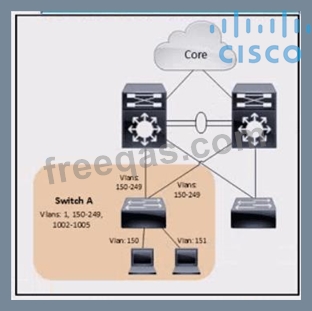
Refer to the exhibit An engineer working for a telecommunication company with an employee ID 4449:30
959 Is calculating STP scalability for switches to ensure that the numbers are below the maximum supported value for STP logical ports How many logical interfaces are active for switch A?

Correct Answer: C
The active logical interface count for Switch A is 202 based on the spanning-tree scalability method used for logical ports. In STP design, a logical port is counted per active VLAN instance on each active trunk or access interface. A trunk carrying multiple VLANs therefore consumes multiple logical STP ports, while an access link normally consumes one logical STP port for its VLAN. Cisco campus design guidance uses logical-port counts to ensure that the selected STP mode and platform stay within supported scalability limits. The calculation in the exhibit produces 202 active logical interfaces for Switch A, not simply the number of physical links. Answer A counts only physical interfaces and ignores VLAN instances. Answer D is too low because it does not account for all active VLANs across the relevant links. Answer B overstates the count by including VLANs or links that are not active for Switch A. Reference topics: STP scalability, logical ports, VLAN instances, trunk design, Layer 2 campus sizing.
insert code

Question 28

A company plans to deploy a new application across the campus network and asks an engineer to create a QoS policy. The application has these characteristics:
- UDP-based
- inelastic flows
- sensitive to delay over 100 milliseconds
- sensitive to jitter over 50 milliseconds
The appropriate bandwidth is allocated and assigned to the queues. Which mechanism must the engineer use to manage the flows that exceed the configured threshold?

Correct Answer: A
Policing is used to enforce bandwidth limits by dropping or remarking packets that exceed the configured threshold, which is necessary for managing inelastic, delay- and jitter-sensitive UDP flows when they exceed the allocated resources.
insert code

Question 29

How do IETF. OpenConfig and Cisco nativo YANG models differ when used to configuro the same feature on an infrastructure device?

Correct Answer: A
insert code

Question 30

A network architect Is enabling TV services In the LAN. The source will be streaming to the 239.1.1.1 group IP address. Dense mode Is not allowed In the network. Multicast has already been enabled on all network devices In the LAN segment. Which action must the architect take to finalize the design?


Correct Answer: D
PIM BSR is the best final design action because the source uses group 239.1.1.1, which is an administratively scoped ASM multicast group, and dense mode is not allowed. In PIM sparse mode, ASM groups require a rendezvous point so receivers can join the shared tree and sources can register. PIM SSM is not the right match for 239.1.1.1 because SSM normally uses the 232.0.0.0/8 group range and requires receivers to know the source address. Auto-RP can distribute RP information, but traditional Auto-RP discovery relies on multicast groups that often require sparse-dense behavior, which conflicts with the requirement that dense mode is not allowed. BSR is the standards-based PIM mechanism for dynamic RP discovery in sparse-mode networks and avoids static RP configuration on every router. Anycast RP is an RP redundancy design but still requires RP discovery or static RP configuration. Reference topics: PIM sparse mode, Bootstrap Router, ASM, RP discovery, administratively scoped multicast.
insert code
  • ««
  • «
  • …
  • 2
  • 3
  • 4
  • 5
  • 6
  • 7
  • 8
  • 9
  • 10
  • 11
  • …
  • »
  • »»
[×]

Download PDF File

Enter your email address to download Cisco.300-420.v2026-06-15.q443 Dumps

Email:

FreeQAs

Our website provides the Largest and the most Latest vendors Certification Exam materials around the world.

Using dumps we provide to Pass the Exam, we has the Valid Dumps with passing guranteed just which you need.

  • DMCA
  • About
  • Contact Us
  • Privacy Policy
  • Terms & Conditions
©2026 FreeQAs

www.freeqas.com materials do not contain actual questions and answers from Cisco's certification exams.