FreeQAs
 Request Exam  Contact
  • Home
  • View All Exams
  • New QA's
  • Upload
PRACTICE EXAMS:
  • Oracle
  • Fortinet
  • Juniper
  • Microsoft
  • Cisco
  • Citrix
  • CompTIA
  • VMware
  • ISC
  • SAP
  • EMC
  • PMI
  • HP
  • Salesforce
  • Other
  • Oracle
    Oracle
  • Fortinet
    Fortinet
  • Juniper
    Juniper
  • Microsoft
    Microsoft
  • Cisco
    Cisco
  • Citrix
    Citrix
  • CompTIA
    CompTIA
  • VMware
    VMware
  • ISC
    ISC
  • SAP
    SAP
  • EMC
    EMC
  • PMI
    PMI
  • HP
    HP
  • Salesforce
    Salesforce
  1. Home
  2. Cisco Certification
  3. 300-420 Exam
  4. Cisco.300-420.v2026-06-15.q443 Dumps
  • ««
  • «
  • …
  • 6
  • 7
  • 8
  • 9
  • 10
  • 11
  • 12
  • 13
  • 14
  • 15
  • …
  • »
  • »»
Download Now

Question 46


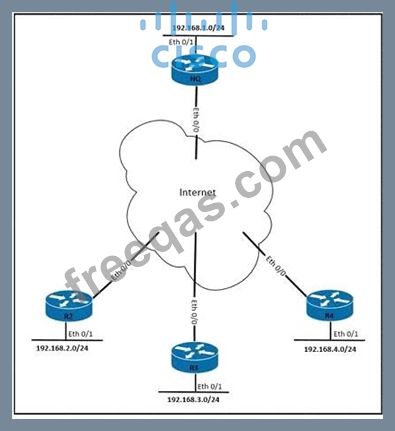
Refer to the exhibit A customer wants to adopt a dynamic site-to-site VPN solution to secure communication for VoIP, video, and FTP traffic between the remote branches and the headquarters. The customer also wants the branches to communicate directly, thereby reducing traffic at the headquarters location. The solution must consider that the branch routers are limited in available memory. Which VPN solution meets these requirements?

Correct Answer: B
insert code

Question 47

Exhibit:

Correct Answer: A
R3 must be made an L1/L2 router so that it can connect the Level 1 area to the Level 2 backbone. IS-IS uses a two-level hierarchy. Level 1 routers know the topology inside their local area, Level 2 routers form the backbone between areas, and Level 1/Level 2 routers provide the boundary between the two. A proper IS-IS backbone cannot have isolated Level 1-only routers positioned between L1/L2 routers that need to exchange interarea reachability. If the link failure exposed an area-continuity problem, converting R3 to L1/L2 gives the area an appropriate attachment point to the backbone and restores interarea forwarding behavior. Making an unrelated router Level 1 or Level 2 only would not necessarily create the required boundary function. Simply making Area 0 L2-only is also not the focused fix if the topology still lacks a correct L1/L2 transition point.
The design principle is straightforward: every Level 1 area must have a dependable L1/L2 router through which traffic can reach destinations outside the area. Reference topics: IS-IS Level 1, Level 2 backbone, L1
/L2 routers, interarea reachability, hierarchical IGP design.
insert code

Question 48

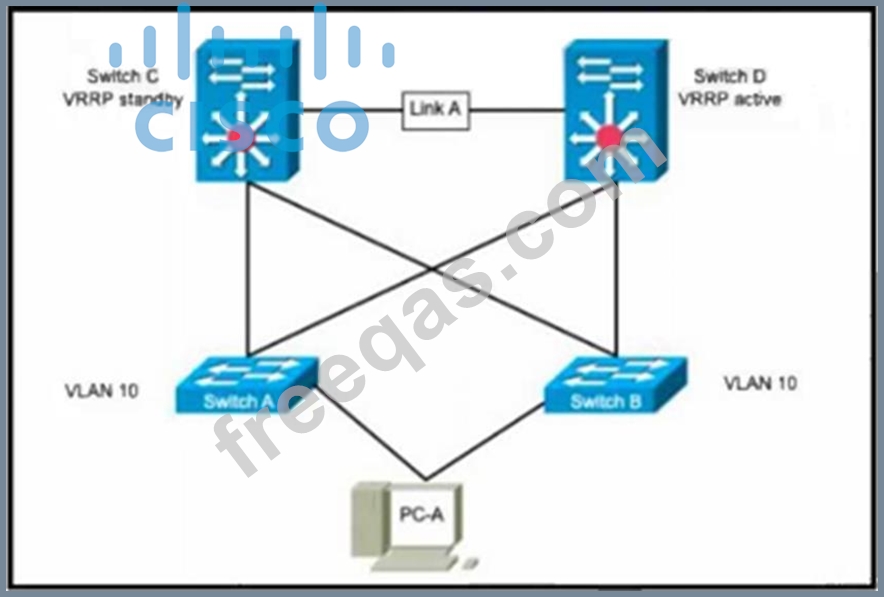
Refer to the exhibit. These requirements must be met:
- VLANs span multiple access switches.
- All VLANs are trunked on all access switch uplinks to distribution
switches.
- The STP version is Rapid PVST+.
Which design provides the fastest spanning-tree convergence?
Correct Answer: D
Configuring link A as a Layer 3 routed link removes it from the Layer 2 topology, reducing the number of potential STP paths and preventing loops. Setting switch D as primary root and switch C as secondary root for VLAN 10 ensures predictable and optimal spanning-tree convergence with Rapid PVST+.
insert code

Question 49

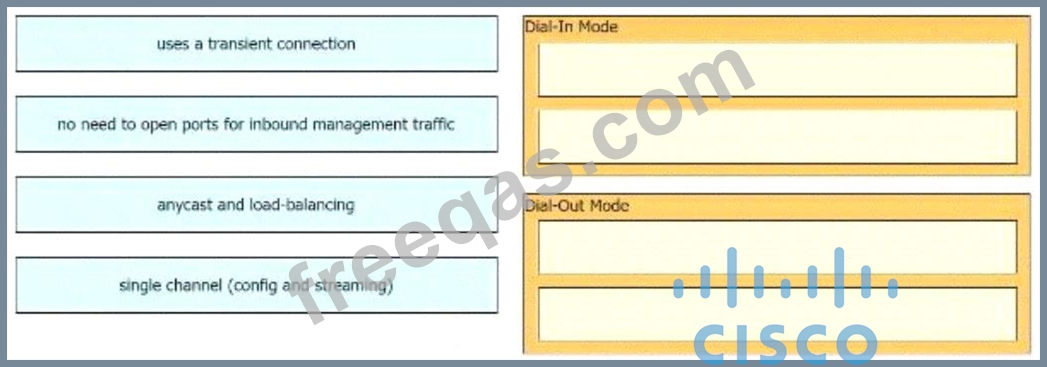
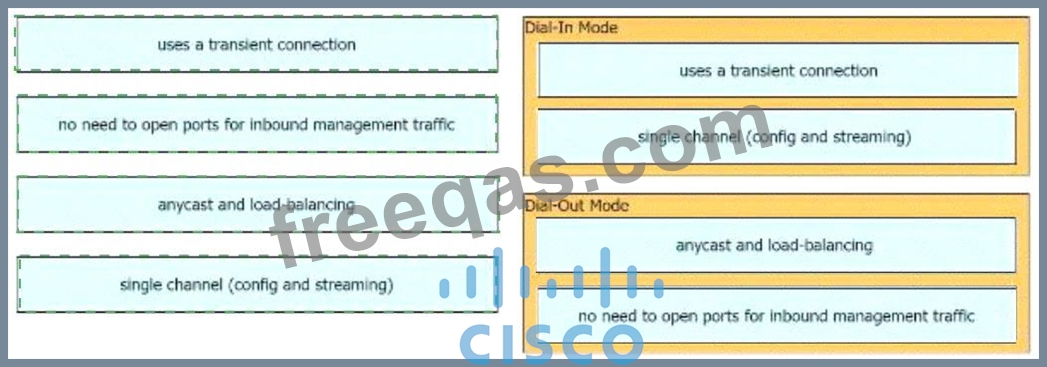
Drag and drop the model- driven telemetry considerations from the left onto the modes they apply to on the right.
Correct Answer:

Explanation:
The telemetry mapping separates dial-in and dial-out behavior. In dial-in telemetry, the collector initiates the session toward the network device and subscribes to the data that it wants streamed. This model gives the collector direct control over the subscription lifecycle, but it requires the collector to reach the device and manage each session. In dial-out telemetry, the network device initiates the session toward the collector based on a configured subscription. This is useful when devices must stream telemetry to a centralized destination through firewalls or controlled management paths. Cisco model-driven telemetry can stream structured data from YANG models using subscription behavior rather than relying on repeated CLI polling. The selected drag-and-drop answer matches each consideration to the mode that owns the connection initiation and subscription handling. In design work, the architect must consider reachability direction, security policy, NAT traversal, collector scale, subscription persistence, and whether subscriptions should be configured on the device or created by the collector. Reference topics: model-driven telemetry, dial-in mode, dial-out mode, YANG subscriptions, gRPC telemetry, operational data streaming.
insert code

Question 50

A network engineer is redesigning a company's QoS solution. The company is currently using IP Precedence, but the engineer plans to move to DiffServ. It is important that the new solution provide backward compatibility with the current solution. Which technology should the design include?


Correct Answer: C
FiffServ is backward compatible with IP Precedence (Ip-Precedence uses the 3 most signifcant bits of the ToS byte, whereas Diffserve uses the fost significant six bits - which includ the ones from IP precedence).
insert code
  • ««
  • «
  • …
  • 6
  • 7
  • 8
  • 9
  • 10
  • 11
  • 12
  • 13
  • 14
  • 15
  • …
  • »
  • »»
[×]

Download PDF File

Enter your email address to download Cisco.300-420.v2026-06-15.q443 Dumps

Email:

FreeQAs

Our website provides the Largest and the most Latest vendors Certification Exam materials around the world.

Using dumps we provide to Pass the Exam, we has the Valid Dumps with passing guranteed just which you need.

  • DMCA
  • About
  • Contact Us
  • Privacy Policy
  • Terms & Conditions
©2026 FreeQAs

www.freeqas.com materials do not contain actual questions and answers from Cisco's certification exams.