FreeQAs
 Request Exam  Contact
  • Home
  • View All Exams
  • New QA's
  • Upload
PRACTICE EXAMS:
  • Oracle
  • Fortinet
  • Juniper
  • Microsoft
  • Cisco
  • Citrix
  • CompTIA
  • VMware
  • ISC
  • SAP
  • EMC
  • PMI
  • HP
  • Salesforce
  • Other
  • Oracle
    Oracle
  • Fortinet
    Fortinet
  • Juniper
    Juniper
  • Microsoft
    Microsoft
  • Cisco
    Cisco
  • Citrix
    Citrix
  • CompTIA
    CompTIA
  • VMware
    VMware
  • ISC
    ISC
  • SAP
    SAP
  • EMC
    EMC
  • PMI
    PMI
  • HP
    HP
  • Salesforce
    Salesforce
  1. Home
  2. Cisco Certification
  3. 300-420 Exam
  4. Cisco.300-420.v2026-06-15.q443 Dumps
  • ««
  • «
  • …
  • 80
  • 81
  • 82
  • 83
  • 84
  • 85
  • 86
  • 87
  • 88
  • 89
  • …
  • »
  • »»
Download Now

Question 416


Refer to the exhibit. An engineer must ensure that the QoS design guarantees bandwidth for the applications, and an application can request a particular type of service to support its delay requirements. Which solution must the engineer select?

Correct Answer: D
insert code

Question 417

Instructions
The main screen consists of two parts; the Main scenario and the Topology tabs. The main scenario describes TSHOOT.com test bed. The Topology tabs allow you to display the appropriate and select the trouble ticket.
To complete the item, you will first need to familiarize yourself with the TSHOOT.com test bed by clicking on the master scenario first and then the topologies tabs. Once you are familiar with the test bed and the topologies, you should start evaluating the trouble ticket. You will be presented with a Trouble Ticket scenario that will describe the fault condition. You will need to determine on which device the fault condition is located, to which technology the fault condition is related, and the solution to each trouble ticket. This will be done by answering three questions.
Ticket Selection
To begin, click on the Ticket on the Topology tabs.
Please note. Some of the questions will require you to use the scroll bar to see all options.
Fault Isolation
Read the ticket scenario to understand the fault condition.
Open the appropriate topology, based upon the ticket scenario.
Open the console of the desired device by clicking on that device in the topology, based upon your troubleshooting methodology.
Use the supported show, ping and trace commands to begin your fault isolation process.
Move to other devices as need by clicking on those devices within the topology.
Fault Identification
The trouble ticket will include three questions that you will need to answer:
1. Which device contains the fault
2. Which technology the fault condition is related to
3. What is the solution to the issue
To advance to the next question within the ticket click on "Next Question".
When you click "DONE", the trouble ticket will turn RED and will no longer be accessible.
You may also use the "Previous Question" button to review questions within that specific ticket.
To complete a trouble ticket, answer all three questions and click "DONE". This will store your response to the questions. Do not click on "DONE" unless you have answered all questions within the ticket.
Item Completion
Click the NEXT button on the bottom of the screen once a ticket is RED. This action moves you to the next item.
Scenario
The company has created the test bed network shown in the layer 2 and layer 3 topology exhibits.
This network consists of four routers, two layer 3 switches and two layer 2 switches.
In the IPv4 layer 3 topology, R1, R2, R3, and R4 are running OSPF with an OSPF process number 1.
DSW1, DSW2 and R4 are running EIGRP with an AS of 10. Redistribution is enabled where necessary.
R1 is running a BGP AS with a number of 65001. This AS has an eBGP connection to AS 65002 in the ISP's network. Because the company's address space is in the private range, R1 is also providing NAT translations between the inside (10.1.0.0/16 & 10.2.0.0/16) networks and the outside (209.65.200.0/24) network.
ASW1 and ASW2 are layer 2 switches.
NTP is enabled on all devices with 209.65.200.226 serving as the master clock source.
The client workstations receive their IP address and default gateway via R4's DHCP server. The default gateway address of 10.2.1.254 is the IP address of HSRP group 10 which is running on DSW1 and DSW2.
In the IPv6 layer 3 topology R1, R2, and R3 are running OSPFv3 with an OSPF process number 6. DSW1, DSW2 and R4 are running RIPng process name RIP_ZONE. The two IPv6 routing domains, OSPF 6 and RIPng are connected via GRE tunnel running over the underlying IPv4 OSPF domain. Redistribution is enabled where necessary.
Recently the implementation group has been using the test bed to do a 'proof-of-concept' on several implementations. This involved changing the configuration on one or more of the devices. You will be presented with a series of trouble tickets related to issues introduced during these configurations.

The implementation group has been using the test bed to do a 'proof-of-concept' that requires both Client 1 and Client 2 to access the WEB Server at 209.65.200.241. After several changes to the network addressing, routing scheme, DHCP services, NTP services, and FHRP services, a trouble ticket has been opened indicating that Client 1 cannot ping the 209.65.200.241 address.
Use the supported commands to isolate the cause of this fault and answer the following questions.
What is the solution to the fault condition?

Correct Answer: B
Solution
Steps need to follow as below:-1.When we check on client 1 & Client 2 desktop we are not receiving DHCP address from R4Ipconfig ----- Client will be getting 169.X.X.X2.On ASW1 port Fa1/0/ 1 & Fa1/0/2 access port VLAN 10 was assigned which is using IPaddress 10.2.1.0/24Sh run ------- & check for running config of int fa1/0/1 & fa1/0/2====================================================interface FastEthernet1/0/1switchport mode accessswitchport access vlan 10interface FastEthernet1/0/2switchport mode accessswitchport access vlan 10
3.We need to check on ASW 1 trunk port the trunk Po13 & Po23 were receiving VLAN 20 &200 but not VLAN
10 so that switch could not get DHCP IP address and was failing to reach IPaddress of Internet4.
Change required:
On ASW1 below change is required for switch-to-switch connectivity..int range portchannel13,portchannel23switchport trunk allowed vlan noneswitchport trunk allowed vlan 10,200
insert code

Question 418

An engineer must design a multicast network for a financial application. Most of the multicast sources also receive multicast traffic (many-to-many deployment model). To better scale routing tables, the design must not use source trees. Which multicast protocol satisfies these requirements?

Correct Answer: D
Explanation
https://www.cisco.com/c/en/us/td/docs/ios-xml/ios/ipmulti_pim/configuration/xe-16/imc-pim-xe-16-book/imc-te Bidir-PIM is designed to be used for many-to-many applications within individual PIM domains. Multicast groups in bidirectional PIM mode can scale to an arbitrary number of sources without incurring overhead due to the number of sources.
insert code

Question 419

What is the purpose of service routes in OMP updates?

Correct Answer: D
Service routes in OMP updates identify services that are available for centralized service insertion. In Cisco Catalyst SD-WAN, OMP does more than advertise ordinary VPN prefixes. It also carries TLOC routes, which describe transport locators, and service routes, which allow the fabric to steer traffic toward network services such as firewalls, intrusion prevention systems, or other centralized service nodes. This is how the SD-WAN control plane distributes enough information for WAN Edge routers to make policy-driven forwarding decisions without requiring each device to learn service attachment through a separate routing protocol. A service route is not used to describe the underlay transport itself, because that function is handled by TLOC information. It is also not a route to the orchestration plane or a remote management definition. The design value is that service insertion can be centrally advertised and controlled through OMP, then applied consistently through SD-WAN policy. Reference topics: Cisco SD-WAN OMP, service routes, TLOC routes, service insertion, centralized data policy.
insert code

Question 420

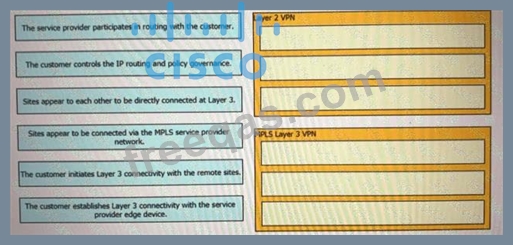
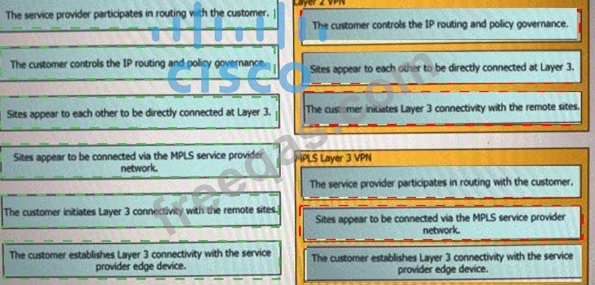
Drag and drop the descriptions from the left onto the corresponding VPN types on the rights.
Correct Answer:

Explanation:
The VPN drag-and-drop answer distinguishes Layer 2 VPN, Layer 3 VPN, and encrypted overlay VPN behavior. VPWS provides a point-to-point Layer 2 service, while VPLS provides multipoint Layer 2 Ethernet service across a provider core. MPLS Layer 3 VPN provides routed private WAN connectivity with provider- managed VPN routing and forwarding separation. GRE and DMVPN are overlay technologies that can carry multicast and dynamic routing protocols; DMVPN adds NHRP and multipoint GRE to scale hub-and-spoke and spoke-to-spoke designs. IPsec provides encryption and integrity for traffic over untrusted transport, but native policy-based IPsec does not carry multicast without an additional overlay such as GRE. GET VPN encrypts traffic across a private routed WAN without building permanent point-to-point tunnels and is often used where multicast and dynamic routing should remain visible to the transport. The selected mapping aligns each VPN type with its forwarding model, scale characteristics, and encryption behavior. In design, the correct VPN choice depends on whether the requirement is Layer 2 extension, routed private connectivity, dynamic spoke-to-spoke tunnels, or private WAN encryption. Reference topics: VPN design, VPLS, VPWS, DMVPN, IPsec, GET VPN.
insert code
  • ««
  • «
  • …
  • 80
  • 81
  • 82
  • 83
  • 84
  • 85
  • 86
  • 87
  • 88
  • 89
  • …
  • »
  • »»
[×]

Download PDF File

Enter your email address to download Cisco.300-420.v2026-06-15.q443 Dumps

Email:

FreeQAs

Our website provides the Largest and the most Latest vendors Certification Exam materials around the world.

Using dumps we provide to Pass the Exam, we has the Valid Dumps with passing guranteed just which you need.

  • DMCA
  • About
  • Contact Us
  • Privacy Policy
  • Terms & Conditions
©2026 FreeQAs

www.freeqas.com materials do not contain actual questions and answers from Cisco's certification exams.
