FreeQAs
 Request Exam  Contact
  • Home
  • View All Exams
  • New QA's
  • Upload
PRACTICE EXAMS:
  • Oracle
  • Fortinet
  • Juniper
  • Microsoft
  • Cisco
  • Citrix
  • CompTIA
  • VMware
  • ISC
  • SAP
  • EMC
  • PMI
  • HP
  • Salesforce
  • Other
  • Oracle
    Oracle
  • Fortinet
    Fortinet
  • Juniper
    Juniper
  • Microsoft
    Microsoft
  • Cisco
    Cisco
  • Citrix
    Citrix
  • CompTIA
    CompTIA
  • VMware
    VMware
  • ISC
    ISC
  • SAP
    SAP
  • EMC
    EMC
  • PMI
    PMI
  • HP
    HP
  • Salesforce
    Salesforce
  1. Home
  2. Cisco Certification
  3. 300-420 Exam
  4. Cisco.300-420.v2026-06-15.q443 Dumps
  • ««
  • «
  • …
  • 77
  • 78
  • 79
  • 80
  • 81
  • 82
  • 83
  • 84
  • 85
  • 86
  • …
  • »
  • »»
Download Now

Question 401

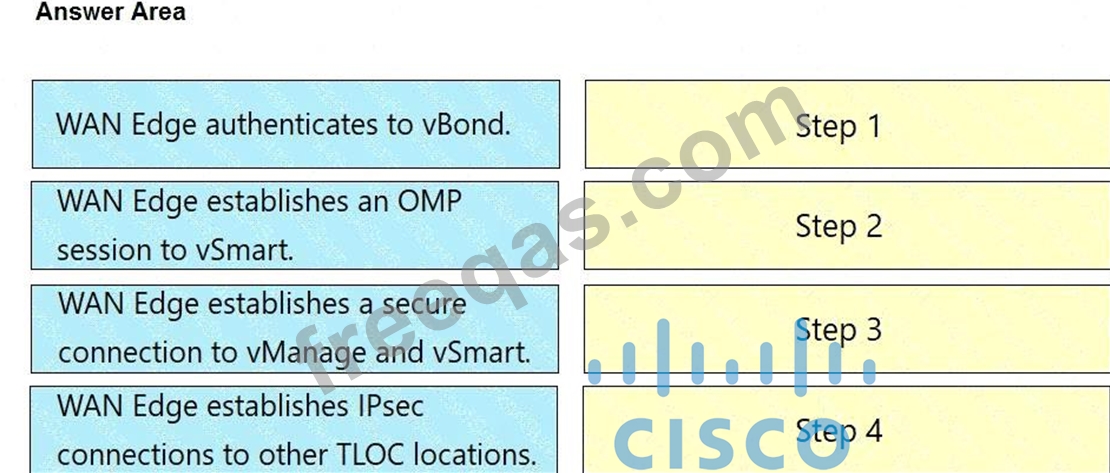
Drag and drop the steps WAN Edge performs when on-boarded into the Cisco SD-WAN overlay from the left into the order they are completed on the right.
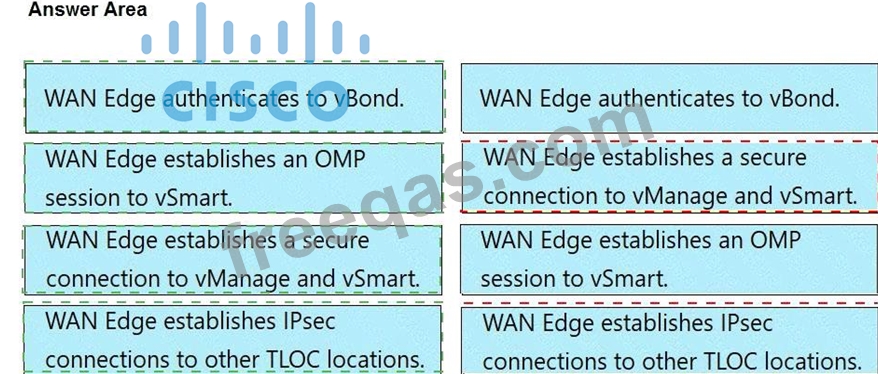
Correct Answer:

Explanation:
The SD-WAN onboarding sequence follows the controller trust and overlay-establishment workflow. A WAN Edge device first obtains basic reachability information through manual bootstrap, ZTP, or PnP-style provisioning so it can reach the orchestration components. It then establishes secure control connectivity to the orchestrator and validates identity through the certificate and authorized serial number information. After orchestration, the device forms the required secure control connections to the management and control-plane components, receives its configuration, and participates in OMP route exchange. Finally, the WAN Edge builds encrypted data-plane tunnels to other WAN Edge devices based on the TLOC and policy information learned through the control plane. This order matters because the device cannot exchange overlay routes or build data-plane IPsec tunnels until it is authenticated and authorized in the SD-WAN fabric. Cisco SD-WAN designs rely on this sequence to support zero-touch deployment, centralized policy, and secure fabric admission. Reference topics: Cisco SD-WAN onboarding, vBond orchestration, certificate validation, OMP, TLOC exchange, data-plane tunnel establishment.
insert code

Question 402

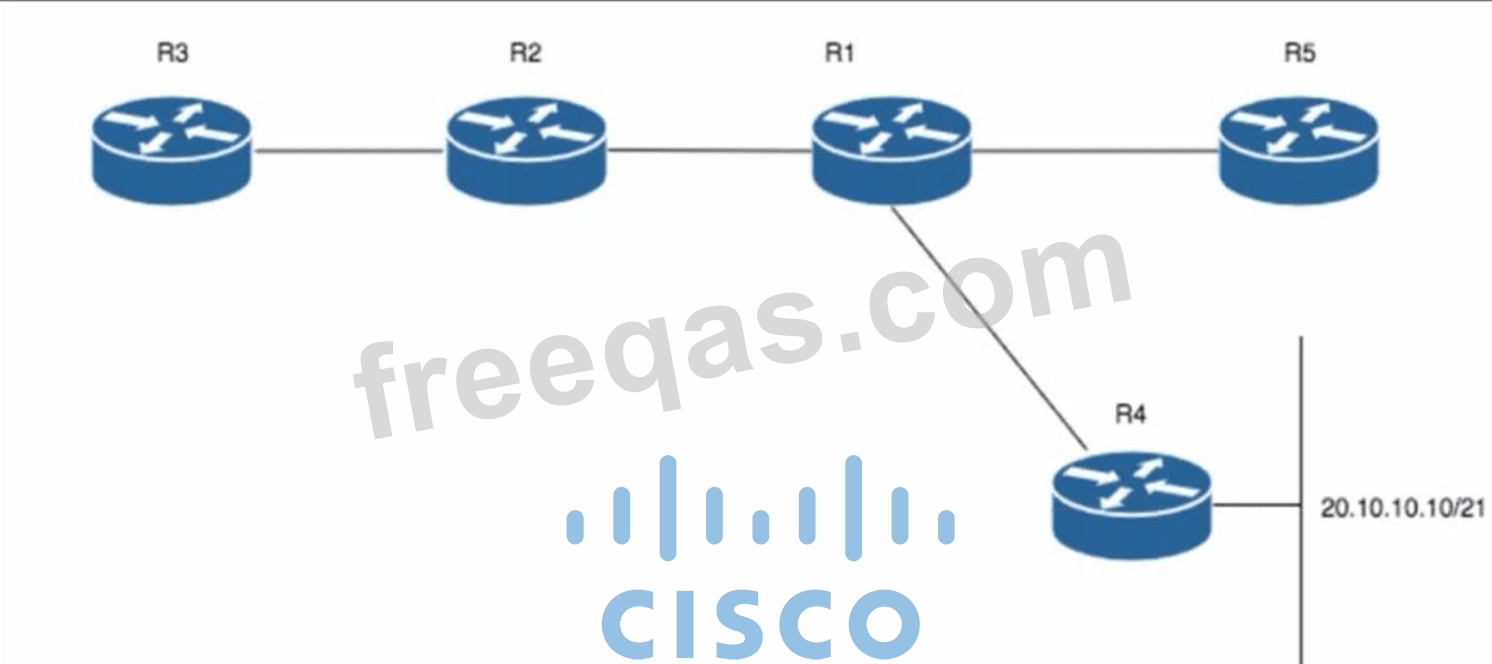
Refer to the exhibit. An architect is designing an ISIS network for a customer migrating from IPv4 to IPv6. The current network uses narrow metrics, and the IPv6 areas will increase to 10 within the next two years. Also, IPv6 traffic must not blackhole in IPv4 network during the migration.
Which two solutions must the architect choose? (Choose two.)

Correct Answer: D,E
insert code

Question 403

When vEdge router redundancy is designed, which FHRP is supported?

Correct Answer: D
Section: Advanced Enterprise Campus Networks
insert code

Question 404

Drag and drop the characteristics from the left onto the correct telemetry mode on the right.

Correct Answer:

Explanation

In a dial-in mode, the destination initiates a session to the router and subscribes to data to be streamed. Dialin mode is supported over gRPC in only 64-bit platforms In a dial-out mode, the router initiates a session to the destinations based on the subscription. All 64-bit IOS XR platforms (except for NCS 6000 series routers) support gRPC and TCP protocols. All 32-bit IOS XR platforms support only TCP.
insert code

Question 405


Refer to the exhibit. A network architect is preparing a network design based on EIGRP. Routers are connected using a Cat6a cable type and the inter-router connection speed is limited to 10 Mbps due to distance. During the pilot phase, a DUAL-3-SIA error message is visible. Which action must the engineer take to create a stable design?


Correct Answer: D
The correct action is to configure EIGRP stub behavior on R4. The DUAL-3-SIA message indicates a Stuck- in-Active condition, which occurs when EIGRP sends a query and does not receive a reply within the expected time. Cisco explains that EIGRP stub routing is used to improve stability and reduce resource usage by preventing unnecessary queries from being sent to remote or edge routers. In the described topology, R4 is connected over a limited 10 Mbps inter-router link and should not be treated as a transit router for the rest of the routing domain. Making R4 an EIGRP stub limits the query scope and reduces the chance of active routes waiting on a slow or constrained neighbor. Poison reverse and split-horizon changes address loop prevention and hub-and-spoke update behavior, but they do not directly solve the SIA instability. A summary on R2 may help scaling but does not identify the edge-router query boundary as precisely as EIGRP stub. Reference topics: EIGRP DUAL, Stuck-in-Active, EIGRP stub routing, query scoping, WAN edge stability.
insert code
  • ««
  • «
  • …
  • 77
  • 78
  • 79
  • 80
  • 81
  • 82
  • 83
  • 84
  • 85
  • 86
  • …
  • »
  • »»
[×]

Download PDF File

Enter your email address to download Cisco.300-420.v2026-06-15.q443 Dumps

Email:

FreeQAs

Our website provides the Largest and the most Latest vendors Certification Exam materials around the world.

Using dumps we provide to Pass the Exam, we has the Valid Dumps with passing guranteed just which you need.

  • DMCA
  • About
  • Contact Us
  • Privacy Policy
  • Terms & Conditions
©2026 FreeQAs

www.freeqas.com materials do not contain actual questions and answers from Cisco's certification exams.