Refer to the exhibit. The four routers in this network have formed adjacencies. Router R2 is an IS- IS level 1-2 router that connects to other areas, and the attach bit is set in the R2 level 1 LSP advertisements to R1. According to the network design, R2 should push level 2 routes from its routing table to the R1 routing table. However, R1 installed a default route in its routing table.
Which action resolves this problem?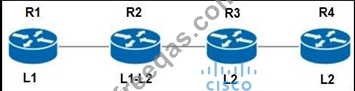
SIMULATION
Guidelines
This is a lab item in which tasks will be performed on virtual devices.
- Refer to the Tasks tab to view the tasks for this lab item.
- Refer to the Topology tab to access the device console(s) and perform the tasks.
- Console access is available for all required devices by clicking the device icon or using the tab(s) above the console window.
- All necessary preconfigurations have been applied.
- Do not change the enable password or hostname for any device.
- Save your configurations to NVRAM before moving to the next item.
- Click Next at the bottom of the screen to submit this lab and move to the next question.
- When Next is clicked, the lab closes and cannot be reopened.
Topology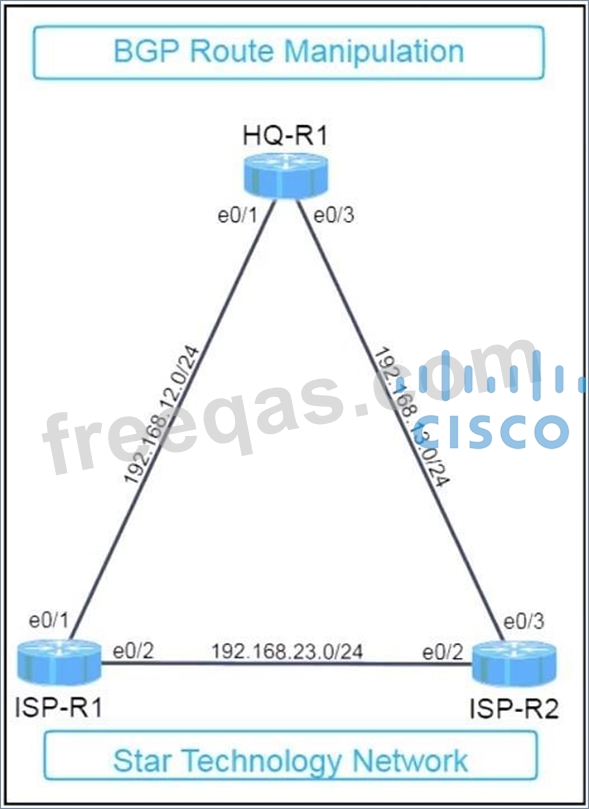
Tasks
Star Technology has decided to establish connectivity with an ISP for accessing the Internet. In phase 1, the approach is to establish a dual-homed connection from HQ-R1 to ISP-R1 and ISP- R2. This will provide some degree of redundancy in the connectivity between HQ-R1 and ISP routers.
Based on network design, an autonomous system of Star Technology is 1, and AS of ISP is 2. A network Implementation Engineer has already initiated the configuration; trouble-shooting is required to find out and complete missing configurations. Moreover, configuration is to be established in a way that links between HQ-R1 and ISP-R1 can be used as the preferred path for reaching AS 2.
Below are tasks to be achieved to include the missing commands and complete the troubleshooting.
For which reason can two devices fail to establish an OSPF neighbor relationship?
An engineer with an employee ID: 4535:15:507 must implement PIM-SSM in the network to support a new multicast messaging service. All the routers in the network run a distance vector routing protocol. Unicast routing is established on the network and is working normally. What must the engineer enable to continue the implementation process?
Refer to the exhibit.
P1 and PE3 Cisco IOS XR routers are directly connected and have this configuration applied. The BGP session is not coming up. Assume that there is no IP reachability problem and both routers can open tcp port 179 to each other. Which action fixes the issue?

