FreeQAs
 Request Exam  Contact
  • Home
  • View All Exams
  • New QA's
  • Upload
PRACTICE EXAMS:
  • Oracle
  • Fortinet
  • Juniper
  • Microsoft
  • Cisco
  • Citrix
  • CompTIA
  • VMware
  • ISC
  • SAP
  • EMC
  • PMI
  • HP
  • Salesforce
  • Other
  • Oracle
    Oracle
  • Fortinet
    Fortinet
  • Juniper
    Juniper
  • Microsoft
    Microsoft
  • Cisco
    Cisco
  • Citrix
    Citrix
  • CompTIA
    CompTIA
  • VMware
    VMware
  • ISC
    ISC
  • SAP
    SAP
  • EMC
    EMC
  • PMI
    PMI
  • HP
    HP
  • Salesforce
    Salesforce
  1. Home
  2. Cisco Certification
  3. 300-510 Exam
  4. Cisco.300-510.v2026-08-18.q100 Dumps
  • ««
  • «
  • …
  • 4
  • 5
  • 6
  • 7
  • 8
  • 9
  • 10
  • 11
  • 12
  • 13
  • …
  • »
  • »»
Download Now

Question 36

Refer to the exhibit.

An engineer is troubleshooting an OSPF issue. Router 1 has a neighbor relationship with router 2. Only router 1 classful EIGRP routes can be seen on router 2. In order for all EIGRP routes to be redistributed correctly, which action should be taken?

Correct Answer: A
insert code

Question 37

Refer to the exhibit

Which router does R1 install as an alternate next hop when trying to reach R3 if LFA is enabled?

Correct Answer: B
insert code

Question 38

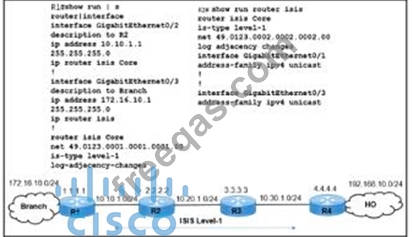
Refer to the exhibit.

Refer to the exhibit. Users at the branch office on R1 reported issue with an application at the home office on R4. While troubleshooting the issue, a network engineer determined that The branch-office users can connect to the home office.
The IS-IS adjacencies between R1 and R2 and R1 and the branch office are up.
Traffic from R1 to the R2 10.20.1.0/24 network is moving normally.
The application at the home office is experiencing packet drops on the connection to the Branch, and R3 cannot reach the R1 172.16.10.0/24 network.
Which action resolves the issues?

Correct Answer: A
insert code

Question 39

Which three methods can be used to reduce the full-mesh IBGP requirement in a service provider core network? (Choose three.)

Correct Answer: C,E,F
insert code

Question 40

A network engineer must implement a segment routing policy rule that specifies that SIDs are bounded manually. The policy will be used for traffic steering based on incoming label traffic with the binding SIDs, adjacency SIDs, and BGP peering SIDs. All labels will be in the local segment with the range from 40000 to 50000. How must the engineer implement dynamic label allocation?


Correct Answer: A
SRLB is the range of segment identifiers (SIDs) allocated locally for specific use cases like binding SIDs, adjacency SIDs, or BGP peering SIDs. By manually bounding the SIDs, the engineer specifies which labels fall within the SRLB range, and this range must be non-default for custom allocations (40000 to 50000 in this case).
The global segment is where both local and globally significant SIDs are defined. Implementing a non-default SRLB range ensures that the specified local labels (40000-50000) are used effectively for steering incoming traffic.
Once the SRLB range is configured in the global segment, dynamic label allocation assigns labels to the binding SIDs, adjacency SIDs, and BGP peering SIDs within the specified range.
insert code
  • ««
  • «
  • …
  • 4
  • 5
  • 6
  • 7
  • 8
  • 9
  • 10
  • 11
  • 12
  • 13
  • …
  • »
  • »»
[×]

Download PDF File

Enter your email address to download Cisco.300-510.v2026-08-18.q100 Dumps

Email:

FreeQAs

Our website provides the Largest and the most Latest vendors Certification Exam materials around the world.

Using dumps we provide to Pass the Exam, we has the Valid Dumps with passing guranteed just which you need.

  • DMCA
  • About
  • Contact Us
  • Privacy Policy
  • Terms & Conditions
©2026 FreeQAs

www.freeqas.com materials do not contain actual questions and answers from Cisco's certification exams.