FreeQAs
 Request Exam  Contact
  • Home
  • View All Exams
  • New QA's
  • Upload
PRACTICE EXAMS:
  • Oracle
  • Fortinet
  • Juniper
  • Microsoft
  • Cisco
  • Citrix
  • CompTIA
  • VMware
  • ISC
  • SAP
  • EMC
  • PMI
  • HP
  • Salesforce
  • Other
  • Oracle
    Oracle
  • Fortinet
    Fortinet
  • Juniper
    Juniper
  • Microsoft
    Microsoft
  • Cisco
    Cisco
  • Citrix
    Citrix
  • CompTIA
    CompTIA
  • VMware
    VMware
  • ISC
    ISC
  • SAP
    SAP
  • EMC
    EMC
  • PMI
    PMI
  • HP
    HP
  • Salesforce
    Salesforce
  1. Home
  2. Cisco Certification
  3. 350-401 Exam
  4. Cisco.350-401.v2022-03-01.q367 Dumps
  • ««
  • «
  • …
  • 24
  • 25
  • 26
  • 27
  • 28
  • 29
  • 30
  • 31
  • 32
  • 33
  • …
  • »
  • »»
Download Now

Question 136

Drag and drop the LISP components from the left onto the function they perform on the right. Not all options are used.

Correct Answer:

Explanation

+ accepts LISP encapsulated map requests: LISP map resolver
+ learns of EID prefix mapping entries from an ETR: LISP map server
+ receives traffic from LISP sites and sends it to non-LISP sites: LISP proxy ETR
+ receives packets from site-facing interfaces: LISP ITR
Explanation
ITR is the function that maps the destination EID to a destination RLOC and then encapsulates the original packet with an additional header that has the source IP address of the ITR RLOC and the destination IP address of the RLOC of an Egress Tunnel Router (ETR).
After the encapsulation, the original packet become a LISP packet.
ETR is the function that receives LISP encapsulated packets, decapsulates them and forwards to its local EIDs. This function also requires EID-to-RLOC mappings so we need to point out an "map-server" IP address and the key (password) for authentication.
A LISP proxy ETR (PETR) implements ETR functions on behalf of non-LISP sites. A PETR is typically used when a LISP site needs to send traffic to non-LISP sites but the LISP site is connected through a service provider that does not accept no routable EIDs as packet sources. PETRs act just like ETRs but for EIDs that send traffic to destinations at non-LISP sites.
Map Server (MS) processes the registration of authentication keys and EID-to-RLOC mappings. ETRs sends periodic Map-Register messages to all its configured Map Servers.
Map Resolver (MR): a LISP component which accepts LISP Encapsulated Map Requests, typically from an ITR, quickly determines whether or not the destination IP address is part of the EID namespace
insert code

Question 137

Drag and drop the Qos mechanisms from the left to the correct descriptions on the right

Correct Answer:

Explanation
+ bandwidth management technique which delays datagrams: shaping+ mechanism to create a scheduler for packets prior to forwarding: policy map+ portion of the IP header used to classify packets: DSCP+ mechanism to apply a QoS policy to an interface: service policy+ tool to enforce rate-limiting on ingress/egress: policing+ portion of the 802.1Q header used to classify packets: CoS To attach a policy map to an input interface, a virtual circuit (VC), an output interface, or a VC that will be used as the service policy for the interface or VC, use the service-policy command in the appropriate configuration mode.
Class of Service (CoS) is a 3 bit field within an Ethernet frame header when we use 802.1q which supports virtual LANs on an Ethernet network. This field specifies a priority value which is between 0 and 63 inclusive which can be used in the Quality of Service (QoS) to differentiate traffic.
The Differentiated Services Code Point (DSCP) is a 6-bit field in the IP header for the classification of packets. Differentiated Services is a technique which is used to classify and manage network traffic and it helps to provide QoS for modern Internet networks. It can provide services to all kinds of networks.
Traffic policing is also known as rate limiting as it propagates bursts. When the traffic rate reaches the configured maximum rate (or committed information rate), excess traffic is dropped (or remarked). The result is an output rate that appears as a saw-tooth with crests and troughs.
Traffic shaping retains excess packets in a queue and then schedules the excess for later transmission over increments of time -> It causes delay.
insert code

Question 138

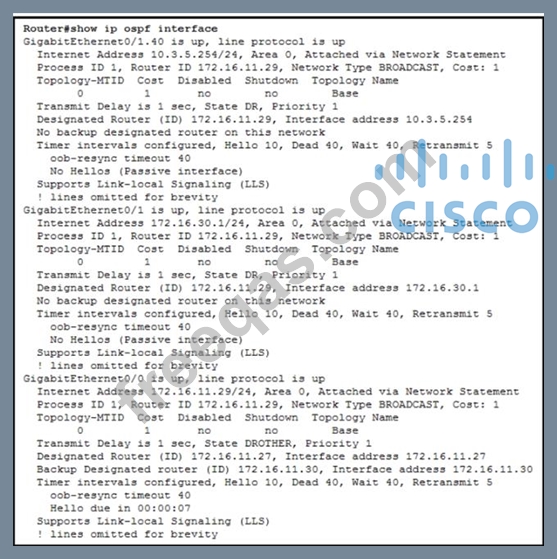
Refer to the exhibit.

A network engineer configures OSPF and reviews the router configuration. Which interface or interface or interface are able to establish OSPF adjacency?

Correct Answer: B
insert code

Question 139

Drag and drop the characteristics from the left onto the routing protocols they describe on the right.

Correct Answer:

Explanation

EIGRP maintains alternative loop-free backup via the feasible successors. To qualify as a feasible successor, a router must have an Advertised Distance (AD) less than the Feasible distance (FD) of the current successor route.
Advertised distance (AD): the cost from the neighbor to the destination. Feasible distance (FD): The sum of the AD plus the cost between the local router and the next-hop router
insert code

Question 140

What is an advantage of using BFD?

Correct Answer: D
insert code
  • ««
  • «
  • …
  • 24
  • 25
  • 26
  • 27
  • 28
  • 29
  • 30
  • 31
  • 32
  • 33
  • …
  • »
  • »»
[×]

Download PDF File

Enter your email address to download Cisco.350-401.v2022-03-01.q367 Dumps

Email:

FreeQAs

Our website provides the Largest and the most Latest vendors Certification Exam materials around the world.

Using dumps we provide to Pass the Exam, we has the Valid Dumps with passing guranteed just which you need.

  • DMCA
  • About
  • Contact Us
  • Privacy Policy
  • Terms & Conditions
©2026 FreeQAs

www.freeqas.com materials do not contain actual questions and answers from Cisco's certification exams.