Which two steps must a service provider consider when adding multicast support to the existing MPLS L3VPN? (Choose two.)

Guidelines
-
This is a lab item in which tasks will be performed on virtual devices.
* Refer to the Tasks tab to view the tasks for this lab item.
* Refer to the Topology tab to access the device console(s) and perform the tasks.
* Console access is available for all required devices by clicking the device icon or using the tab(s) above the console window.
* All necessary preconfigurations have been applied.
* Do not change the enable password or hostname for any device.
* Save your configurations to NVRAM before moving to the next item.
* Click Next at the bottom of the screen to submit this lab and move to the next question.
* When Next is clicked, the lab closes and cannot be reopened.
Topology
Tasks
-
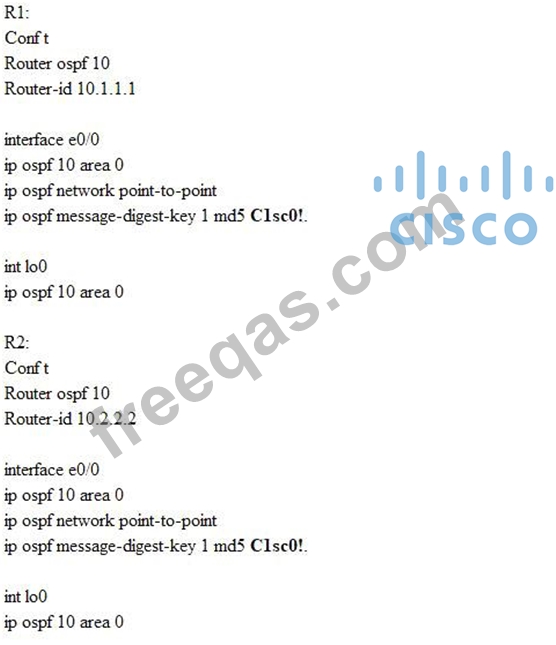
Configure and verify the OSPF neighbor adjacency between R1 and R2 in OSPF area 0 according to the topology to achieve these goals:
1. Establish R1 and R2 OSPF adjacency. All interfaces must be advertised in OSPF by using the OSPF interface command method. Use Loopback0 as the OSPF ID.
2. There must be no DR/BDR elections in OSPF Area 0 when establishing the neighbor relationship between R1 and R2. OSPF must not generate the host entries /32 for the adjacent interfaces.
3. Enable OSPF MD5 Authentication between both routers at the interface level with password C1sc0!.
Refer to the exhibit. P3 and PE4 are at the edge of the service provider core and serve as ABR routers Aggregation areas are on either side of the core.
Which statement about the architecture is true?
Refer to the exhibit. An ISP engineer configured a VRF to isolate traffic for the customer ciscotest as shown. Now, the engineer must implement the Intra-AS VPN feature on PE1 to pass traffic between customer sites. Which additional configuration must the engineer apply to PE1 to meet this requirement?