FreeQAs
 Request Exam  Contact
  • Home
  • View All Exams
  • New QA's
  • Upload
PRACTICE EXAMS:
  • Oracle
  • Fortinet
  • IBM
  • Juniper
  • Microsoft
  • Cisco
  • Citrix
  • CompTIA
  • VMware
  • ISC
  • SAP
  • EMC
  • PMI
  • HP
  • Salesforce
  • Other
  • Oracle
    Oracle
  • Fortinet
    Fortinet
  • IBM
    IBM
  • Juniper
    Juniper
  • Microsoft
    Microsoft
  • Cisco
    Cisco
  • Citrix
    Citrix
  • CompTIA
    CompTIA
  • VMware
    VMware
  • ISC
    ISC
  • SAP
    SAP
  • EMC
    EMC
  • PMI
    PMI
  • HP
    HP
  • Salesforce
    Salesforce
  1. Home
  2. CompTIA Certification
  3. PT0-002 Exam
  4. CompTIA.PT0-002.v2025-09-27.q272 Dumps
  • ««
  • «
  • …
  • 14
  • 15
  • 16
  • 17
  • 18
  • 19
  • 20
  • 21
  • 22
  • 23
  • …
  • »
  • »»
Download Now

Question 86

A penetration tester who is doing a company-requested assessment would like to send traffic to another system using double tagging. Which of the following techniques would BEST accomplish this goal?

Correct Answer: D
Explanation
since vlan hopping requires 2 vlans to be nested in a single packet. Double tagging occurs when an attacker adds and modifies tags on an Ethernet frame to allow the sending of packets through any VLAN. This attack takes advantage of how many switches process tags. Most switches will only remove the outer tag and forward the frame to all native VLAN ports. With that said, this exploit is only successful if the attacker belongs to the native VLAN of the trunk link.
https://cybersecurity.att.com/blogs/security-essentials/vlan-hopping-and-mitigation Tag nesting is a technique that involves inserting two VLAN tags into an Ethernet frame to bypass VLAN hopping prevention mechanisms. The first tag is stripped by the first switch, and the second tag is processed by the second switch, allowing the frame to reach a different VLAN than intended. RFID cloning is a technique that involves copying the data from an RFID tag to another tag or device. RFID tagging is a technique that involves attaching an RFID tag to an object or person for identification or tracking purposes.
Meta tagging is a technique that involves adding metadata to web pages or files for search engine optimization or classification purposes.
insert code

Question 87

A penetration tester developed the following script to be used during an engagement:
#!/usr/bin/python
import socket, sys
ports = [21, 22, 23, 25, 80, 139, 443, 445, 3306, 3389]
if len(sys.argv) > 1:
target = socket.gethostbyname (sys. argv [0])
else:
print ("Few arguments.")
print ("Syntax: python {} <target ip>". format (sys. argv [0]))
sys.exit ()
try:
for port in ports:
s = socket. socket (socket. AF_INET, socket. SOCK_STREAM)
s.settimeout (2)
result = s.connect_ex ((target, port) )
if result == 0:
print ("Port {} is opened". format (port) )
except KeyboardInterrupt:
print ("\nExiting ... ")
sys.exit ()
However, when the penetration tester ran the script, the tester received the following message:
socket.gaierror: [Errno -2] Name or service not known
Which of the following changes should the penetration tester implement to fix the script?

Correct Answer: A
The socket.gaierror: [Errno -2] Name or service not known is an error that occurs when the socket module cannot resolve the hostname or IP address given as an argument. In this case, the script is using sys.argv[0] as the argument for socket.gethostbyname, which is the name of the script itself, not the target IP address. The target IP address should be the first command-line argument after the script name, which is sys.argv1. Therefore, changing the script to use sys.argv1 as the argument for socket.gethostbyname will fix the error and allow the script to scan the ports of the target IP address. Reference:
* The Official CompTIA PenTest+ Study Guide (Exam PT0-002), Chapter 5: Attacks and Exploits, page 262-263.
* socket.gaierror: [Errno -2] Name or service not known | Python1
* How do I fix the error socket.gaierror: [Errno -2] Name or service not known on debian/testing?2
insert code

Question 88

Given the following script:

Which of the following BEST characterizes the function performed by lines 5 and 6?

Correct Answer: D
Explanation
The script is using the scapy library to perform a DNS query for www.comptia.org and store the response in variable b. Lines 5 and 6 are using a for loop to iterate over each answer in variable b and print its summary to the screen. This can help the penetration tester to view the DNS records returned by the query.
insert code

Question 89

Which of the following are the MOST important items to include in the final report for a penetration test?
(Choose two.)

Correct Answer: C,D
insert code

Question 90

The following output is from reconnaissance on a public-facing banking website:
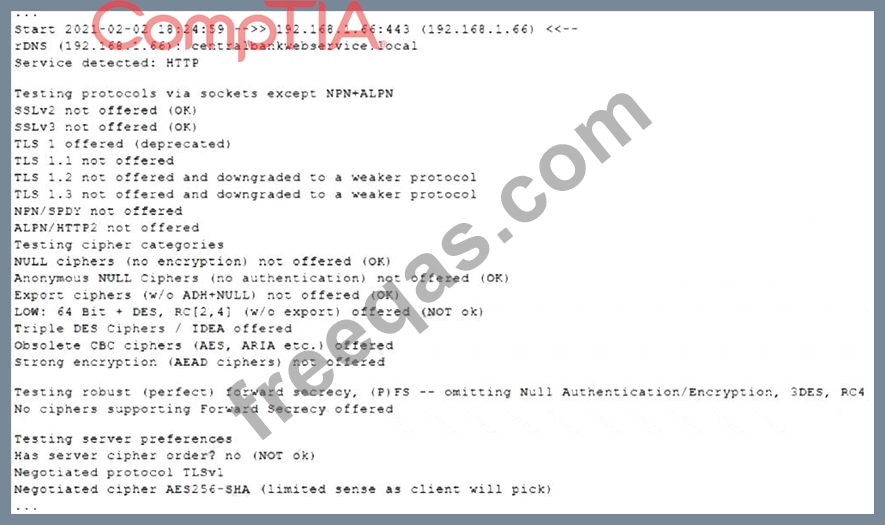
Based on these results, which of the following attacks is MOST likely to succeed?

Correct Answer: D
Based on these results, the most likely attack to succeed is a Heartbleed attack. The Heartbleed attack is a vulnerability in the OpenSSL implementation of the TLS/SSL protocol that allows an attacker to read the memory of the server and potentially steal sensitive information, such as private keys, passwords, or session tokens. The results show that the website is using OpenSSL 1.0.1f, which is vulnerable to the Heartbleed attack1.
insert code
  • ««
  • «
  • …
  • 14
  • 15
  • 16
  • 17
  • 18
  • 19
  • 20
  • 21
  • 22
  • 23
  • …
  • »
  • »»
[×]

Download PDF File

Enter your email address to download CompTIA.PT0-002.v2025-09-27.q272 Dumps

Email:

FreeQAs

Our website provides the Largest and the most Latest vendors Certification Exam materials around the world.

Using dumps we provide to Pass the Exam, we has the Valid Dumps with passing guranteed just which you need.

  • DMCA
  • About
  • Contact Us
  • Privacy Policy
  • Terms & Conditions
©2026 FreeQAs

www.freeqas.com materials do not contain actual questions and answers from Cisco's certification exams.
