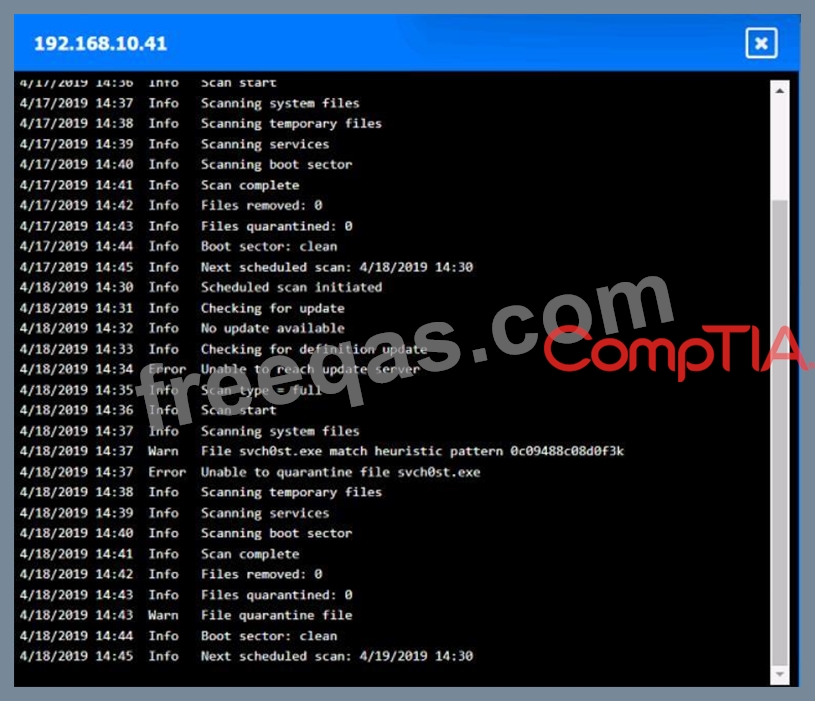
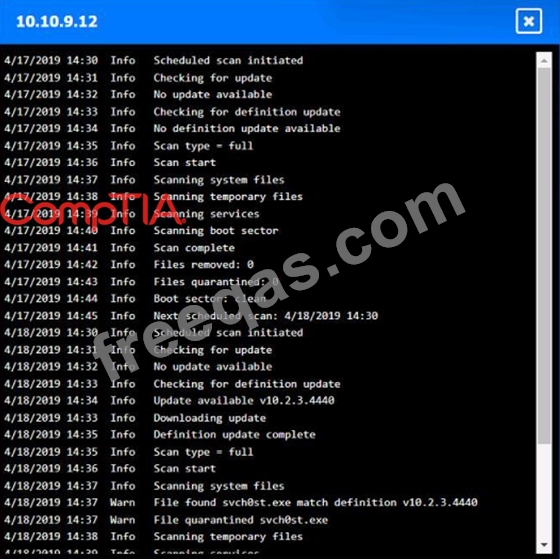
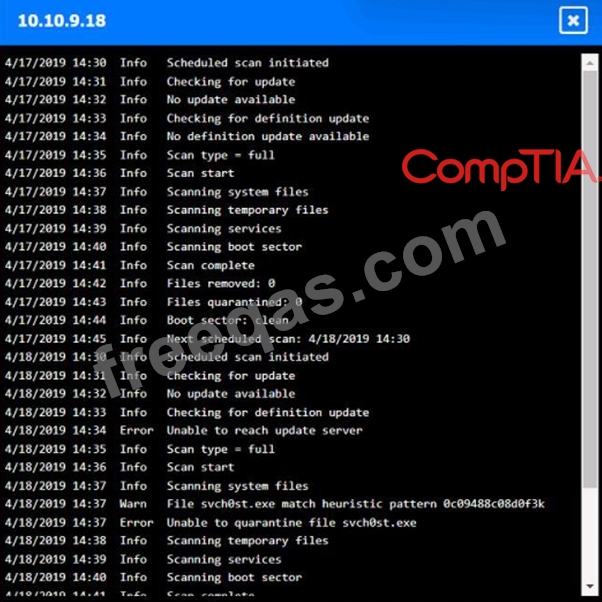
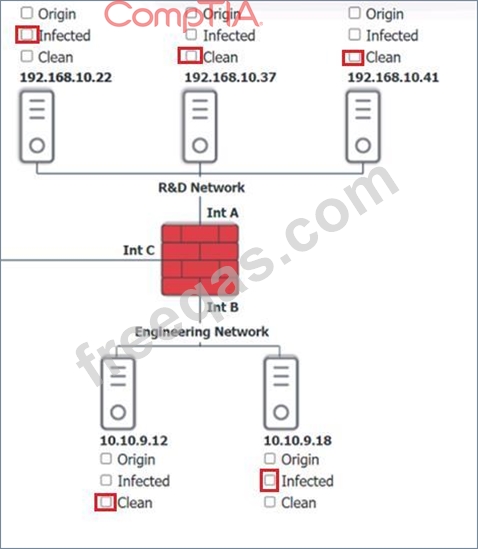
You are security administrator investigating a potential infection on a network. Click on each host and firewall. Review all logs to determine which host originated the Infecton and then deny each remaining hosts clean or infected.
Correct Answer:
Explanation Based on the logs, it seems that the host that originated the infection is 192.168.10.22. This host has a suspicious process named svchost.exe running on port 443, which is unusual for a Windows service. It also has a large number of outbound connections to different IP addresses on port 443, indicating that it is part of a botnet. The firewall log shows that this host has been communicating with 10.10.9.18, which is another infected host on the engineering network. This host also has a suspicious process named svchost.exe running on port 443, and a large number of outbound connections to different IP addresses on port 443. The other hosts on the R&D network (192.168.10.37 and 192.168.10.41) are clean, as they do not have any suspicious processes or connections.
Question 157
An employee receives a text message that appears to have been sent by the payroll department and is asking for credential verification. Which of the following social engineering techniques are being attempted? (Choose two.)
Correct Answer: B,E
Smishing is a type of social engineering technique that uses text messages (SMS) to trick victims into revealing sensitive information, clicking malicious links, or downloading malware. Smishing messages often appear to come from legitimate sources, such as banks, government agencies, or service providers, and use urgent or threatening language to persuade the recipients to take action12. In this scenario, the text message that claims to be from the payroll department is an example of smishing. Impersonation is a type of social engineering technique that involves pretending to be someone else, such as an authority figure, a trusted person, or a colleague, to gain the trust or cooperation of the target. Impersonation can be done through various channels, such as phone calls, emails, text messages, or in- person visits, and can be used to obtain information, access, or money from the victim34. In this scenario, the text message that pretends to be from the payroll department is an example of impersonation. A: Typosquatting is a type of cyberattack that involves registering domain names that are similar to popular or well-known websites, but with intentional spelling errors or different extensions. Typosquatting aims to exploit the common mistakes that users make when typing web addresses, and redirect them to malicious or fraudulent sites that may steal their information, install malware, or display ads56. Typosquatting is not related to text messages or credential verification. B: Phishing is a type of social engineering technique that uses fraudulent emails to trick recipients into revealing sensitive information, clicking malicious links, or downloading malware. Phishing emails often mimic the appearance and tone of legitimate organizations, such as banks, retailers, or service providers, and use deceptive or urgent language to persuade the recipients to take action78. Phishing is not related to text messages or credential verification. D: Vishing is a type of social engineering technique that uses voice calls to trick victims into revealing sensitive information, such as passwords, credit card numbers, or bank account details. Vishing calls often appear to come from legitimate sources, such as law enforcement, government agencies, or technical support, and use scare tactics or false promises to persuade the recipients to comply9 . Vishing is not related to text messages or credential verification. F: Misinformation is a type of social engineering technique that involves spreading false or misleading information to influence the beliefs, opinions, or actions of the target. Misinformation can be used to manipulate public perception, create confusion, damage reputation, or promote an agenda . Misinformation is not related to text messages or credential verification. References = 1: What is Smishing? | Definition and Examples | Kaspersky 2: Smishing - Wikipedia 3: Impersonation Attacks: What Are They and How Do You Protect Against Them? 4: Impersonation - Wikipedia 5: What is Typosquatting? | Definition and Examples | Kaspersky 6: Typosquatting - Wikipedia 7: What is Phishing? | Definition and Examples | Kaspersky 8: Phishing - Wikipedia 9: What is Vishing? | Definition and Examples | Kaspersky : Vishing - Wikipedia : What is Misinformation? | Definition and Examples | Britannica : Misinformation - Wikipedia
Question 158
A Chief Security Officer wants to change user authentication to the company wireless network. The authentication must use the LDAP database and must be centrally managed. Which of the following would help fulfill this requirement?
Correct Answer: D
RADIUS provides centralized authentication, authorization, and accounting, and it can integrate with an LDAP database to authenticate users connecting to the company's wireless network.
Question 159
A company is expanding its threat surface program and allowing individuals to security test the company's internet-facing application. The company will compensate researchers based on the vulnerabilities discovered. Which of the following best describes the program the company is setting up?
Correct Answer: B
A bug bounty is a program that rewards security researchers for finding and reporting vulnerabilities in an application or system. Bug bounties are often used by companies to improve their security posture and incentivize ethical hacking. A bug bounty program typically defines the scope, rules, and compensation for the researchers.
Question 160
Which of the following best explains how tokenization helps protect sensitive data?
Correct Answer: B
The best answer is B. It replaces the original data with reference values that do not hold exploitable meaning . Tokenization protects sensitive data by substituting the original value with a token , which is a non-sensitive reference value. The token has no meaningful value to an attacker if it is intercepted or exposed. The real sensitive data is stored separately in a protected system, often called a token vault. This is commonly used for: * payment card data * personally identifiable information * sensitive customer records Why the other options are incorrect: * A. It permanently deletes sensitive information from production systems. Tokenization does not necessarily delete the original data permanently. It replaces exposed operational use with tokens while the real data is retained securely elsewhere. * C. It stores sensitive data across multiple cloud environments to prevent data loss. This is unrelated to tokenization. * D. It conceals data by converting it into unreadable ciphertext using symmetric encryption. This describes encryption , not tokenization. From a SY0-701 perspective, tokenization reduces exposure by replacing real sensitive values with non- exploitable substitutes , so B is correct.