What is the primary purpose of implementing a dedicated IP in security POPs?
Correct Answer: C
A dedicated IP in security POPs is used to anchor a user's traffic to a consistent source IP, enabling geolocation-based policies and ensuring applications that rely on fixed source IPs function correctly.
Question 27
Refer to the exhibit. You want the performance service-level agreement (SLA) to measure the jitter of each member. Which configuration change must you make to achieve this result?
Correct Answer: A
According to the SD-WAN 7.6 Core Administrator study guide and FortiOS 7.6 Administration Guide , no configuration change is required to simply measure jitter. * Implicit Measurement : In FortiOS, once a Performance SLA (Health Check) is configured with an Active probe mode (as seen in the exhibit with Ping selected), the FortiGate automatically begins calculating three key quality metrics for every member interface: Latency , Jitter , and Packet Loss . * Visibility : Even without an SLA Target defined, these real-time measurements are visible in the SD- WAN Monitor and via the CLI command diagnose sys virtual-wan-link health-check < SLA_Name > . * Active Probes : Because the probe mode is set to Active using the Ping protocol, the FortiGate sends synthetic packets at the defined Check interval (500ms in the exhibit). It calculates jitter by measuring the variation in the round-trip time (RTT) between these consecutive probes. Why other options are incorrect : * Option B : Adding an SLA target and defining a jitter threshold is only necessary if you want the SD- WAN engine to make steering decisions based on that metric (e.g., " remove this link from the pool if jitter exceeds 50ms " ). It is not required just to measure the jitter. * Option C : While you can specify participants, the current setting is " All SD-WAN Members, " which means it is already measuring jitter for every member. * Option D : HTTP is an alternative probe protocol, but Ping (ICMP) is perfectly capable of measuring jitter and is often preferred for its lower overhead.
Question 28
You have a FortiGate configuration with three user-defined SD-WAN zones and one or two members in each of these zones. One SD-WAN member is no longer used in health-check and SD-WAN rules. This member is the only member of its zone. You want to delete it. What happens if you delete the SD-WAN member from the FortiGate GUI?
Correct Answer: B
Questions no:9Verified answer: B Comprehensive and Detailed Explanation with all FortiSASE and SD-WAN 7.6 Core Administrator curriculum documents: According to theSD-WAN 7.6 Core Administratorstudy guide andFortiOS 7.6 Administration Guide, the behavior for deleting an SD-WAN member from the GUI when it is the only member in its zone is governed by the following operational logic: * Reference Checks: Before allowing the deletion of any SD-WAN member, FortiOS performs a "check for dependencies." If an interface is being used in an activePerformance SLAor anSD-WAN Rule, the GUI will typically prevent the deletion or gray out the option until those references are removed. However, the question specifies that this member isno longer usedin health-checks or rules. * Zone Integrity: Unlike some other network objects, an SD-WAN zone is permitted to exist without any members. When you delete the final member of a user-defined zone through the GUI, the zone itself remains in the configuration as an empty container. * Route Management: When an SD-WAN member is deleted, any static routes that were specifically tied to that interface's membership in the SD-WAN bundle are automatically updated or removed by the FortiGate to prevent routing loops or "black-holing" traffic. This is part of the automated cleanup process handled by the FortiOS management plane. * GUI vs. CLI: In the GUI, the process is streamlined to allow the removal of the member interface. Once the member is deleted, the interface returns to being a "regular" system interface and can be used for standard firewall policies or other functions. Why other options are incorrect: * Option A: There is no requirement that a zone must contain at least one member; "empty" zones are valid configuration objects in FortiOS 7.6. * Option C: While the deletion is accepted, it is not with "no further action"-the system must still reconcile the routing table and interface status. * Option D: FortiGate does not automatically move deleted members into the default zone (virtual-wan- link). Once deleted, the interface is simply no longer an SD-WAN member.
Question 29
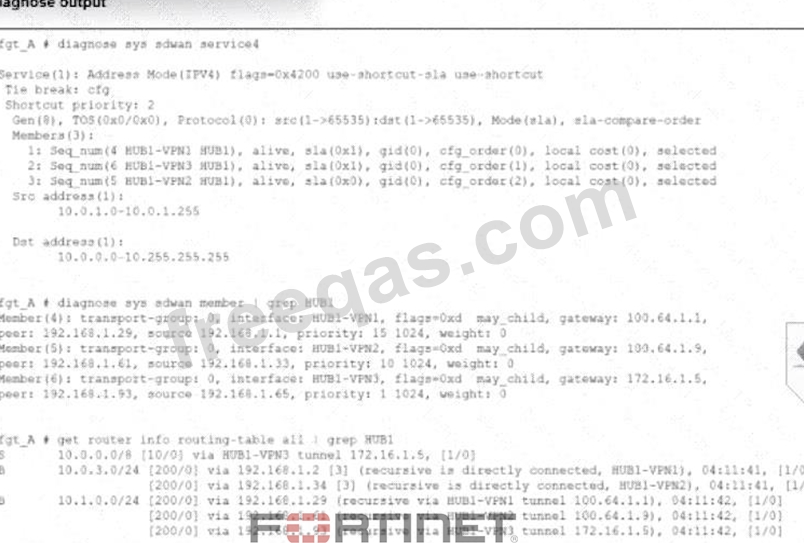
An administrator is troubleshooting SD-WAN on FortiGate. A device behind branch1_fgt generates traffic to the 10.0.0.0/8 network. The administrator expects the traffic to match SD-WAN rule ID 1 and be routed over HUB1-VPN1. However, the traffic is routed over HUB1-VPN3. Based on the output shown in the exhibit, which two reasons, individually or together, could explain the observed behavior? (Choose two.)
Correct Answer: A,C
According to the SD-WAN 7.6 Core Administrator curriculum and the diagnostic outputs shown in the exhibit, the reason traffic is steered to HUB1-VPN3 instead of the expected HUB1-VPN1 (defined in SD- WAN rule ID 1) can be explained by two core routing principles in FortiOS: * Valid Route Requirement (Option A) : In the diagnose sys sdwan service 4 output (which corresponds to Rule ID 1), it shows the rule has members HUB1-VPN1 , HUB1-VPN2 , and HUB1- VPN3 . A key principle of SD-WAN steering is that for a member to be " selectable " by a rule, it must have a valid route to the destination in the routing table (RIB/FIB). If the routing table output (the third section of the exhibit) shows a route to 10.0.0.0/8 via HUB1-VPN3 but not through HUB1-VPN1 , the SD-WAN engine will skip HUB1-VPN1 entirely because it is considered a " non-reachable " path for that specific destination. * Policy Route Precedence (Option D) : In the FortiOS route lookup hierarchy, Regular Policy Routes (PBR) are evaluated before SD-WAN rules. If an administrator has configured a traditional Policy Route (found under Network > Policy Routes ) that matches traffic destined for 10.0.0.0/8 and specifies HUB1-VPN3 as the outgoing interface, the FortiGate will forward the packet based on that policy route and will never evaluate the SD-WAN rules for that session. This " bypass " occurs regardless of whether the SD-WAN rule would have chosen a " better " link. Why other options are incorrect : * Option B : While member configuration priority (cfg_order) is a tie-breaker in some strategies, the SD- WAN rule logic is only applied if the routing table allows it or if a higher-priority policy route doesn ' t intercept the traffic first. * Option C : Lower route priority (which means higher preference in the RIB) affects the Implicit Rule (standard routing). However, SD-WAN rules are designed to override RIB priority for matching traffic. If HUB1-VPN1 was a valid candidate and no Policy Route existed, the SD-WAN rule would typically ignore RIB priority to enforce its own steering strategy.
Question 30
Which secure internet access (SIA) use case minimizes individual endpoint configuration? (Choose one answer)
Correct Answer: C
According to theFortiSASE 7.6 Architecture GuideandAdministration Guide, theSite-based remote user internet accessuse case is the only deployment model that completely eliminates the need for individual endpoint configuration. * Centralized Enforcement: In a site-based deployment, a "thin edge" device (such as aFortiExtender or aFortiGatein LAN extension mode) is installed at the remote site. This device establishes a secure tunnel to the FortiSASE Point of Presence (PoP). * Zero Endpoint Configuration: Because the traffic redirection happens at the network gateway level, individual devices (laptops, IoT devices, mobile phones) behind the site-based device do not require any specialized software or settings. They simply connect to the local network as they would normally, and their traffic is automatically secured by the SASE cloud. * Comparison with Other Modes: * Agent-based (Option B): Requires the installation and maintenance ofFortiClientsoftware on every device, often managed via MDM tools. * Agentless (Option A): While it doesn't need an agent, it typically requires the configuration of Explicit Web Proxysettings or the distribution of aPAC (Proxy Auto-Configuration) filevia GPO or SCCM to each device's browser. * ZTNA (Option D): Generally requires an endpoint agent (FortiClient) to perform posture checks and identity verification, involving significant endpoint-level configuration. Why other options are incorrect: * Option A: Agentless mode is often confused with being "configuration-free," but it still requires endpoints to be pointed toward the FortiSASE proxy. * Option B: This is the most configuration-intensive mode, requiring full software lifecycles for every endpoint. * Option D: ZTNA is an access methodology that adds configuration complexity (tags, certificates, posture checks) rather than minimizing it.