FreeQAs
 Request Exam  Contact
  • Home
  • View All Exams
  • New QA's
  • Upload
PRACTICE EXAMS:
  • Oracle
  • Fortinet
  • IBM
  • Juniper
  • Microsoft
  • Cisco
  • Citrix
  • CompTIA
  • VMware
  • ISC
  • SAP
  • EMC
  • PMI
  • HP
  • Salesforce
  • Other
  • Oracle
    Oracle
  • Fortinet
    Fortinet
  • IBM
    IBM
  • Juniper
    Juniper
  • Microsoft
    Microsoft
  • Cisco
    Cisco
  • Citrix
    Citrix
  • CompTIA
    CompTIA
  • VMware
    VMware
  • ISC
    ISC
  • SAP
    SAP
  • EMC
    EMC
  • PMI
    PMI
  • HP
    HP
  • Salesforce
    Salesforce
  1. Home
  2. Google Certification
  3. Professional-Cloud-DevOps-Engineer Exam
  4. Google.Professional-Cloud-DevOps-Engineer.v2025-01-09.q159 Dumps
  • ««
  • «
  • …
  • 9
  • 10
  • 11
  • 12
  • 13
  • 14
  • 15
  • 16
  • 17
  • 18
  • …
  • »
  • »»
Download Now

Question 61

You manage an application that runs in Google Kubernetes Engine (GKE) and uses the blue/green deployment methodology Extracts of the Kubernetes manifests are shown below
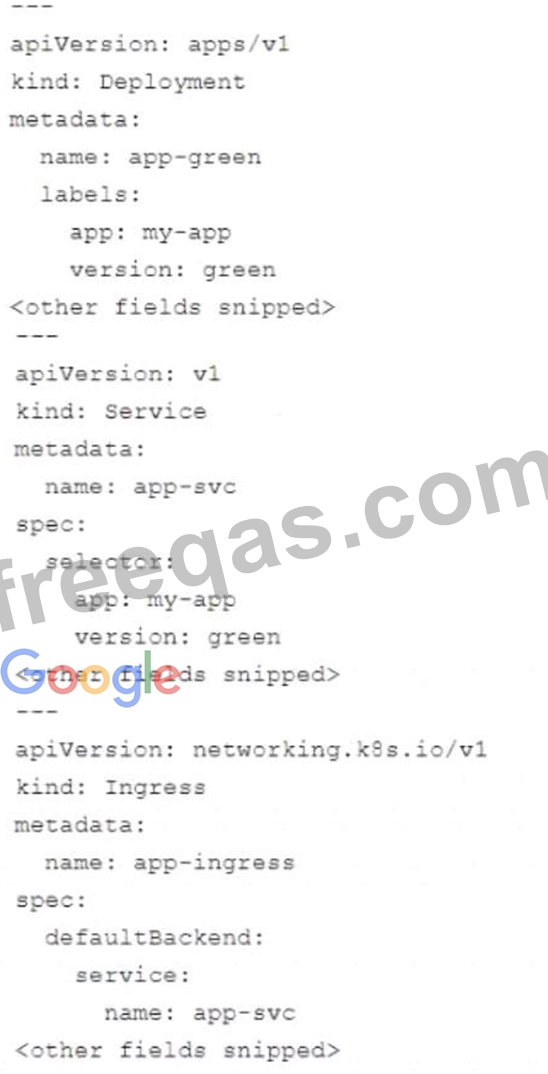
The Deployment app-green was updated to use the new version of the application During post-deployment monitoring you notice that the majority of user requests are failing You did not observe this behavior in the testing environment You need to mitigate the incident impact on users and enable the developers to troubleshoot the issue What should you do?

Correct Answer: D
Explanation
The best option for mitigating the incident impact on users and enabling the developers to troubleshoot the issue is to change the selector on the Service app-svc to app: my-app, version: blue. A Service is a resource that defines how to access a set of Pods. A selector is a field that specifies which Pods are selected by the Service. By changing the selector on the Service app-svc to app: my-app, version: blue, you can ensure that the Service only routes traffic to the Pods that have both labels app: my-app and version: blue. These Pods belong to the Deployment app-blue, which uses the previous version of the application. This way, you can mitigate the incident impact on users by switching back to the working version of the application. You can also enable the developers to troubleshoot the issue with the new version of the application in the Deployment app-green without affecting users.
insert code

Question 62

Your application images are built wing Cloud Build and pushed to Google Container Registry (GCR). You want to be able to specify a particular version of your application for deployment based on the release version tagged in source control. What would you do when you push the image?

Correct Answer: D
insert code

Question 63

Your company follows Site Reliability Engineering practices. You are the person in charge of Communications for a large, ongoing incident affecting your customer-facing applications. There is still no estimated time for a resolution of the outage. You are receiving emails from internal stakeholders who want updates on the outage, as well as emails from customers who want to know what is happening. You want to efficiently provide updates to everyone affected by the outage. What should you do?

Correct Answer: D
insert code

Question 64

You are writing a postmortem for an incident that severely affected users. You want to prevent similar incidents in the future. Which two of the following sections should you include in the postmortem? (Choose two.)

Correct Answer: A,C
For a postmortem to be truly blameless, it must focus on identifying the contributing causes of the incident without indicting any individual or team for bad or inappropriate behavior.
insert code

Question 65

Your organization stores all application logs from multiple Google Cloud projects in a central Cloud Logging project. Your security team wants to enforce a rule that each project team can only view their respective logs, and only the operations team can view all the logs. You need to design a solution that meets the security team's requirements, while minimizing costs. What should you do?

Correct Answer: B
Create log views for each project team, and only show each project team their application logs. Grant the operations team access to the _AllLogs View in the central logging project1.
This approach aligns with the Google Cloud's recommended methodologies for Professional Cloud DevOps Engineers1. Log views allow you to create and manage access control at a finer granularity for your logs. By creating a separate log view for each project team, you can ensure that they only have access to their respective logs. The operations team, on the other hand, can be granted access to the _AllLogs view in the central logging project, allowing them to view all logs as required.
This solution not only meets the security team's requirements but also minimizes costs as it leverages built-in features of Google Cloud's logging and does not require exporting logs to another service like BigQuery (as suggested in option A), which could incur additional costs1.
insert code
  • ««
  • «
  • …
  • 9
  • 10
  • 11
  • 12
  • 13
  • 14
  • 15
  • 16
  • 17
  • 18
  • …
  • »
  • »»
[×]

Download PDF File

Enter your email address to download Google.Professional-Cloud-DevOps-Engineer.v2025-01-09.q159 Dumps


Email:

FreeQAs

Our website provides the Largest and the most Latest vendors Certification Exam materials around the world.

Using dumps we provide to Pass the Exam, we has the Valid Dumps with passing guranteed just which you need.

  • DMCA
  • About
  • Contact Us
  • Privacy Policy
  • Terms & Conditions
©2026 FreeQAs

www.freeqas.com materials do not contain actual questions and answers from Cisco's certification exams.