You are a network administrator at your company planning a migration to Google Cloud and you need to finish the migration as quickly as possible, To ease the transition, you decided to use the same architecture as your on-premises network' a hub-and-spoke model. Your on-premises architecture consists of over 50 spokes.
Each spoke does not have connectivity to the other spokes, and all traffic IS sent through the hub for security reasons. You need to ensure that the Google Cloud architecture matches your on-premises architecture. You want to implement a solution that minimizes management overhead and cost, and uses default networking quotas and limits. What should you do?
You have the following Shared VPC design VPC Flow Logs is configured for Subnet-1 In the host VPC. You also want to monitor flow logs for Subnet-2. What should you do?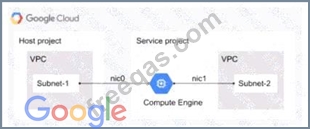
You need to create the technical architecture for hybrid connectivity from your data center to Google Cloud This will be managed by a partner. You want to follow Google-recommended practices for production-level applications. What should you do?
You have enabled HTTP(S) load balancing for your application, and your application developers have reported that HTTP(S) requests are not being distributed correctly to your Compute Engine Virtual Machine instances. You want to find data about how the request are being distributed.
Which two methods can accomplish this? (Choose two.)
Your company acquired a new division. The new division's network team requires complete control over their networking infrastructure. You need to extend your existing Google Cloud network infrastructure, that consists of a single VPC, to allow workloads from all divisions to communicate with each other. You want to avoid incurring extra costs and granting unnecessary permissions to the new division's networking team.
What should you do?
Enter your email address to download Google.Professional-Cloud-Network-Engineer.v2026-01-02.q124 Dumps

