FreeQAs
 Request Exam  Contact
  • Home
  • View All Exams
  • New QA's
  • Upload
PRACTICE EXAMS:
  • Oracle
  • Fortinet
  • Juniper
  • Microsoft
  • Cisco
  • Citrix
  • CompTIA
  • VMware
  • SAP
  • EMC
  • PMI
  • HP
  • Salesforce
  • Other
  • Oracle
    Oracle
  • Fortinet
    Fortinet
  • Juniper
    Juniper
  • Microsoft
    Microsoft
  • Cisco
    Cisco
  • Citrix
    Citrix
  • CompTIA
    CompTIA
  • VMware
    VMware
  • SAP
    SAP
  • EMC
    EMC
  • PMI
    PMI
  • HP
    HP
  • Salesforce
    Salesforce
  1. Home
  2. Google Certification
  3. Professional-Cloud-Network-Engineer Exam
  4. Google.Professional-Cloud-Network-Engineer.v2026-01-02.q124 Dumps
  • ««
  • «
  • …
  • 11
  • 12
  • 13
  • 14
  • 15
  • 16
  • 17
  • 18
  • 19
  • 20
  • …
  • »
  • »»
Download Now

Question 71

You have an application running on Compute Engine that uses BigQuery to generate some results that are stored in Cloud Storage. You want to ensure that none of the application instances have external IP addresses.
Which two methods can you use to accomplish this? (Choose two.)

Correct Answer: A,E
https://cloud.google.com/nat/docs/overview#interaction-pga Specifications https://cloud.google.com/vpc/docs/configure-private-google-access#specifications
insert code

Question 72

Your company's logo is published as an image file across multiple websites that are hosted by your company You have implemented Cloud CDN, however, you want to improve the performance of the cache hit ratio associated with this image file. What should you do?

Correct Answer: A
This answer meets the requirement of improving the performance of the cache hit ratio associated with the image file. The reason is:
Custom cache keys allow you to control which parts of the request URL are used to build the cache key. The cache key is a unique identifier that Cloud CDN uses to store and retrieve cached content1.
By default, Cloud CDN uses the complete request URL, including the protocol (http or https) and the host (the domain name), to build the cache key. This means that if the same image file is requested from different domains or protocols, Cloud CDN will cache multiple copies of it, which reduces the cache hit ratio1.
By clearing the Host and Protocol checkboxes, you can tell Cloud CDN to ignore these parts of the request URL when building the cache key. This way, Cloud CDN will cache only one copy of the image file, regardless of which domain or protocol it is requested from, which improves the cache hit ratio1.
Option B is incorrect because configuring Cloud Storage as a custom origin backend does not affect the cache hit ratio. It only affects how Cloud CDN retrieves the content from the origin if it is not cached. Option C is incorrect because configuring versioned URLs for each domain does not improve the cache hit ratio. It actually worsens it, because it creates more variations of the request URL that Cloud CDN has to cache separately. Option D is incorrect because configuring the default TTL as 0 for the image file means that Cloud CDN will not cache it at all, which defeats the purpose of using Cloud CDN.
Reference:
Custom cache keys | Cloud CDN | Google Cloud
insert code

Question 73

You have the following routing design. You discover that Compute Engine instances in Subnet-2 in the asia-southeast1 region cannot communicate with compute resources on-premises. What should you do?
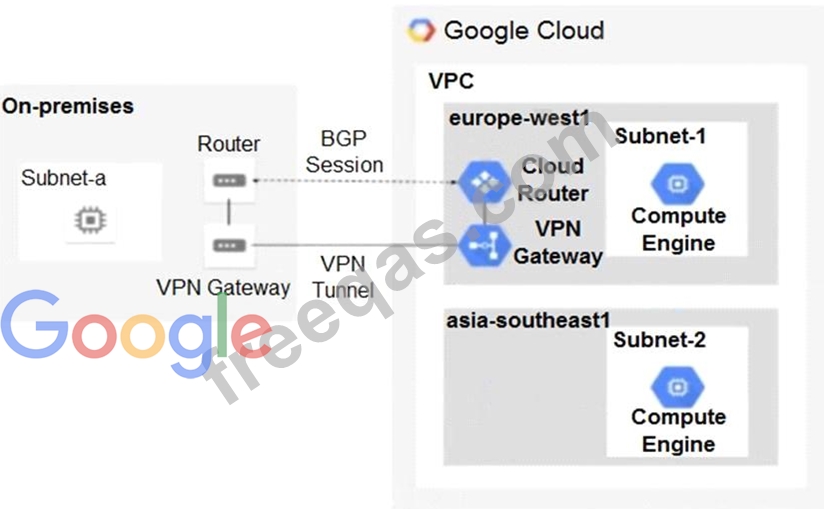
Correct Answer: D
insert code

Question 74

In your Google Cloud organization, you have two folders: Dev and Prod. You want a scalable and consistent way to enforce the following firewall rules for all virtual machines (VMs) with minimal cost:
Port 8080 should always be open for VMs in the projects in the Dev folder.
Any traffic to port 8080 should be denied for all VMs in your projects in the Prod folder.
What should you do?

Correct Answer: D
insert code

Question 75

You are planning to use Terraform to deploy the Google Cloud infrastructure for your company The design must meet the following requirements
* Each Google Cloud project must represent an Internal project that your team Will work on
* After an internal project is finished, the infrastructure must be deleted
* Each Internal project must have Its own Google Cloud project owner to manage the Google Cloud resources-
* You have 10-100 projects deployed at a time,
While you are writing the Terraform code, you need to ensure that the deployment IS Simple, and the code IS reusable With centralized management What should you doo

Correct Answer: C
The correct answer is C. Create a single Shared VPC and attach each Google Cloud project as a service project.
This answer is based on the following facts:
A Shared VPC allows you to share one or more VPC networks across multiple Google Cloud projects1. This simplifies the deployment and management of the network infrastructure, as you only need to create and maintain one VPC network for all your internal projects.
A Shared VPC consists of a host project that owns the VPC network and one or more service projects that use the VPC network2. You can attach and detach service projects as needed, depending on the lifecycle of your internal projects. You can also delete service projects without affecting the host project or other service projects.
A Shared VPC allows you to delegate administrative roles to different project owners3. You can grant the Shared VPC Admin role to the owner of the host project, who can manage the VPC network and its subnets. You can also grant the Service Project Admin role to the owners of the service projects, who can manage the Google Cloud resources in their own projects.
The other options are not correct because:
Option A is not suitable. Creating a single project and additional VPCs for each internal project will increase the complexity and cost of the network infrastructure. You will need to create and maintain multiple VPC networks, firewall rules, routes, and VPN tunnels. You will also have a limit on the number of VPC networks per project4.
Option B is not feasible. Creating a single project and single VPC for each internal project will not meet the requirement of having separate project owners for each internal project. You will have only one project owner who can manage all the Google Cloud resources in the same project.
Option D is not optimal. Creating a Shared VPC and service project for each internal project will not meet the requirement of having a simple and reusable code with centralized management. You will need to create and maintain multiple Shared VPCs, which will increase the complexity and cost of the network infrastructure. You will also have more Terraform code to write and manage for each Shared VPC.
insert code
  • ««
  • «
  • …
  • 11
  • 12
  • 13
  • 14
  • 15
  • 16
  • 17
  • 18
  • 19
  • 20
  • …
  • »
  • »»
[×]

Download PDF File

Enter your email address to download Google.Professional-Cloud-Network-Engineer.v2026-01-02.q124 Dumps


Email:

FreeQAs

Our website provides the Largest and the most Latest vendors Certification Exam materials around the world.

Using dumps we provide to Pass the Exam, we has the Valid Dumps with passing guranteed just which you need.

  • DMCA
  • About
  • Contact Us
  • Privacy Policy
  • Terms & Conditions
©2026 FreeQAs

www.freeqas.com materials do not contain actual questions and answers from Cisco's certification exams.