You are using a 10-Gbps direct peering connection to Google together with the gsutil tool to upload files to Cloud Storage buckets from on-premises servers. The on-premises servers are 100 milliseconds away from the Google peering point. You notice that your uploads are not using the full 10-Gbps bandwidth available to you. You want to optimize the bandwidth utilization of the connection.
What should you do on your on-premises servers?
You have the networking configuration shown in the diagram. A pair of redundant Dedicated Interconnect connections (int-Igal and int-Iga2) terminate on the same Cloud Router. The Interconnect connections terminate on two separate on-premises routers. You are advertising the same prefixes from the Border Gateway Protocol (BGP) sessions associated with the Dedicated Interconnect connections. You need to configure one connection as Active for both ingress and egress traffic. If the active Interconnect connection fails, you want the passive Interconnect connection to automatically begin routing all traffic Which two actions should you take to meet this requirement? (Choose Two)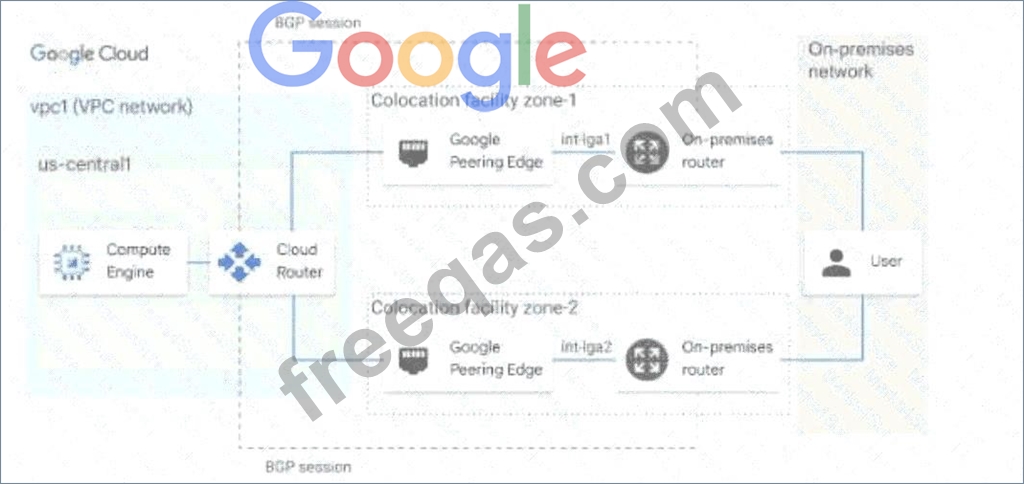
You recently deployed Cloud VPN to connect your on-premises data canter to Google Cloud. You need to monitor the usage of this VPN and set up alerts in case traffic exceeds the maximum allowed. You need to be able to quickly decide whether to add extra links or move to a Dedicated Interconnect. What should you do?
You are creating a new application and require access to Cloud SQL from VPC instances without public IP addresses.
Which two actions should you take? (Choose two.)
You are designing a shared VPC architecture. Your network and security team has strict controls over which routes are exposed between departments. Your Production and Staging departments can communicate with each other, but only via specific networks. You want to follow Google- recommended practices.
How should you design this topology?
Enter your email address to download Google.Professional-Cloud-Network-Engineer.v2026-11-25.q288 Dumps

