FreeQAs
 Request Exam  Contact
  • Home
  • View All Exams
  • New QA's
  • Upload
PRACTICE EXAMS:
  • Oracle
  • Fortinet
  • Juniper
  • Microsoft
  • Cisco
  • Citrix
  • CompTIA
  • VMware
  • ISC
  • SAP
  • EMC
  • PMI
  • HP
  • Salesforce
  • Other
  • Oracle
    Oracle
  • Fortinet
    Fortinet
  • Juniper
    Juniper
  • Microsoft
    Microsoft
  • Cisco
    Cisco
  • Citrix
    Citrix
  • CompTIA
    CompTIA
  • VMware
    VMware
  • ISC
    ISC
  • SAP
    SAP
  • EMC
    EMC
  • PMI
    PMI
  • HP
    HP
  • Salesforce
    Salesforce
  1. Home
  2. HP Certification
  3. HPE0-V27 Exam
  4. HP.HPE0-V27.v2024-08-05.q51 Dumps
  • «
  • 1
  • 2
  • 3
  • 4
  • 5
  • 6
  • 7
  • 8
  • 9
  • 10
  • …
  • »
  • »»
Download Now

Question 21

Which statements about HPE InfoSight are true? (Choose two.)

Correct Answer: B,E
HPE InfoSight is a cloud-based platform that uses AI and machine learning to provide predictive analytics, proactive recommendations, and automated actions for HPE infrastructure. It collects and analyzes data from more than 100,000 systems worldwide and uses that intelligence to make every system smarter and more self-sufficient. HPE InfoSight offers the following features:
B). It provides cloud-based predictive analytics for HPE Alletra all-flash arrays. HPE InfoSight supports HPE Alletra 6000 and 9000 all-flash arrays, which deliver consistentperformance, availability, and efficiency for mission-critical and business-critical workloads. HPE InfoSight monitors the health, performance, and capacity of the arrays and provides insights and guidance to optimize them. HPE InfoSight also predicts and prevents issues, such as bottlenecks, failures, or configuration errors, and automatically resolves them before they impact the business12.
E). It enables cross-stack analytics for VMware and Hyper-V environments. HPE InfoSight provides visibility and insights across the entire stack, from the virtual machines to the storage, and helps troubleshoot and optimize the virtualized infrastructure. HPE InfoSight can identify the root cause of performance issues, correlate metrics and events, and provide recommendations for improvement. HPE InfoSight also supports VMware vVols, which simplifies storage management and provisioning for virtual machines34.
The other options are not true because:
A). It automates the firmware updates of all registered HPE devices. HPE InfoSight does not automate the firmware updates of all registered HPE devices. It provides firmware recommendations based on the best practices and compatibility of the devices, but the firmware updates need to be performed manually by the administrator or through other tools, such as HPE OneView or HPE iLO Amplifier Pack56.
C). It can be used locally (dark sites) and in cloud environments. HPE InfoSight is a cloud-based platform that requires internet connectivity to collect and analyze data from the devices. It cannot be used locally (dark sites) or in offline environments. However, HPE offers other solutions, such as HPE Primera Data Collector or HPE Nimble Storage Data Collector, that can be deployed on-premises and provide some of the features of HPE InfoSight, such as health monitoring, performance analysis, and support automation78.
D). It provides cloud-based predictive analytics for HPE MSA. HPE InfoSight does not support HPE MSA, which is an entry-level storage array for small and medium businesses. HPE MSA has its own web-based management interface that provides basic monitoring and configuration capabilities, but it does not have the advanced features of HPE InfoSight, such as predictive analytics, AI-driven operations, or cross-stack visibility9 .
References:
HPE InfoSight - AI-Driven Intelligence for Infrastructure
HPE Alletra 6000 Data Sheet
HPE InfoSight for Servers
HPE InfoSight for VMware vCenter
HPE InfoSight Firmware Recommendations
HPE InfoSight Firmware Recommendations FAQ
HPE Primera Data Collector
HPE Nimble Storage Data Collector
HPE MSA Storage
[HPE MSA Storage Management Utility]
insert code

Question 22

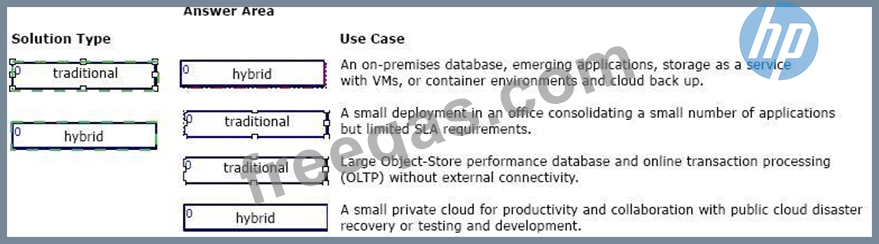
For each use case, identify whether it is a traditional solution or a hybrid solution.

Correct Answer:

Explanation:

According to the HPE Edge-to-Cloud Adoption Framework, page 5, a traditional solution is a cloud deployment model where the cloud infrastructure is provisioned for exclusive use by a single organization comprising multiple consumers (e.g., business units). It may be owned, managed, and operated by the organization, a third party, or somecombination of them, and it may exist on or off premises. A traditional solution offers the organization more control, security, and customization over their cloud resources, but it also requires more investment, maintenance, and expertise.
A hybrid solution is a cloud deployment model where the cloud infrastructure is a composition of two or more distinct cloud infrastructures (private, community, or public) that remain unique entities, but are bound together by standardized or proprietary technology that enables data and application portability (e.g., cloud bursting for load balancing between clouds). A hybrid solution offers the consumers more choice, agility, and innovation over their cloud resources, but it also requires more integration, management, and complexity.
Based on these definitions, the following use cases are hybrid solutions:
An on-premises database, emerging applications, storage as a service with VMs, or container environments and cloud back up. = Hybrid solution. This use case involves a combination of on-premises and cloud resources, and requires data and application portability between them.
A small private cloud for productivity and collaboration with public cloud disaster recovery or testing and development. = Hybrid solution. This use case involves a combination of private and public cloud resources, and requires data and application portability between them.
The following use cases are traditional solutions:
A small deployment in an office consolidating a small number of applications but limited SLA requirements. = Traditional solution. This use case involves a single organization using a cloud infrastructure for exclusive use, and does not require data and application portability to other clouds.
Large Object-Store performance database and online transaction processing (OLTP) without external connectivity. = Traditional solution. This use case involves a single organization using a cloud infrastructure for exclusive use, and does not require data and application portability to other clouds
insert code

Question 23

You are presenting an HPE Alletra 9000 solution to the customer. They ask for a high level implementation check list to prepare their site ahead of the implementation.
What resource can you share with the customer to aid you in providing this check list?

Correct Answer: A
The Welcome Center is a web-based portal that provides customers with a guided and simplified experience for setting up and managing their HPE Alletra 9000 storage systems. The Welcome Center helps customers to plan and prepare for the hardware installation, enable cloud management, discover and initialize the storage system, and access additional resources and support. The Welcome Center also provides a checklist of the tasks and requirements for each step of the implementation process, such as network configuration, site preparation, cabling, and power. By using the Welcome Center, customers can ensure that their site is readyfor the implementation and avoid any potential issues or delays. References: https://support.hpe.com/hpesc/public/docDisplay?docId=a00113699en_us&docLocale=en_U
insert code

Question 24

What is one competitive advantage of an HPE Intelligent Workspace solution?

Correct Answer: C
insert code

Question 25

You have designed an HPE Synergy solution for a customer site. The customer wants to use this solution design as a blueprint to implement the same solution in 200 locations. They want to minimize cost for installation and configuration and therefore plan to order everything Factory pre-installed and pre-configured.
Which HPE tool can you use to document the customer requirements and attach them to the order?

Correct Answer: A
HPE SmartCID is a tool that enables you to document the customer requirements and attach them to the order for HPE Synergy solutions. HPE SmartCID allows you to capture the configuration details, such as the frame layout, the compute modules, the interconnect modules, the storage options, the network settings, and the firmware versions, and generate a configuration file that can be used for factory pre-installation and pre-configuration. HPE SmartCID also validates the configuration for compatibility and compliance with HPE best practices and provides a graphical representation of the solution design. HPE SmartCID can help you reduce the cost and time for installation and configuration and ensure a consistent and error-free deployment across multiple sites. References: HPE SmartCID User Guide, HPE Synergy 12000 Frame Setup and Installation Guide, HPE Factory Express Integration Services
insert code
  • «
  • 1
  • 2
  • 3
  • 4
  • 5
  • 6
  • 7
  • 8
  • 9
  • 10
  • …
  • »
  • »»
[×]

Download PDF File

Enter your email address to download HP.HPE0-V27.v2024-08-05.q51 Dumps

Email:

FreeQAs

Our website provides the Largest and the most Latest vendors Certification Exam materials around the world.

Using dumps we provide to Pass the Exam, we has the Valid Dumps with passing guranteed just which you need.

  • DMCA
  • About
  • Contact Us
  • Privacy Policy
  • Terms & Conditions
©2026 FreeQAs

www.freeqas.com materials do not contain actual questions and answers from Cisco's certification exams.
