FreeQAs
 Request Exam  Contact
  • Home
  • View All Exams
  • New QA's
  • Upload
PRACTICE EXAMS:
  • Oracle
  • Fortinet
  • Juniper
  • Microsoft
  • Cisco
  • Citrix
  • CompTIA
  • VMware
  • ISC
  • SAP
  • EMC
  • PMI
  • HP
  • Salesforce
  • Other
  • Oracle
    Oracle
  • Fortinet
    Fortinet
  • Juniper
    Juniper
  • Microsoft
    Microsoft
  • Cisco
    Cisco
  • Citrix
    Citrix
  • CompTIA
    CompTIA
  • VMware
    VMware
  • ISC
    ISC
  • SAP
    SAP
  • EMC
    EMC
  • PMI
    PMI
  • HP
    HP
  • Salesforce
    Salesforce
  1. Home
  2. HP Certification
  3. HPE6-A85 Exam
  4. HP.HPE6-A85.v2024-05-10.q58 Dumps
  • «
  • 1
  • 2
  • 3
  • 4
  • 5
  • 6
  • 7
  • 8
  • 9
  • 10
  • …
  • »
  • »»
Download Now

Question 16

A customer has just implemented user and device certificates via a company-wide Group Based Policy (GPO) Which EAP method requires client certificates when authenticating to the network?

Correct Answer: B
EAP-TLS is an authentication method that requires client certificates when authenticating to the network. It provides mutual authentication between the client and the server using public key cryptography and digital certificates. Reference: https://www.arubanetworks.com/techdocs/ClearPass/6.9/Guest/Content/CPPM_UserGuide/EAP-TLS/EAP-TLS.htm EAP-TLS (Extensible Authentication Protocol-Transport Layer Security) is an EAP method that requires both server-side and client-side certificates for authentication. It is considered one of the most secure EAP methods because it uses a mutual authentication process where both the user and the authentication server must prove their identities to each other through the use of certificates. Implementing user and device certificates via a Group Based Policy (GPO) aligns well with EAP-TLS requirements for client-side certificates.
insert code

Question 17

Match the switching technology with the appropriate use case.

Correct Answer:

Explanation
USE CASE: a) Controls the dynamic addition and removal of ports to groups Technology: 3) LACP USE CASE: b) Tags Ethernet frames with an additional VLAN header Technology: 1) 802.1Q USE CASE: c) Used to authenticate EAP-Capable client on a switch port Technology: 2) 802.1X USE CASE: d) Used to identify a voice VLAN to an IP phone Technology: 4) LLDP The following table summarizes the switching technologies and their use cases:
Technology
Use case
1) 802.1Q
802.1Q is a standard that defines how to create and manage virtual LANs (VLANs) on a network. VLANs allow network administrators to logically segment a network into different broadcast domains, improving security, performance, and manageability. 802.1Q tags Ethernet frames with an additional VLAN header that contains a VLAN identifier (VID), which indicates which VLAN the frame belongs to1.
2) 802.1X
802.1X is a standard that defines how to provide port-based network access control (PNAC) on a network.
PNAC allows network administrators to authenticate and authorize devices before granting them access to network resources. 802.1X uses the Extensible Authentication Protocol (EAP) to exchange authentication messages between a supplicant (a device that wants to access the network), an authenticator (a device that controls access to the network, such as a switch), and an authentication server (a device that verifies the credentials of the supplicant, such as a RADIUS server)
3) LACP
LACP stands for Link Aggregation Control Protocol, which is part of the IEEE 802.3ad standard that defines how to bundle multiple physical links into a single logical link, also known as a link aggregation group (LAG) or an EtherChannel. LAGs provide increased bandwidth, load balancing, and redundancy for network connections. LACP controls the dynamic addition and removal of ports to groups, ensuring that only ports with compatible configurations can form a LAG3.
4) LLDP
LLDP stands for Link Layer Discovery Protocol, which is part of the IEEE 802.1AB standard that defines how to discover and advertise information about neighboring devices on a network. LLDP operates at Layer 2 of the OSI model and uses TLVs (type-length-value) to exchange information such as device name, port number, VLAN ID, capabilities, and power requirements. LLDP can be used to identify a voice VLAN to an IP phone by sending a TLV that contains the voice VLAN ID and priority.
References: 1 https://en.wikipedia.org/wiki/IEEE_802.1Q 2 https://en.wikipedia.org/wiki/IEEE_802.1X 3
https://en.wikipedia.org/wiki/Link_aggregation
https://en.wikipedia.org/wiki/Link_Layer_Discovery_Protocol
insert code

Question 18

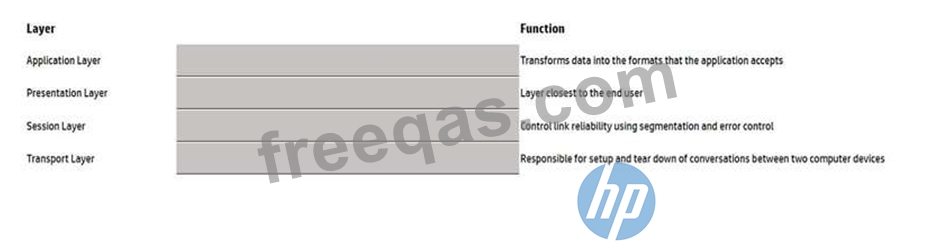
Match the Open Systems Interconnection (OSI) layer with its function.

Correct Answer:
insert code

Question 19

Describe the purpose of the administrative distance

Correct Answer: A
insert code

Question 20

What can be done to dynamically set the PoE Priority on a switch port when deploying IP cameras APs. and other PoE devices?

Correct Answer: B
Profiling is a feature that allows Aruba switches to automatically identify and classify devices connected to them based on various attributes such as MAC address, DHCP options, LLDP information, etc. Profiling can be used to dynamically set the PoE priority on a switch port based on the device type and power requirements. For example, an IP camera may have a higher PoE priority than a printer or a PC. Profiling can also be used to apply other configuration settings such as VLANs, ACLs, QoS, etc. based on the device profile. Reference: https://www.arubanetworks.com/techdocs/ArubaOS_86_Web_Help/Content/arubaos-solutions/1-overview/profiling.htm
insert code
  • «
  • 1
  • 2
  • 3
  • 4
  • 5
  • 6
  • 7
  • 8
  • 9
  • 10
  • …
  • »
  • »»
[×]

Download PDF File

Enter your email address to download HP.HPE6-A85.v2024-05-10.q58 Dumps

Email:

FreeQAs

Our website provides the Largest and the most Latest vendors Certification Exam materials around the world.

Using dumps we provide to Pass the Exam, we has the Valid Dumps with passing guranteed just which you need.

  • DMCA
  • About
  • Contact Us
  • Privacy Policy
  • Terms & Conditions
©2026 FreeQAs

www.freeqas.com materials do not contain actual questions and answers from Cisco's certification exams.