FreeQAs
 Request Exam  Contact
  • Home
  • View All Exams
  • New QA's
  • Upload
PRACTICE EXAMS:
  • Oracle
  • Fortinet
  • Juniper
  • Microsoft
  • Cisco
  • Citrix
  • CompTIA
  • VMware
  • ISC
  • SAP
  • EMC
  • PMI
  • HP
  • Salesforce
  • Other
  • Oracle
    Oracle
  • Fortinet
    Fortinet
  • Juniper
    Juniper
  • Microsoft
    Microsoft
  • Cisco
    Cisco
  • Citrix
    Citrix
  • CompTIA
    CompTIA
  • VMware
    VMware
  • ISC
    ISC
  • SAP
    SAP
  • EMC
    EMC
  • PMI
    PMI
  • HP
    HP
  • Salesforce
    Salesforce
  1. Home
  2. HP Certification
  3. HPE6-A85 Exam
  4. HP.HPE6-A85.v2025-02-08.q90 Dumps
  • «
  • 1
  • 2
  • 3
  • 4
  • 5
  • 6
  • 7
  • 8
  • 9
  • 10
  • …
  • »
  • »»
Download Now

Question 16

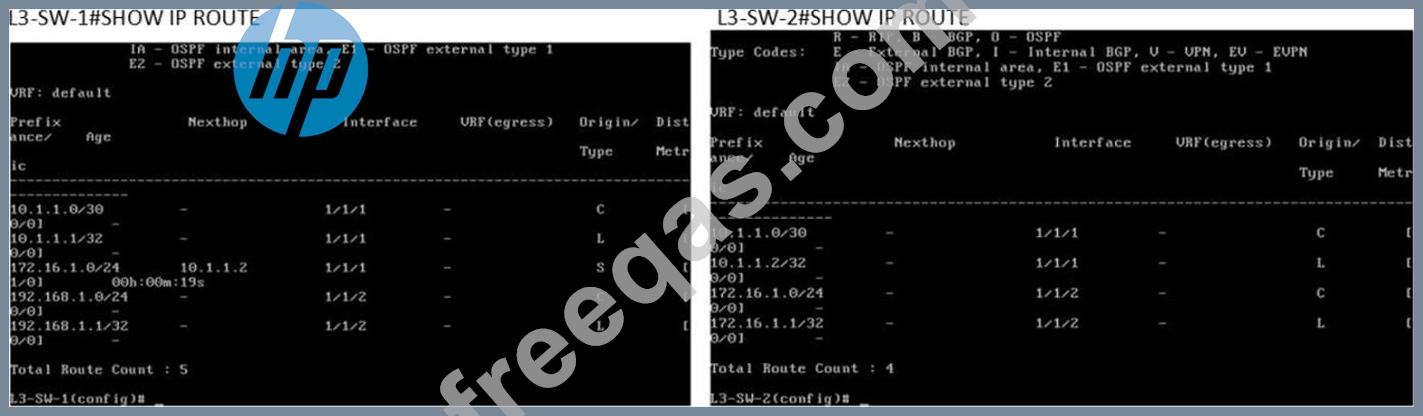
You have been asked to troubleshoot failed connectivity between a local subnet in the HQ Office and a remote subnet in the Branch Office. PC1 is unable to ping PC2.
Use the provided topology and show command output to identify the reason for the failure:

Correct Answer: D
Using the provided topology and show command output, it can be determined that L3-SW-2 in the Branch Office does not have a route to reach the subnet where PC1 resides (192.168.1.0/24 in the HQ Office). L3-SW-1 in the HQ Office has a route to the Branch Office subnet (172.16.1.0/24), but without the reciprocal route on L3-SW-2, traffic from the Branch Office will not be able to reach the HQ Office subnet, hence PC1 cannot ping PC2.
insert code

Question 17

A client connects to an Aruba AP in tunnel mode and is assigned to a VLAN based on the client's MAC address.
Which client VLAN assignment was configured?

Correct Answer: D
When a client connects to an Aruba AP in tunnel mode and is assigned to a VLAN based on the client's MAC address, this indicates a Dynamic VLAN assignment. The VLAN is determined dynamically at the time of authentication based on the client's credentials or attributes, such as its MAC address.
insert code

Question 18

Based on the "snow ip route" output on an AruDaCX 8400. what type of route is "10.1 20 0/24, vrf default via 10.1.12.2. [1/0]"?

Correct Answer: B
A static route is a route that is manually configured on a router or switch and does not change unless it is modified by an administrator. Static routes are used to specify how traffic should reach specific destinations that are not directly connected to the device or that are not reachable by dynamic routing protocols. In Aruba CX switches, static routes can be configured using the ip route command in global configuration mode. Based on the "show ip route" output on an Aruba CX 8400 switch, the route "10.1 20
0/24, vrf default via 10.1.12.2, [1/0]" is a static route because it has an administrative distance of 1 and a metric of 0, which are typical values for static routes.
References:
https://en.wikipedia.org/wiki/Static_routing
https://www.arubanetworks.com/techdocs/AOS-CX_10_04/NOSCG/Content/cx-noscg/ip-routing/static- routes.h
insert code

Question 19

What can be done to dynamically set the PoE Priority on a switch port when deploying IP cameras APs. and other PoE devices?

Correct Answer: B
Explanation
Profiling is a feature that allows Aruba switches to automatically identify and classify devices connected to them based on various attributes such as MAC address, DHCP options, LLDP information, etc. Profiling can be used to dynamically set the PoE priority on a switch port based on the device type and power requirements.
For example, an IP camera may have a higher PoE priority than a printer or a PC. Profiling can also be used to apply other configuration settings such as VLANs, ACLs, QoS, etc. based on the device profile.
References:https://www.arubanetworks.com/techdocs/ArubaOS_86_Web_Help/Content/arubaos-solutions/1-ove
insert code

Question 20

What does the status of "ALFOE" mean when checking LACP with "show lacp interfaces'"?

Correct Answer: D
Explanation
The status of "ALFOE" means that LACP Link Aggregation Control Protocol (LACP) is a network protocol that provides dynamic negotiation of link aggregation between two devices. LACP allows multiple physical links to be combined into a single logical link for increased bandwidth, redundancy, and load balancing. LACP is defined in IEEE 802.3ad standard. is working fine with no problems when checking LACP with "show lacp interfaces". The status of "ALFOE" is an acronym that stands for:
A: Active - The interface is actively sending LACP packets to negotiate link aggregation with the peer device.
L: Link Up - The interface has physical connectivity with the peer device.
F: Aggregatable - The interface can be aggregated with other interfaces into a single logical link.
D: Synchronized - The interface has successfully negotiated link aggregation parameters with the peer device and can transmit or receive traffic on the logical link.
E: Collecting/Distributing - The interface is collecting incoming traffic from the peer device and distributing outgoing traffic to the peer device on the logical link.
The other options are not correct because:
The interface on the local switch is configured as static-LAG: This option is false because static-LAG does not use LACP to negotiate link aggregation. Static-LAG requires manual configuration of link aggregation parameters on both devices and does not have any status indicators.
LACP is not configured on the peer side: This option is false because if LACP is not configured on the peer side, the status of the interface would be "ALF-" instead of "ALFOE". This means that the interface would not be synchronized or collecting/distributing with the peer device.
LACP is in a synchronizing process: This option is false because if LACP is in a synchronizing process, the status of the interface would be "ALF-O" instead of "ALFOE". This means that the interface would not be collecting/distributing with the peer device.
References:
https://www.arubanetworks.com/techdocs/AOS-CX_10_08/NOSCG/Content/cx-noscg/lag/lag-overview.htm
https://www.arubanetworks.com/techdocs/AOS-CX_10_08/NOSCG/Content/cx-noscg/lag/lag-lacp.htm
https://www.arubanetworks.com/techdocs/AOS-CX_10_08/NOSCG/Content/cx-noscg/lag/lag-lacp-status.htm
insert code
  • «
  • 1
  • 2
  • 3
  • 4
  • 5
  • 6
  • 7
  • 8
  • 9
  • 10
  • …
  • »
  • »»
[×]

Download PDF File

Enter your email address to download HP.HPE6-A85.v2025-02-08.q90 Dumps

Email:

FreeQAs

Our website provides the Largest and the most Latest vendors Certification Exam materials around the world.

Using dumps we provide to Pass the Exam, we has the Valid Dumps with passing guranteed just which you need.

  • DMCA
  • About
  • Contact Us
  • Privacy Policy
  • Terms & Conditions
©2026 FreeQAs

www.freeqas.com materials do not contain actual questions and answers from Cisco's certification exams.
