FreeQAs
 Request Exam  Contact
  • Home
  • View All Exams
  • New QA's
  • Upload
PRACTICE EXAMS:
  • Oracle
  • Fortinet
  • IBM
  • Juniper
  • Microsoft
  • Cisco
  • Citrix
  • CompTIA
  • VMware
  • ISC
  • SAP
  • EMC
  • PMI
  • HP
  • Salesforce
  • Other
  • Oracle
    Oracle
  • Fortinet
    Fortinet
  • IBM
    IBM
  • Juniper
    Juniper
  • Microsoft
    Microsoft
  • Cisco
    Cisco
  • Citrix
    Citrix
  • CompTIA
    CompTIA
  • VMware
    VMware
  • ISC
    ISC
  • SAP
    SAP
  • EMC
    EMC
  • PMI
    PMI
  • HP
    HP
  • Salesforce
    Salesforce
  1. Home
  2. HP Certification
  3. HPE7-A01 Exam
  4. HP.HPE7-A01.v2024-06-09.q109 Dumps
  • ««
  • «
  • …
  • 5
  • 6
  • 7
  • 8
  • 9
  • 10
  • 11
  • 12
  • 13
  • 14
  • …
  • »
  • »»
Download Now

Question 41

With the Aruba CX 6000 24G switch with uplinks of 1/1/25 and what does the switch do when a client port detects a loop and the do-not-disabie parameter is used?

Correct Answer: B
Explanation
The correct answer is B. An event log message is created.
The do-not-disable parameter is used to prevent the switch from disabling the port when a loop is detected by the loop-protect feature. Instead, the switch will generate an event log message that indicates the port number and the VLAN ID where the loop was detected. The switch will also send a trap to the SNMP manager, if configured1.
The other options are incorrect because:
* A. Port status will not be validated once status is cleared. The port will remain enabled even if a loop is detected, unless the loop-protect action is changed to tx-disable or tx-rx-disable1.
* C. The network analytics engine will not be triggered by a loop detection. The network analytics engine is a feature that allows users to monitor and troubleshoot network issues using scripts and agents2.
* D. Port status LED will not blink in amber with 100Hz. The port status LED will indicate the normal port status, such as link speed and activity, regardless of the loop detection3.
insert code

Question 42

Which component is used by the Aruba Network Analytics Engine (NAE)?

Correct Answer: A
Explanation
The component that is used by the Aruba Network Analytics Engine (NAE) is D. Current State Database.
The Current State Database is a database that stores the configuration and state information of the switch, such as interfaces, VLANs, routing protocols, statistics, and more. The NAE can access this database through the AOS-CX REST API and monitor the values of any data point using monitors. The NAE can also track the history of the values in a time-series database and correlate them with network events or configuration changes1. The Current State Database provides NAE with direct visibility into the entire current state of the device, which enables intelligent troubleshooting and automation of network tasks1.
The other options are incorrect because:
* A. JSON-based scripts: JSON is a data format that is used to exchange information between applications. It is not a scripting language that can be used by NAE. NAE scripts are written in Python, which is a popular and powerful programming language1.
* B. Lisp-based agents: Lisp is a family of programming languages that are mainly used for artificial intelligence and functional programming. It is not a language that can be used by NAE. NAE agents are instances of scripts that run on the switch and collect relevant network information and trigger alerts or actions1.
* C. Ruby-based scripts: Ruby is a general-purpose programming language that is known for its expressiveness and elegance. It is not a language that can be used by NAE. NAE scripts are written in Python, which is a popular and powerful programming language1.
insert code

Question 43

Which statements are true regarding a VXLAN implementation on Aruba Switches? (Select two.)

Correct Answer: A,B
Explanation
Option A: MTU size must be increased beyond the default
This is because option A shows how to configure the MTU size for VXLAN tunnels on Aruba switches using the interface command and the vxlan command. The MTU size must be increased beyond the default value of
1500 bytes to accommodate the VXLAN header and payload2.
Therefore, option A is true regarding a VXLAN implementation on Aruba switches.
Option B: VNIs encapsulate and decapsulate VXLAN traffic
This is also true regarding a VXLAN implementation on Aruba switches. VNIs are used to encapsulate and decapsulate VXLAN traffic between two devices, such as a switch and a server. VNIs are also used to map VXLAN tunnels to overlay networks3.
Therefore, option B is also true regarding a VXLAN implementation on Aruba switches.
VXLAN is a Layer 2 encapsulation technology that substitutes the usage of VLAN numbers to label Ethernet broadcast domains with VXLAN numbers. VXLAN supports 224 Ethernet broadcast domains or VXLAN numbers. A VXLAN number ID is referred to as VNI. There is a one-to-one relationship between an Ethernet broadcast domain and a VNI. A single Ethernet broadcast domain can't have more than one VNI.
insert code

Question 44

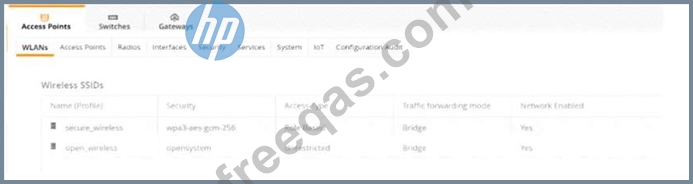
Refer to the exhibit.

A company has deployed 200 AP-635 access points. To but is not working as expected What would be the correct action to fix the issue?

Correct Answer: A
Explanation
This is the correct action to fix the issue where the SSID is not working as expected. WPA3-Enhanced Open is a new security standard for public networks that uses Opportunistic Wireless Encryption (OWE) to provide encryption and privacy on open, non-password-protected networks. WPA3-Enhanced Open can be configured on an Aruba Access Point by changing the SSID security mode to WPA3-Enhanced Open in Aruba Central or Aruba Instant. The other options are incorrect because they either do not use WPA3-Enhanced Open or do not exist as valid security modes. References:
https://www.arubanetworks.com/assets/wp/WP_WPA3-Enhanced-Open.pdf
https://www.arubanetworks.com/techdocs/Instant_86_WebHelp/Content/instant-ug/wpa3-enhanced-open.htm
insert code

Question 45

Which Aruba AP mode is sending captured RF data to Aruba Central for waterfall plot?

Correct Answer: C
Explanation
Spectrum Monitor is an Aruba AP mode that is sending captured RF data to Aruba Central for waterfall plot.
Spectrum Monitor is a mode that allows an AP to scan all channels in both 2.4 GHz and 5 GHz bands and collect information about the RF environment, such as interference sources, noise floor, channel utilization, etc. The AP then sends this data to Aruba Central, which is a cloud-based network management platform that can display the data in various formats, including waterfall plot. Waterfall plot is a graphical representation of the RF spectrum over time, showing the frequency, amplitude, and duration of RF signals. The other options are incorrect because they are either not AP modes or not sending RF data to Aruba Central. References:
https://www.arubanetworks.com/techdocs/ArubaOS_86_Web_Help/Content/arubaos-solutions/1-overview/spect
https://www.arubanetworks.com/techdocs/ArubaOS_86_Web_Help/Content/arubaos-solutions/1-overview/water
https://www.arubanetworks.com/products/network-management-operations/aruba-central/
insert code
  • ««
  • «
  • …
  • 5
  • 6
  • 7
  • 8
  • 9
  • 10
  • 11
  • 12
  • 13
  • 14
  • …
  • »
  • »»
[×]

Download PDF File

Enter your email address to download HP.HPE7-A01.v2024-06-09.q109 Dumps

Email:

FreeQAs

Our website provides the Largest and the most Latest vendors Certification Exam materials around the world.

Using dumps we provide to Pass the Exam, we has the Valid Dumps with passing guranteed just which you need.

  • DMCA
  • About
  • Contact Us
  • Privacy Policy
  • Terms & Conditions
©2026 FreeQAs

www.freeqas.com materials do not contain actual questions and answers from Cisco's certification exams.