FreeQAs
 Request Exam  Contact
  • Home
  • View All Exams
  • New QA's
  • Upload
PRACTICE EXAMS:
  • Oracle
  • Fortinet
  • IBM
  • Juniper
  • Microsoft
  • Cisco
  • Citrix
  • CompTIA
  • VMware
  • ISC
  • SAP
  • EMC
  • PMI
  • HP
  • Salesforce
  • Other
  • Oracle
    Oracle
  • Fortinet
    Fortinet
  • IBM
    IBM
  • Juniper
    Juniper
  • Microsoft
    Microsoft
  • Cisco
    Cisco
  • Citrix
    Citrix
  • CompTIA
    CompTIA
  • VMware
    VMware
  • ISC
    ISC
  • SAP
    SAP
  • EMC
    EMC
  • PMI
    PMI
  • HP
    HP
  • Salesforce
    Salesforce
  1. Home
  2. HP Certification
  3. HPE7-A01 Exam
  4. HP.HPE7-A01.v2024-06-09.q109 Dumps
  • «
  • 1
  • 2
  • 3
  • 4
  • 5
  • 6
  • 7
  • 8
  • 9
  • 10
  • …
  • »
  • »»
Download Now

Question 21

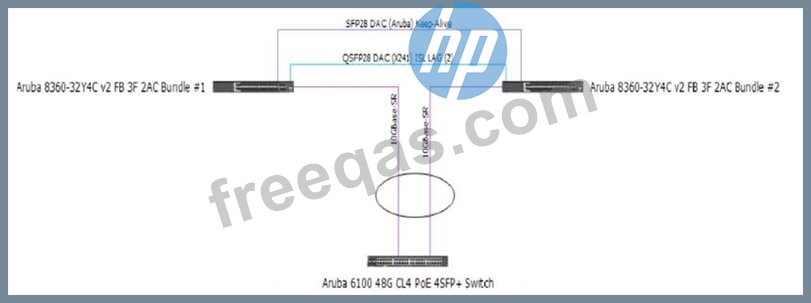
Review the exhibit.

You are troubleshooting an issue with a 10 102.39 0/24 subnet which is also VLAN 1000 used Tor wireless clients on a pair of Aruba CX 8360 switches The subnet SVI is configured on the 8360 pair, and the DHCP server is a Microsoft Windows Server 2022 Standard with an IP address of 10 200 1.100. The 10.102.250.0/24 subnet is used for switch management.
A large number of DHCP requests are failing You are observing sporadic DHCP behavior across clients attached to the CX 6100 switch.
Which action may help fix the issue?

Correct Answer: B
Explanation
Option B is the correct action that may help fix the issue of sporadic DHCP behavior across clients attached to the CX 6100 switch. Option B enables DHCP relay on VLAN 1000 interface on Core-1 switch, which allows DHCP requests from clients in VLAN 1000 to be forwarded to the DHCP server in a different subnet (10.200.1.100). Without DHCP relay, clients in VLAN 1000 cannot obtain IP addresses from the DHCP server because they are in different broadcast domains. The other options are incorrect because they either do not enable DHCP relay or do not configure it correctly. References:
https://www.arubanetworks.com/techdocs/AOS-CX/10.04/HTML/5200-6728/bk01-ch02.html
https://www.arubanetworks.com/techdocs/AOS-CX/10.04/HTML/5200-6728/bk01-ch03.html
insert code

Question 22

What is the best practice for handling voice traffic with dynamic segmentation on AOS-CX switches?

Correct Answer: A
Explanation
This is the best practice for handling voice traffic with dynamic segmentation on AOS-CX switches. Dynamic segmentation is a feature that allows AOS-CX switches to tunnel user traffic to a controller or another switch based on user roles and policies. For voice traffic, it is recommended to use switch authentication and local forwarding, which means the voice devices are authenticated by the switch and their traffic is forwarded locally without tunneling. This reduces latency and jitter for voice traffic and improves voice quality. The other options are incorrect because they either use central authentication or tunneling, which are not optimal for voice traffic. References:
https://www.arubanetworks.com/techdocs/AOS-CX/10.04/HTML/5200-6728/bk01-ch05.html
https://www.arubanetworks.com/assets/ds/DS_AOS-CX.pdf
insert code

Question 23

your customer has asked you to assign a switch management role for a new user The customer requires the user role to View switch configuration information and have access to the PUT and POST meth0ds for REST API.
Which default AOS-CX user role meets these requirements?

Correct Answer: C
The correct answer is C. sysops.
The sysops user role is a predefined role that allows users to view switch configuration information and have access to the PUT and POST methods for REST API. The sysops user role can also use the PATCH and DELETE methods for REST API, but not for all resources. The sysops user role is suitable for users who need to perform system operations on the switch, such as backup, restore, upgrade, or reboot.
According to the AOS-CX REST API Reference basics1, one of the predefined user roles is:
sysops: Users with this role can view switch configuration information and have access to the PUT and POST methods for REST API. They can also use the PATCH and DELETE methods for REST API, but not for all resources. Users with this role can perform system operations on the switch, such as backup, restore, upgrade, or reboot.
The other options are incorrect because:
A) administrators: Users with this role have full access to all switch configuration information and all REST API methods. This role is more than what the customer requires.
B) auditors: Users with this role can only view switch configuration information and have access to the GET method for REST API. They cannot use the PUT and POST methods for REST API.
D) helpdesk: Users with this role can view switch configuration information and have access to the GET method for REST API. They can also use the PATCH method for REST API, but only for a limited set of resources. They cannot use the PUT and POST methods for REST API.
insert code

Question 24

Describe the difference between Class of Service (CoS) and Differentiated Services Code Point (DSCP).

Correct Answer: B
CoS and DSCP are both methods of marking packets for quality of service (QoS) purposes. QoS is a mechanism that allows network devices to prioritize and differentiate traffic based on certain criteria, such as application type, source, destination, etc. CoS stands for Class of Service and is a 3-bit field in the 802.1Q VLAN tag header. CoS can only be used on Ethernet frames that have a VLAN tag, and it can only be preserved within a single VLAN domain. DSCP stands for Differentiated Services Code Point and is a 6-bit field in the IP header. DSCP can be used on any IP packet, regardless of the underlying layer 2 technology, and it can be preserved throughout the IP packet flow, unless it is modified by intermediate devices. Reference: https://www.cisco.com/c/en/us/td/docs/ios-xml/ios/qos/configuration/15-mt/qos-15-mt-book/qos-overview.html https://www.cisco.com/c/en/us/support/docs/lan-switching/8021q/17056-741-4.html https://www.cisco.com/c/en/us/support/docs/quality-of-service-qos/qos-packet-marking/10103-dscpvalues.html
insert code

Question 25

A system engineer needs to preconfigure several Aruba CX 6300 switches that will be sent to a remote office An untrained local field technician will do the rollout of the switches and the mounting of several AP-515s and AP-575S. Cables running to theAPs are not labeled.
The VLANs are already preconfigured to VLAN 100 (mgmt), VLAN 200 (clients), and VLAN 300 (guests) What is the correct configuration to ensure that APs will work properly?


Correct Answer: C
Option C is the correct configuration to ensure that APs will work properly. It uses the ap command to configure a port profile for APs with VLAN 100 as the native VLAN and VLAN 200 and 300 as tagged VLANs. It also enables LLDP on the ports to discover the APs and assign them to the port profile automatically. The other options are incorrect because they either do not use the ap command, do not enable LLDP, or do not configure the VLANs correctly. Reference: https://www.arubanetworks.com/techdocs/AOS-CX_10_08/UG/bk01-ch02.html https://www.arubanetworks.com/techdocs/AOS-CX_10_08/UG/bk01-ch03.html
insert code
  • «
  • 1
  • 2
  • 3
  • 4
  • 5
  • 6
  • 7
  • 8
  • 9
  • 10
  • …
  • »
  • »»
[×]

Download PDF File

Enter your email address to download HP.HPE7-A01.v2024-06-09.q109 Dumps

Email:

FreeQAs

Our website provides the Largest and the most Latest vendors Certification Exam materials around the world.

Using dumps we provide to Pass the Exam, we has the Valid Dumps with passing guranteed just which you need.

  • DMCA
  • About
  • Contact Us
  • Privacy Policy
  • Terms & Conditions
©2026 FreeQAs

www.freeqas.com materials do not contain actual questions and answers from Cisco's certification exams.