True or False? The root and default policies can be deleted if they are not needed or being used.
Correct Answer: B
Comprehensive and Detailed In-Depth Explanation: In HashiCorp Vault, therootanddefaultpolicies are built-in and cannot be deleted: * B. False: "The default and root policy cannot be deleted. You don't have to use them, but you can't delete them." The root policy grants superuser privileges, while the default policy provides common permissions assigned to new tokens unless explicitly excluded (e.g., via vault token create -no-default- policy). Their permanence ensures baseline functionality and security. * Incorrect Option: * A. True: Incorrect; these policies are immutable in terms of deletion. "The root and default policies cannot be deleted." This design choice maintains Vault's operational integrity and security model. Reference:https://developer.hashicorp.com/vault/docs/concepts/policies#built-in-policies
Question 72
You are enabling a secrets engine in Vault using the CLI. What subcommands are available when using the vault secrets command? (Select five)
Correct Answer: C,D,E,F,G
Comprehensive and Detailed In-Depth Explanation: The vault secrets command supports: * C. tune: "Tune a secrets engine configuration." * D. enable: "Enable a secrets engine." * E. move: "Move a secrets engine to a new path." * F. disable: "Disable a secrets engine." * G. list: "List enabled secrets engines." * Incorrect Options: * A. update: Not a subcommand. * B. migrate: Not applicable here. "The vault secrets command has several subcommands to use when working with secrets engines." Reference:https://developer.hashicorp.com/vault/docs/commands/secrets#usage
Question 73
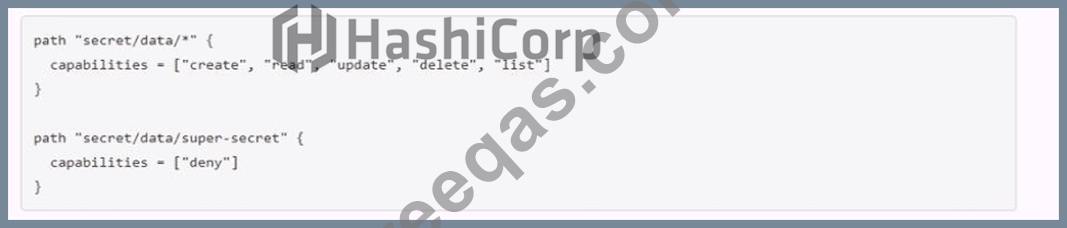
The key/value v2 secrets engine is enabled at secret/ See the following policy: Which of the following operations are permitted by this policy? Choose two correct answers.
Correct Answer: A,C
The policy shown in the image is: path "secret/data/webapp1" { capabilities = ["create", "read", "update", "delete", "list"] } path "secret/data/super-secret" { capabilities = ["deny"] } This policy grants or denies access to the key/value v2 secrets engine mounted at secret/ according to the following rules: * The path "secret/data/webapp1" has the capabilities of "create", "read", "update", "delete", and "list". This means that the policy allows performing any of these operations on the secrets stored under this path. The data/ prefix is used to access the actual secret data in the key/value v2 secrets engine5. Therefore, the policy permits the operation of vault kv get secret/webapp1, which reads the secret data at secret/data/webapp16. * The path "secret/data/super-secret" has the capability of "deny". This means that the policy denies performing any operation on the secrets stored under this path. The policy overrides any other policy that might grant access to this path. Therefore, the policy does not permit the operations of vault kv delete secret/super-secret and vault kv list secret/super-secret, which delete and list the secret data at secret/data/super-secret respectively6. * The policy does not explicitly define any rules for the path "secret/metadata". The metadata/ prefix is used to access the metadata of the secrets in the key/value v2 secrets engine, such as the number of versions, the deletion status, the creation time, etc5. By default, if the policy grants any of the capabilities of "create", "read", "update", or "delete" on the data/ path, it also grants the same capabilities on the corresponding metadata/ path7. Therefore, the policy permits the operation of vault kv metadata get secret/webapp1, which reads the metadata of the secret at secret/metadata/webapp18. 5 (https://developer.hashicorp.com/vault/docs/secrets/kv/kv-v2), [6]6, 7 (https://developer.hashicorp.com/vault/docs/secrets/kv/kv-v2), [8]8
Question 74
Which of the following is true about the token authentication method in Vault? (Select three)
Correct Answer: A,B,C
Comprehensive and Detailed In-Depth Explanation: The token auth method is foundational to Vault. The Vault documentation states: "Tokens are the core method for authentication within Vault. It is also the only auth method that cannot be disabled. If you've gone through the getting started guide, you probably noticed that vault server -dev (or vault operator init for a non-dev server) outputs an initial 'root token.' This is the first method of authentication for Vault. All external authentication mechanisms, such as GitHub, mapdown to dynamically created tokens." -Vault Concepts: Tokens * A,B,C: Correct per the above. * D: Incorrect; tokens can be used directly: "Tokens can be used directly or auth methods can be used to dynamically generate tokens based on external identities." -Vault Concepts: Tokens References: Vault Concepts: Tokens
Question 75
You are considering using HCP Vault Dedicated but are concerned about differences between a hosted version and a self-hosted deployment. Which of the following statements is true about HCP Vault Dedicated?
Correct Answer: A
Comprehensive and Detailed In-Depth Explanation: HCP Vault Dedicated is a managed Vault service provided by HashiCorp, designed to mirror the self-hosted Vault Enterprise experience while simplifying deployment: * A. Same Vault Binary: "HCP Vault Dedicated provides a similar experience to self-hosted Vault Enterprise because it uses the same Vault binary." This ensures consistency in functionality, CLI commands, APIs, and UI interactions, making it familiar to users of self-hosted Vault. The documentation confirms: "HCP Vault Dedicated uses the same binary asself-hosted Vault Enterprise, which means you will have a consistent user experience." * Incorrect Options: * B. Multi-Cloud Deployment: HCP Vault Dedicated is a HashiCorp-managed service, not deployable by users on any cloud provider. "It is specifically offered as a hosted solution by HashiCorp and does not support deployment on other cloud platforms." It currently supports AWS and Azure, but not full multi-cloud flexibility. * C. Different CLI/APIs: The use of the same binary ensures identical CLI and API interfaces. "Does not require different CLI commands and APIs compared to self-hosted Vault Enterprise." * D. Single Region Limitation: It supports multiple regions (e.g., North America, Asia, Europe). "Not limited to a single region and can be deployed across multiple regions." This consistency aids adoption for organizations transitioning to a managed solution. Reference:https://developer.hashicorp.com/hcp/docs/vault/what-is-hcp-vault#why-hcp-vault-dedicated