FreeQAs
 Request Exam  Contact
  • Home
  • View All Exams
  • New QA's
  • Upload
PRACTICE EXAMS:
  • Oracle
  • Fortinet
  • Juniper
  • Microsoft
  • Cisco
  • Citrix
  • CompTIA
  • VMware
  • ISC
  • SAP
  • EMC
  • PMI
  • HP
  • Salesforce
  • Other
  • Oracle
    Oracle
  • Fortinet
    Fortinet
  • Juniper
    Juniper
  • Microsoft
    Microsoft
  • Cisco
    Cisco
  • Citrix
    Citrix
  • CompTIA
    CompTIA
  • VMware
    VMware
  • ISC
    ISC
  • SAP
    SAP
  • EMC
    EMC
  • PMI
    PMI
  • HP
    HP
  • Salesforce
    Salesforce
  1. Home
  2. Huawei Certification
  3. H12-891_V1.0 Exam
  4. Huawei.H12-891_V1.0.v2026-06-05.q295 Dumps
  • «
  • 1
  • 2
  • 3
  • 4
  • 5
  • 6
  • 7
  • 8
  • 9
  • 10
  • …
  • »
  • »»
Download Now

Question 16

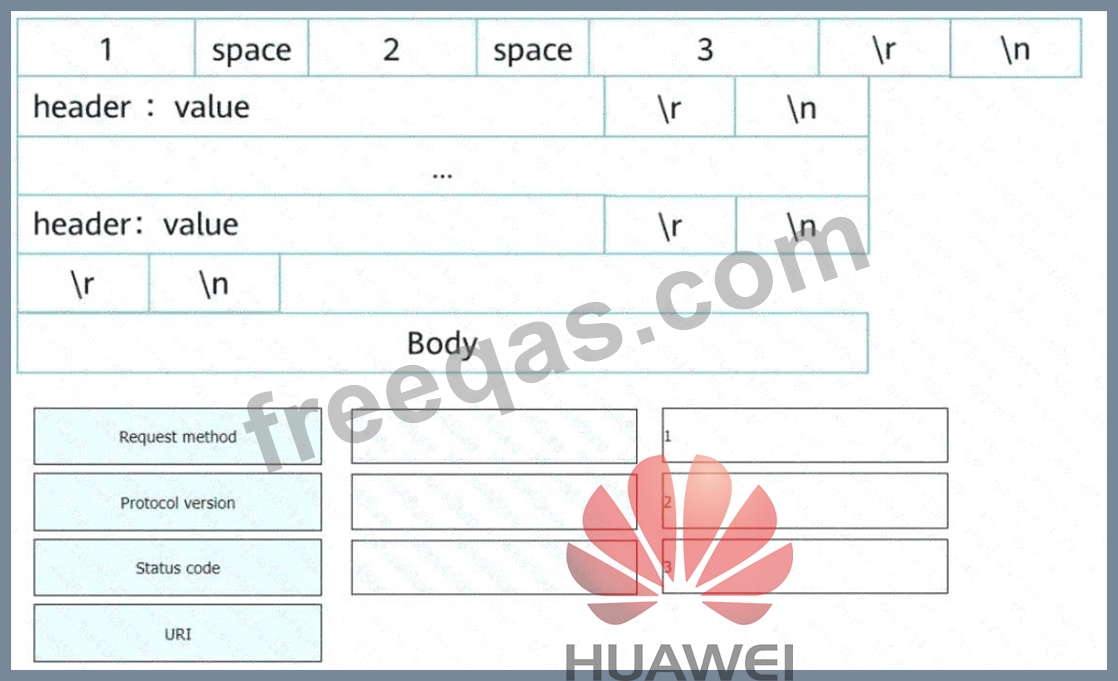
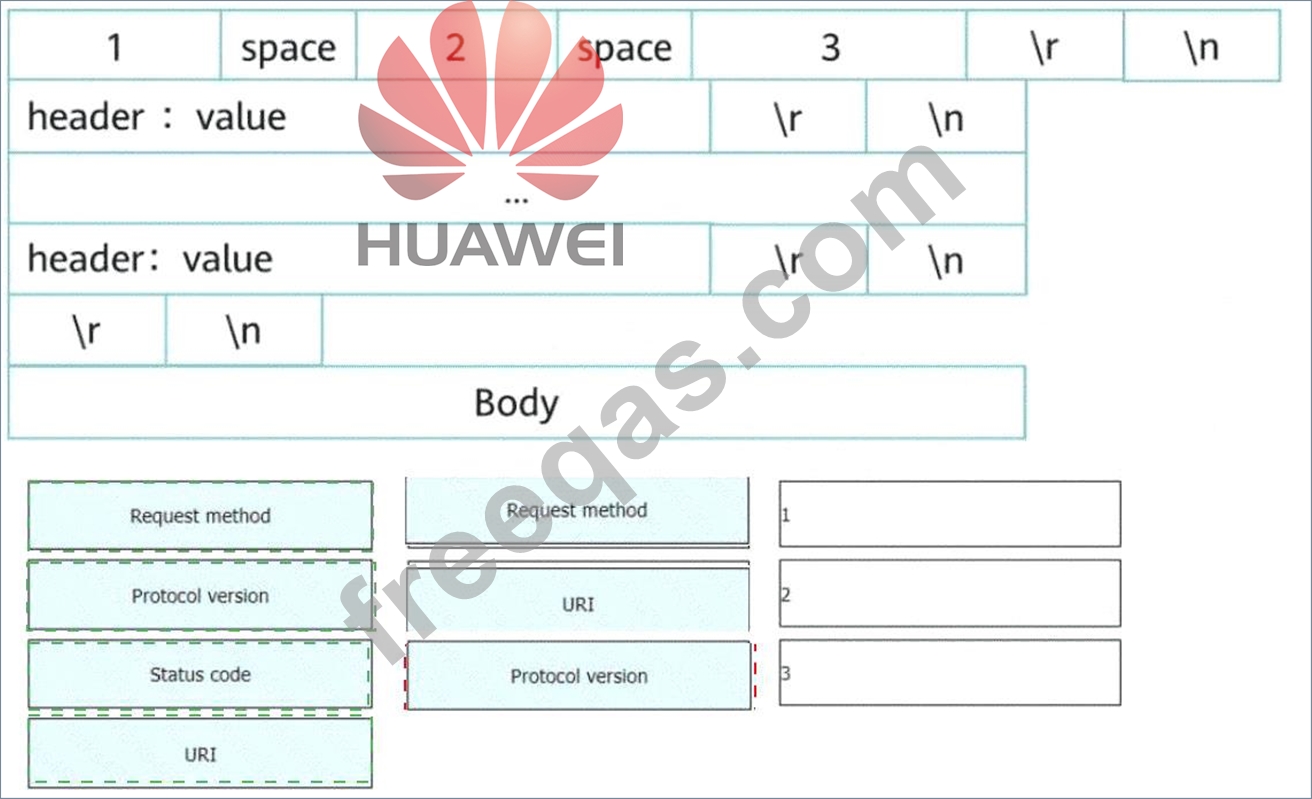
An HTTP request line consists of three fields. Select the fields to form a complete HTTP request message.
Correct Answer:

Explanation:
Correct Order for HTTP Request Line:
1. Request Method (e.g., GET, POST)
2. URI (Uniform Resource Identifier) (e.g., /index.html)
3. Protocol Version (e.g., HTTP/1.1)
Request Method
URI
Protocol Version
Comprehensive and Detailed Explanation:
Structure of an HTTP Request Message
An HTTP request message consists of:
1##Request Line # Specifies the request method, the target resource (URI), andthe HTTP version.
2##Headers # Provides additional request details (e.g., Host, User-Agent).
3##Body (optional) # Used in methods like POST for sending data.
Format of an HTTP Request Line:
GET /index.html HTTP/1.1
GET # Request method
/index.html # URI (resource being requested)
HTTP/1.1 # Protocol version
Why Other Fields Are Incorrect?
#Status Code # This belongs to an HTTP response, not a request.
#Mixing Headers into the Request Line # Headers should be placed separately after the request line.
insert code

Question 17

The following description of CBWFQ is correct?

Correct Answer: B
insert code

Question 18

In 0SPFv3 , Router-LSA is generated by each router, which describes the interface address and cost of each link of the router, and also includes the RouterlD of the neighbor router

Correct Answer: A
insert code

Question 19

Fill in Blank
On a VXLAN-based virtualized network, if the fabric networking mode is centralized gateway networking, the gateway is located on the _____ device. (Capitalize the first letter.)

Correct Answer:
SpineInVXLANcentralizedgatewaynetworking
Explanation:
SpineIn VXLAN centralized gateway networking, the default gateway (for both intra- and inter-subnet traffic) is placed on the Spine node, which acts as a centralized gateway device.This architecture simplifies routing and enables centralized control for inter-VNI routing. It is often contrasted with distributed gateway mode, where gateways reside on leaf nodes.Huawei Datacom Reference:"In centralized gateway mode, the spine node functions as the gateway and processes both inter-VNI routing and gateway services."(Source: HCIE-Datacom V1.0 Official Training - VXLAN & Fabric Networking Chapter, Section: VXLAN Gateway Deployment Modes)
insert code

Question 20

Which of the following statements about VXLAN principles is incorrect?

Correct Answer: B
Understanding VXLAN (Virtual eXtensible LAN) Technology
VXLAN is a Layer 2 over Layer 3 encapsulation protocol designed to extend Layer 2 domains across routed networks using MAC-in-UDP encapsulation.
# Key VXLAN Components:
* VTEP (VXLAN Tunnel Endpoints): These encapsulate and decapsulate VXLAN packets.
* Underlay Network: The routed IP network that forwards VXLAN packets (does not require VXLAN awareness).
* Overlay Network: The logical Layer 2 segments tunneled over VXLAN.
Analysis of the Answer Choices:
# A. VXLAN uses MAC-in-UDP encapsulation to encapsulate Ethernet packets into UDP packets and thereby extend Layer 2 networks.
* Correct: VXLAN uses MAC-in-UDP encapsulation, meaning that the original Ethernet frame is placed inside a UDP packet, allowing Layer 2 networks to extend over IP-based networks.
# B. When VXLAN is deployed, in addition to devices at both ends of a VXLAN tunnel, intermediate forwarding devices are also required to support VXLAN. Otherwise, VXLAN packets cannot be forwarded.
* Incorrect: VXLAN packets are forwarded as regular UDP traffic in the underlay network.
* Intermediate routers or switches DO NOT need to support VXLAN, as they only forward UDP packets based on the outer IP headers.
* Only VTEP devices must support VXLAN because they handle encapsulation/decapsulation.
# C. VXLAN packets are forwarded through routes on the underlay network, and the MAC address of the terminal in the inner data frame is not considered during underlay forwarding.
* Correct: The underlay network routes VXLAN packets using outer IP headers (VTEP IP addresses), not the inner MAC address.
# D. VXLAN can be deployed on campus networks to implement Layer 2 and Layer 3 communication.
* Correct: VXLAN is commonly used in campus networks to provide both Layer 2 bridging and Layer 3 routing across different locations.
Real-World Application:
* Data Center Networks: VXLAN is widely used for multi-tenant network segmentation in cloud environments.
* Enterprise Campus Networks: Enables seamless Layer 2 and Layer 3 connectivity across different buildings or locations.
# Reference: Huawei HCIE-Datacom Guide - VXLAN Deployment and Forwarding Principles
insert code
  • «
  • 1
  • 2
  • 3
  • 4
  • 5
  • 6
  • 7
  • 8
  • 9
  • 10
  • …
  • »
  • »»
[×]

Download PDF File

Enter your email address to download Huawei.H12-891_V1.0.v2026-06-05.q295 Dumps

Email:

FreeQAs

Our website provides the Largest and the most Latest vendors Certification Exam materials around the world.

Using dumps we provide to Pass the Exam, we has the Valid Dumps with passing guranteed just which you need.

  • DMCA
  • About
  • Contact Us
  • Privacy Policy
  • Terms & Conditions
©2026 FreeQAs

www.freeqas.com materials do not contain actual questions and answers from Cisco's certification exams.
