An accounting change requiring retrospective treatment is a change in:
Correct Answer: B
A change in depreciation methods is reported as a change in accounting policy. A voluntary change in accounting policy is applied retrospectively unless it is impracticable. Retrospective application means adjusting the opening balances of equity for the first period presented and restating other comparative amounts.
Question 7
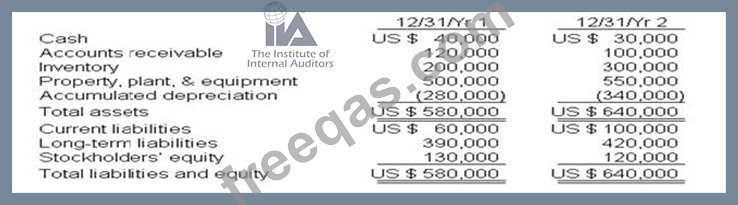
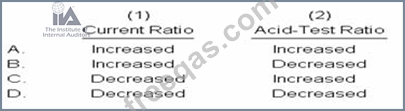
A condensed comparative balance sheet for an entity appears below: In looking at liquidity ratios at both balance sheet dates, what happened to the 1) current ratio and 2) acid-test (quick) ratio?
Correct Answer: D
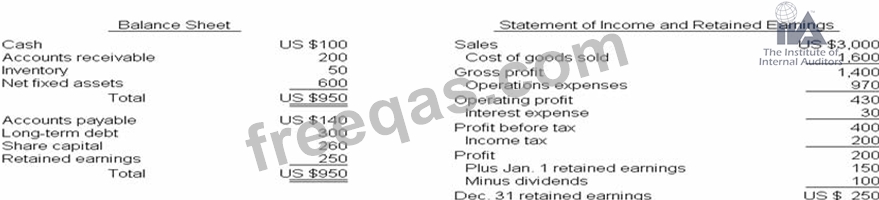
The current ratio is determined by dividing current assets by current liabilities. The acidtest ratio is determined by dividing quick assets by current liabilities. At December 31. Year 1. The current ratio is 6 to 1 [(US $40,000 + $120,000 + $200,000) - $60,01101. December 31. Year 2, the current ratio is 4.3 to 1 [(US $30,000 + $100,000 + $300,000) -$100,000]. Hence, there was a decrease in the current ratio. At December 31, Year 1, the acid-test ratio is 2.667 to 1 [(US $40,000 + $120,000) - $60.000]. At December 31, Year 2, the acid-test ratio is 1.3 to 1 [(US $3:0,000 + $100,000) - $100,000]. Thus, the acidtest ratio also declined. An entity's financial statements for the current year are presented below:
Question 8
An organization discovered fraudulent activity involving the employee time-tracking system. One employee regularly docked in and clocked out her co-worker friends on their days off, inflating their reported work hours and increasing their wages. Which of the following physical authentication devices would be most effective at disabling this fraudulent scheme?
Correct Answer: A
Question 9
Which of the following measures the operating success of a company for a given period of time?
Correct Answer: B
Profitability ratios measure a company's ability to generate profit over a specific period, making them the best indicators of operating success. These ratios assess financial performance by comparing income to various financial metrics such as revenue, assets, and equity. * Correct Answer (B - Profitability Ratios) * Profitability ratios reflect how effectively a company generates income from its operations over a given period. * Key profitability ratios include: * Gross Profit Margin: Measures how efficiently a company produces goods and services. * Operating Profit Margin: Shows profitability from core operations. * Net Profit Margin: Indicates the percentage of revenue converted into profit. * Return on Assets (ROA): Measures how efficiently assets generate earnings. * Return on Equity (ROE): Assesses how well equity investments generate returns. * The IIA Practice Guide: Auditing Financial Performance emphasizes profitability ratios in evaluating operational success. * Why Other Options Are Incorrect: * Option A (Liquidity Ratios): * Liquidity ratios measure a company's ability to meet short-term obligations rather than its operating success. * Examples: Current Ratio, Quick Ratio. * IIA GTAG 13: Business Performance emphasizes that liquidity ratios relate to short-term financial health, not operating success. * Option C (Solvency Ratios): * Solvency ratios evaluate a company's ability to meet long-term financial obligations, not operating performance. * Examples: Debt-to-Equity Ratio, Interest Coverage Ratio. * Option D (Current Ratio): * The current ratio is a liquidity ratio, measuring whether a company can meet its short- term liabilities with current assets. * It does not directly assess profitability or operational success. * IIA Practice Guide: Auditing Financial Performance - Covers the role of profitability ratios in evaluating a company's success. * IIA GTAG 13: Business Performance - Discusses financial analysis, including profitability, liquidity, and solvency metrics. Step-by-Step Explanation:IIA References for Validation:Thus, profitability ratios (B) are the best measures of a company's operating success over a period.
Question 10
Which of the following is an example of a contingent liability?
Correct Answer: D
This is a guarantee. The liability is contingent on the lesser's not receiving the full residual value from a third party.