FreeQAs
 Request Exam  Contact
  • Home
  • View All Exams
  • New QA's
  • Upload
PRACTICE EXAMS:
  • Oracle
  • Fortinet
  • Juniper
  • Microsoft
  • Cisco
  • Citrix
  • CompTIA
  • VMware
  • SAP
  • EMC
  • PMI
  • HP
  • Salesforce
  • Other
  • Oracle
    Oracle
  • Fortinet
    Fortinet
  • Juniper
    Juniper
  • Microsoft
    Microsoft
  • Cisco
    Cisco
  • Citrix
    Citrix
  • CompTIA
    CompTIA
  • VMware
    VMware
  • SAP
    SAP
  • EMC
    EMC
  • PMI
    PMI
  • HP
    HP
  • Salesforce
    Salesforce
  1. Home
  2. IIA Certification
  3. IIA-CIA-Part3 Exam
  4. IIA.IIA-CIA-Part3.v2026-01-13.q113 Dumps
  • ««
  • «
  • …
  • 3
  • 4
  • 5
  • 6
  • 7
  • 8
  • 9
  • 10
  • 11
  • 12
  • …
  • »
  • »»
Download Now

Question 31

Which of the following can be classified as debt investments?

Correct Answer: B
Debt investments refer to financial instruments where an investor lends money to an entity (corporation, government, or institution) in exchange for periodic interest payments and the repayment of the principal amount at maturity. These include:
* Government bonds (such as U.S. Treasury bonds, municipal bonds, and sovereign bonds)
* Corporate bonds
* Certificates of deposit (CDs)
* Commercial paper
* A. Investments in the capital stock of a corporation # Incorrect. Capital stock represents ownership (equity investments), not debt investments.
* C. Contents of an investment portfolio # Incorrect. A portfolio may contain both equity and debt investments, making this too broad to classify specifically as debt.
* D. Acquisition of common stock of a corporation # Incorrect. Common stock is an equity investment, not a debt investment.
* The IIA's Global Internal Audit Standards on Investment Management and Risk Assessment highlight debt instruments as fixed-income securities.
* International Financial Reporting Standards (IFRS 9 - Financial Instruments) classify bonds and loans as debt investments, distinct from equity instruments.
* The Generally Accepted Accounting Principles (GAAP) - FASB ASC 320 specifies how to account for debt securities.
Explanation of the Other Options:IIA References & Best Practices:Thus, the correct answer is B. Acquisition of government bonds.
insert code

Question 32

Which of the following assessments will assist in evaluating whether the internal audit function is consistently delivering quality engagements?

Correct Answer: B
The QAIP (Quality Assurance and Improvement Program) requires both ongoing monitoring and periodic assessments. Among these, ongoing monitoring is the mechanism that ensures continuous evaluation of whether engagements are being performed with quality and in conformance with the Standards.
Option A (periodic assessments) review effectiveness but are not continuous. Option C (external assessments) and Option D (SAIV) are broader and periodic, not engagement-level consistency checks.
Reference:
IIA Standards - Standard 1311: Internal Assessments.
insert code

Question 33

On December 31, Year 1, Health entities reported a US $150,000 warranty expense in its income statement. The expense was based on actual warranty cost of US$30,000 in Year 1 and expected warrant costs of US $35,000 in Year 2, US $40,000 in Year 3, and US $45,000 in Year 4. For tax purposes, warrant costs are not deductible until paid. At December 31, Year 1, deferred taxes should be based on a:

Correct Answer: A
At year-end year 1, Health entities should report a US $120,000 warranty liability in its balance sheet. The warranty liability is equal to the US $150,000 warranty expense minus the US $30,000 warrant cost actually incurred in Year 1. Because warranty costs are not deductible until paid, the tax base of the warranty liability is 0. The result is a US $120,000 temporary difference US$120,000 carrying amount tax base). When the liability is settled through the actually incurrence of warranty costs, the amounts will be deductible. Thus, the temporary difference should be classified as a deductible temporary difference.
insert code

Question 34

In Year 2, a manufacturing company instituted a total quality management (TQM) program producing the following report:
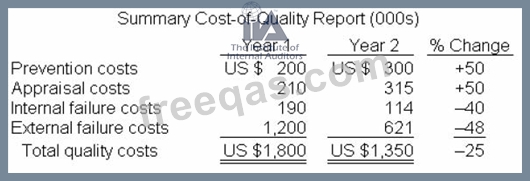
On the basis of this report, which one of the following statements is most likely true?

Correct Answer: A
Answer (A) is correct. Prevention and appraisal costs increased substantially, but internal and external failure costs decreased. Thus, the soundest conclusion is that the increase in prevention and appraisal costs resulted in a higher-quality product.
insert code

Question 35

Of the following, the greatest advantage of a database server) architecture is:

Correct Answer: A
Data organized in files and used by the organization's various applications programs are collectively known as a database. In a database system, storage structures are created that render the applications programs independent of the physical or logical arrangement of the data. Each data item has a standard definition, name, and format, and related items are linked by a system of pointers. The programs therefore need only to specify data items by name, not by location. A database management system handles retrieval and storage. Because separate files for different applications programs are unnecessary, data redundancy can be substantially reduced.
insert code
  • ««
  • «
  • …
  • 3
  • 4
  • 5
  • 6
  • 7
  • 8
  • 9
  • 10
  • 11
  • 12
  • …
  • »
  • »»
[×]

Download PDF File

Enter your email address to download IIA.IIA-CIA-Part3.v2026-01-13.q113 Dumps

Email:

FreeQAs

Our website provides the Largest and the most Latest vendors Certification Exam materials around the world.

Using dumps we provide to Pass the Exam, we has the Valid Dumps with passing guranteed just which you need.

  • DMCA
  • About
  • Contact Us
  • Privacy Policy
  • Terms & Conditions
©2026 FreeQAs

www.freeqas.com materials do not contain actual questions and answers from Cisco's certification exams.
