An insurance company wants to increase sales by 15% and customer retention by 10% within 1 calendar year.
Various strategies to achieve this were considered and a restructure to the existing pricing model is selected to help achieve these goals.
A business analyst (BA) works with stakeholders such as actuaries, product specialists, sales staff, risk managers, and underwriters who agree to applying varying levels of discounts to customers based on:
*Total annual premium the customer has with the company (Financial worth)
*Time with the insurance company (Loyalty)
Various financial models are considered but the stakeholders agree that an initial applicable discount is determined based on the customer's overall premium: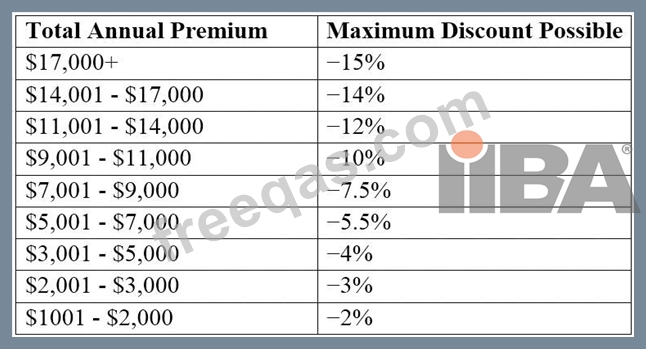
The percentage of the maximum possible discount available to the customer is adjusted based on time with the company:
Which technique would the BA use to validate the desired outcomes?
Which of the following can be an effective tool during quality control to help determine the how the problem occurred?
An insurance company wants to increase sales by 15% and customer retention by 10% within 1 calendar year.
Various strategies to achieve this were considered and a restructure to the existing pricing model is selected to help achieve these goals.
A business analyst (BA) works with stakeholders such as actuaries, product specialists, sales staff, risk managers, and underwriters who agree to applying varying levels of discounts to customers based on:
*Total annual premium the customer has with the company (Financial worth)
*Time with the insurance company (Loyalty)
Various financial models are considered but the stakeholders agree that an initial applicable discount is determined based on the customer's overall premium: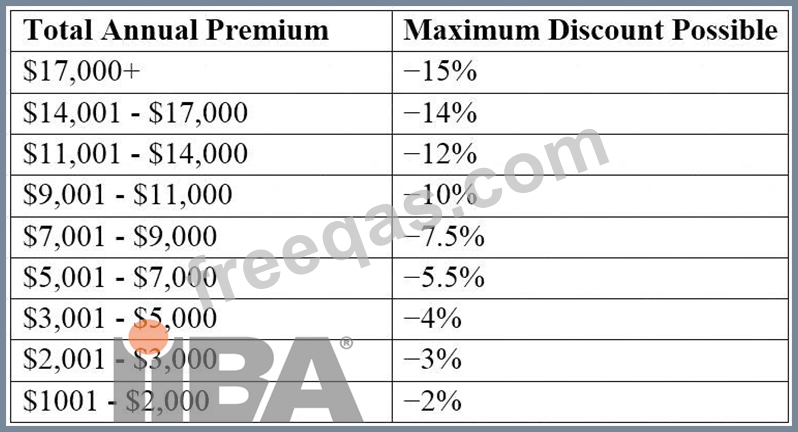
The percentage of the maximum possible discount available to the customer is adjusted based on time with the company:
If within the first six months, customer retention increased by 5 % and sales increased by 6%, then when will the desired sales and retention goals be achieved assuming the trend continues at the same pace?
A business unit of a transnational manufacturer wants to implement a robust process for addressing integrity- critical equipment deterioration incidents. Timely and complete resolution of such incidents is vital for the business unit's continuous safe and profitable operation. Treating each incident involves many employees from different departments extensively collaborating and exchanging information. That information is spread across multiple systems having their access limited to particular user groups. With the current manual process, some incidents get forgotten and remain unresolved for years.
The project's Sponsor is an Equipment Integrity and Reliability Advisor, who moved into this position from another business unit. That business unit implemented a proprietary application to integrate the information and to assist in tracking and managing the incidents. Having a positive experience with the application, the Sponsor is suggesting to customize it and reuse in the new business unit.
The business unit's Enterprise Architect (EA), who is responsible for assessing solution options and presenting them to executive decision makers, has a few concerns with adopting the existing application. The application uses point-to-point interfaces with other data sources whereas the business unit's target architecture relies on a data warehouse-based integration. Moreover, the two business units use different legacy systems, as well as different front-end implementation technologies. Additionally, the existing application is monolingual, while the business unit needs user interfaces and some data to be presented in two languages. With all of this, it may be easier to build a new application from scratch than to customize the existing one. To understand which option is better, the EA asks a business analyst (BA) to define business requirements.
The EA wants to understand whether the integration capabilities of the existing solution match the business unit's IT landscape. The requirement definition that the EA needs should read as, "Each record of an incident shall __________."
Which of the following types of elicitation allows each stakeholder to freely discuss their role in a particular process?

