FreeQAs
 Request Exam  Contact
  • Home
  • View All Exams
  • New QA's
  • Upload
PRACTICE EXAMS:
  • Oracle
  • Fortinet
  • IBM
  • Juniper
  • Microsoft
  • Cisco
  • Citrix
  • CompTIA
  • VMware
  • ISC
  • SAP
  • EMC
  • PMI
  • HP
  • Salesforce
  • Other
  • Oracle
    Oracle
  • Fortinet
    Fortinet
  • IBM
    IBM
  • Juniper
    Juniper
  • Microsoft
    Microsoft
  • Cisco
    Cisco
  • Citrix
    Citrix
  • CompTIA
    CompTIA
  • VMware
    VMware
  • ISC
    ISC
  • SAP
    SAP
  • EMC
    EMC
  • PMI
    PMI
  • HP
    HP
  • Salesforce
    Salesforce
  1. Home
  2. IIBA Certification
  3. CBAP Exam
  4. IIBA.CBAP.v2024-01-19.q463 Dumps
  • ««
  • «
  • …
  • 13
  • 14
  • 15
  • 16
  • 17
  • 18
  • 19
  • 20
  • 21
  • 22
  • …
  • »
  • »»
Download Now

Question 83

You are the business analyst for your organization. As part of the requirements prioritization you have given each key stakeholder $10,000 in play money to distribute among the identified requirements. Each stakeholder can assign their play money to any of the requirements, but the requirements will be prioritized based on the value of the play money assigned to each requirement. What type of requirements prioritization is happening in this scenario?

Correct Answer: D
insert code

Question 84

What is the purpose of the business case?

Correct Answer: A
Explanation
A business case is a document that provides justification for undertaking a project, programme or portfolio. It evaluates the benefit, cost and risk of alternative options and provides a rationale for the preferred solution.
The purpose of the business case is to communicate the value of the solution to the organization and help the decision-makers decide whether to approve the project or not. The business case should include the following elements:
Executive summary: A brief overview of the problem, opportunity, solution, benefits, costs, risks and recommendations.
Introduction: A description of the background, context, scope and objectives of the project.
Analysis: A detailed analysis of the current state, future state, gap, options, criteria, assumptions and constraints.
Evaluation: A comparison of the options based on the criteria, such as financial, strategic, operational, technical, social and environmental factors.
Recommendation: A clear statement of the preferred option and the reasons for choosing it over the others.
Implementation: A description of the implementation plan, including the schedule, resources, roles, responsibilities, governance, change management and risk management.
Appendices: Any supporting information, such as data, calculations, charts, diagrams, references, etc.
References:
Business Analysis Body of Knowledge (BABOK) Guide, Version 3, Chapter 3: Business Analysis Planning and Monitoring, Section 3.4: Plan Business Analysis Approach, Task 3.4.3: Define Business Analysis Process, Technique 3.4.3.1: Decision Analysis, p. 66-67.
What is business case? | APM
How to Write a Business Case: Template & Examples | Adobe Workfront
insert code

Question 85

Which of the following types of elicitation allows each stakeholder to freely discuss their role in a particular process?

Correct Answer: A
insert code

Question 86

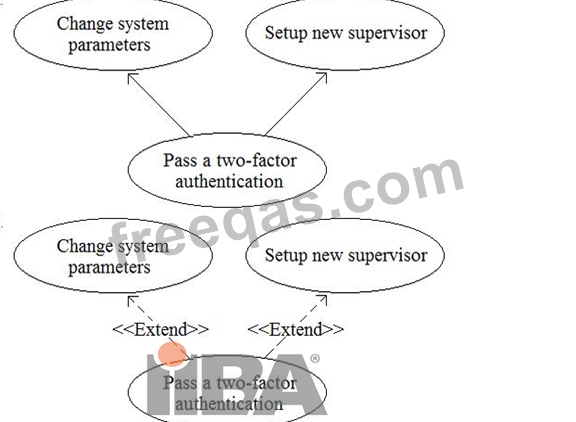
A business analyst (BA) is working on a payment system (PS) implementation. A set of systems which should interact with a new system has been identified. The business analyst defined that a user with role of "Supervisor" in the PS must pass a two-factor authentication before an execution of the functions: "Change system parameters" and "Set up new supervisor." A user must have the role of "Supervisor" to use the standard functions "Send mail notification" or "Send SMS notification".
The BA defined the following use cases:
* "Change system parameters"
* "Setup new supervisor"
* "Send mail notification"
* "Send SMS notification"
* "Send notification"
* "Pass a two-factor authentication"
The BA wants to create a Use Case diagram.
What standard relationship should be defined between "Change system parameters", "Setup new supervisor" and "Pass a two-factor authentication"?
Correct Answer: B
insert code

Question 87

The stakeholders are interested in ensuring that expected value is assessed prior to acceptance. To determine if the solution is providing expected value and ensure the accuracy of the measurements, the stakeholders and the business analyst (BA) determine that they need to measure:


Correct Answer: A
Explanation/Reference: https://vancouver.iiba.org/sites/vancouver/files/archive/Media/Downloads/CBAP-CCBA%20Study%
20Group%202017/Session%207_Chapter%208-solution-evaluatio.pdf
insert code
  • ««
  • «
  • …
  • 13
  • 14
  • 15
  • 16
  • 17
  • 18
  • 19
  • 20
  • 21
  • 22
  • …
  • »
  • »»
[×]

Download PDF File

Enter your email address to download IIBA.CBAP.v2024-01-19.q463 Dumps

Email:

FreeQAs

Our website provides the Largest and the most Latest vendors Certification Exam materials around the world.

Using dumps we provide to Pass the Exam, we has the Valid Dumps with passing guranteed just which you need.

  • DMCA
  • About
  • Contact Us
  • Privacy Policy
  • Terms & Conditions
©2026 FreeQAs

www.freeqas.com materials do not contain actual questions and answers from Cisco's certification exams.