Assessing the probability and consequences of identified risks to the project objectives, assigning a risk score to each risk, and creating a list of prioritized risks describes which of the following processes?
Correct Answer: A
Explanation/Reference: Explanation: The purpose of qualitative risk analysis is to determine what impact the identified risk events will have on the project and the probability they'll occur. It also puts risks in priority order according to their effects on the project objectives and assigns a risk score for the project. Incorrect Answers: B: Risk Management is used to identify, assess, and control risks. It includes analyzing the value of assets to the business, identifying threats to those assets, and evaluating how vulnerable each asset is to those threats. Assessing the probability and consequences of identified risks is only the part of risk management. C: It involves listing of all the possible risks so as to cure them before it can occur. In risk identification both threats and opportunities are considered, as both carry some level of risk with them. D: This process does not involve assessing the probability and consequences of identified risks. Quantitative analysis is the use of numerical and statistical techniques rather than the analysis of verbal material for analyzing risks. Some of the quantitative methods of risk analysis are: Internal loss method External data analysis Business process modeling (BPM) and simulation Statistical process control (SPC)
Question 72
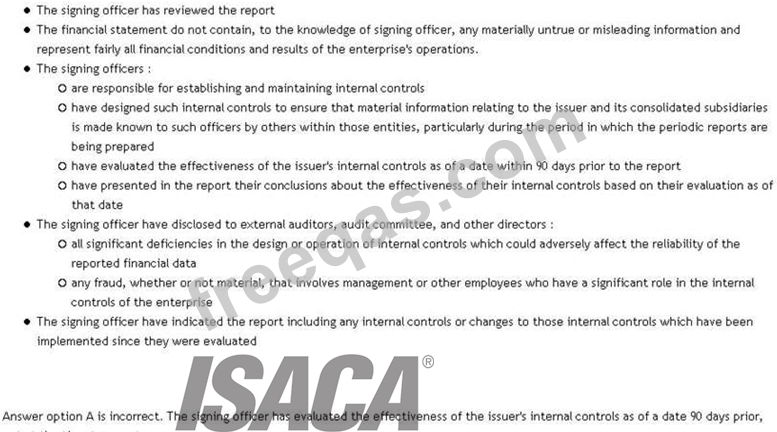
According to the Section-302 of the Sarbanes-Oxley Act of 2002, what does certification of reports implies? Each correct answer represents a complete solution. Choose three.
Correct Answer: B,C,D
Section 302 of Sarbanes-Oxley act has the tremendous impact on the risk management solution adopted by corporations. This section specifies that the reports must be certified by the CEO, CFO, or other senior officer performing similar functions. Certification of reports establishes:
Question 73
When updating a risk register with the results of an IT risk assessment, the risk practitioner should log:
Correct Answer: C
Question 74
When evaluating enterprise IT risk management it is MOST important to:
Correct Answer: D
Question 75
Which of the following is the MOST important characteristic of an effective risk management program?