FreeQAs
 Request Exam  Contact
  • Home
  • View All Exams
  • New QA's
  • Upload
PRACTICE EXAMS:
  • Oracle
  • Fortinet
  • IBM
  • Juniper
  • Microsoft
  • Cisco
  • Citrix
  • CompTIA
  • VMware
  • ISC
  • SAP
  • EMC
  • PMI
  • HP
  • Salesforce
  • Other
  • Oracle
    Oracle
  • Fortinet
    Fortinet
  • IBM
    IBM
  • Juniper
    Juniper
  • Microsoft
    Microsoft
  • Cisco
    Cisco
  • Citrix
    Citrix
  • CompTIA
    CompTIA
  • VMware
    VMware
  • ISC
    ISC
  • SAP
    SAP
  • EMC
    EMC
  • PMI
    PMI
  • HP
    HP
  • Salesforce
    Salesforce
  1. Home
  2. ISQI Certification
  3. CTAL-TM-001 Exam
  4. ISQI.CTAL-TM-001.v2025-10-23.q104 Dumps
  • «
  • 1
  • 2
  • 3
  • 4
  • 5
  • 6
  • 7
  • 8
  • 9
  • 10
  • …
  • »
  • »»
Download Now

Question 6

SCENARIO 1
DreamPartner dating agency are redesigning their dating application following a major security breach in which sensitive customer data was made publically available. The redesign includes stronger security encryption and performance tuning.
The product risk register for the redesign project, which was produced after all requirements had been agreed, includes the following:

The organisational Test Strategy contains the following objectives:
1. A Risk-based lest approach must be adopted for all projects
2. Functional regression testing should start as soon as functional testing is complete
3. Automated tests may be run before or in parallel with manual tests
The project Test Plan has allocated 6 weeks to complete all test execution, with functional testing taking 3 weeks to execute, performance and security testing 2 weeks each and regression testing 1 week.
Which of the following options places the test suites (TS1 to TS5) in the correct order for test execution?
SELECT ONE OPTION

Correct Answer: D
insert code

Question 7

When scheduling performance testing, which of the following approaches would be most advisable? [1]

Correct Answer: A
Performance testing is the process of determining the speed, responsiveness, and stability of a system under a given workload1. Performance testing should be started as early aspossible in the software development lifecycle, preferably during unit and integration testing, to identify and resolve performance issues before they become costly or risky2. Starting performance testing early can also help to validate the performance requirements, design, and architecture of the system, as well as to optimize the performance testing strategy and scope3. Therefore, option A is the correct answer. Option B is incorrect because deferring the start of performance testing until all functional defects have been resolved can delay the detection and resolution of performance issues, increase the cost and effort of performance testing, and reduce the confidence and quality of the system4. Option C is incorrect because leveraging end users to do unit-level performance testing and automated tools for system-level performance testing can introduce inconsistency, bias, and inefficiency in the performance testing process, as well as compromise the reliability and validity of the performance test results. Option D is incorrect because requiring all performance tests to pass before starting functional testing can create unrealistic or unnecessary expectations, as well as hinder the progress and feedback of the functional testing activities. References: 1: ISTQB Glossary, Performance Testing 2: ISTQB Certified Tester
- Performance Testing (CT-PT)3 3: ISTQB Performance Testing - TesterYou4 4: Performance Testing - ISTQB not-for-profit association : ISTQB - PERFORMANCE TESTING : Performance Testing - ISTQB not-for-profit association
insert code

Question 8

Test results are reported as "Requirements tested, passed, and failed".
What test strategy are you using? [1]

Correct Answer: C
An analytical test strategy is a test strategy that is based on the analysis of the factors that affect the quality of the software under test, such as the requirements, the risks, the complexity, or the criticality1. An analytical test strategy uses these factors to define the test objectives, scope, approach, and techniques, as well as to prioritize and allocate the test resources2. Reporting the test results as "Requirements tested, passed, and failed" implies that the testing is driven by the requirements, which are the specifications of the desired features and functions of the software under test. Testing based on the requirements is an example of an analytical test strategy, as it uses the requirements as the main factor to guide the testing activities. Therefore, option C is the correct answer. Option A is incorrect because a model-based test strategy is a test strategy that uses models to represent the desired behavior and structure of the software under test, and to derive test cases, test data, test procedures, and test oracles. A model-based test strategy does not necessarily report the test results as "Requirements tested, passed, and failed", as it may use other types of models, such as state diagrams, data flow diagrams, or decision tables, to generate and execute the tests. Option B is incorrect because an exploratory test strategy is a test strategy that uses the tester's knowledge, skills, and creativity to design and execute tests dynamically, without predefined test cases or test procedures. An exploratory test strategy does not report the test results as "Requirements tested, passed, and failed", as it does not follow a formal or structured testing process, but rather relies on the tester's intuition, experience, and feedback. Option D is incorrect because a reactive test strategy is a test strategy that uses the actual behavior and results of the software under test to design and execute tests, without prior knowledge or documentation of the software. A reactive test strategy does not report the test results as "Requirements tested, passed, and failed", as it does not have any requirements or specifications to compare the software against, but rather uses the software itself as the test basis. Reference: 1: ISTQB Glossary, Analytical Test Strategy 2: ISTQB Advanced Level Test Manager Syllabus, Section 1.1.1 : ISTQB Glossary, Requirement : ISTQB Advanced Level Test Manager Syllabus, Section 1.1.1 : ISTQB Glossary, Model-Based Testing : ISTQB Advanced Level Test Manager Syllabus, Section 1.1.1 : ISTQB Glossary, Exploratory Testing : ISTQB Advanced Level Test Manager Syllabus, Section 1.1.1 : ISTQB Glossary, Reactive Test Strategy : ISTQB Advanced Level Test Manager Syllabus, Section 1.1.1 : Test Strategy | ISTQB Glossary : Test Strategy - ISTQB not-for-profit association
insert code

Question 9

You have recently implemented a new defect management process which now includes a defect triage committee whose job is to review all new defects. The process is shown in the following diagram:
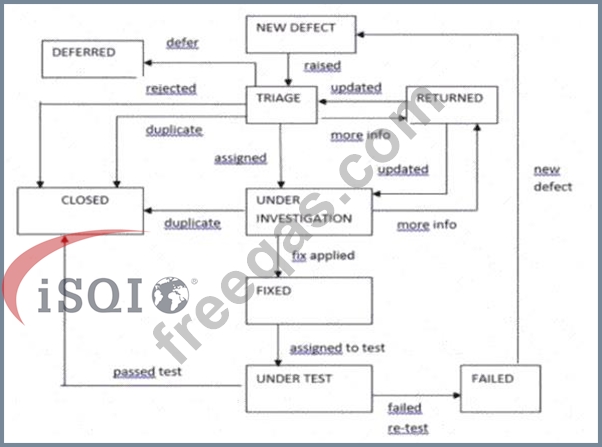
b. The total number of defects rejected as not a problem following investigation by the product author c. The number of defects returned to the defect author, expressed as a percentage of all defects raised d. The total number of defects that failed re-test more than once e. The total number of defects closed by the defect triage committee SELECT ONE OPTION

Correct Answer: A
insert code

Question 10

A tester has just completed a challenging assignment as the sole tester in an agile development team and is now being reassigned. Which of the following is most likely to DEMOTIVATE this tester?
SELECT ONE OPTION


Correct Answer: B
insert code
  • «
  • 1
  • 2
  • 3
  • 4
  • 5
  • 6
  • 7
  • 8
  • 9
  • 10
  • …
  • »
  • »»
[×]

Download PDF File

Enter your email address to download ISQI.CTAL-TM-001.v2025-10-23.q104 Dumps

Email:

FreeQAs

Our website provides the Largest and the most Latest vendors Certification Exam materials around the world.

Using dumps we provide to Pass the Exam, we has the Valid Dumps with passing guranteed just which you need.

  • DMCA
  • About
  • Contact Us
  • Privacy Policy
  • Terms & Conditions
©2026 FreeQAs

www.freeqas.com materials do not contain actual questions and answers from Cisco's certification exams.