You have just joined a medium-sized company as a senior Test Manager. You would like to take a more proactive approach to process improvement than this company has done in the past. The company uses the V-model as its software development lifecycle. The list below shows five items that are not currently captured on defect reports from dynamic testing. Which TWO of these items will be MOST useful for identifying potential test process improvements?
Correct Answer: B,E
* B (Type from taxonomy): Helps identify defect patterns (e.g., design vs. coding errors) for process targeting. * E (Lifecycle activity): Knowing when a defect was introduced enables root cause analysis and preventive actions. "Defect classification and root cause analysis provide input to process improvement by identifying where and why defects are introduced." -ISTQB CTFL Syllabus 2018, Section 5.6 These two attributes are directly aligned with structured test process improvement efforts.
Question 7
In general, why is it NOT a good idea to estimate the testing effort based only on a percentage of development effort? Identify THREE valid reasons. 1 credit
Correct Answer: A,D,E
Explanation/Reference: Explanation:
Question 8
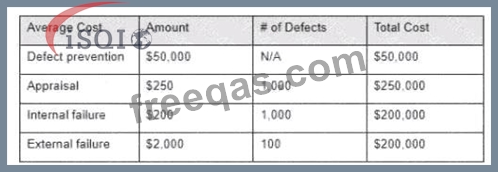
You have assembled the following cost of quality numbers 1 000 defects were found prior to release and 100 were found after. Given this information what should you conclude?
Correct Answer: B
* Cost of Quality Analysis: * The given table lists costs for defect prevention, appraisal, internal failure, and external failure. * Defect prevention cost is $50,000, while costs for appraisal, internal failures, and external failures are $250,000, $200,000, and $200,000, respectively. * The combined cost of internal and external failures is significantly high compared to defect prevention costs. * Defect Detection and Prevention (DDP): * DDP measures the effectiveness of defect prevention activities and early detection mechanisms. * In this case, 1,000 defects were caught before release (appraisal) and 100 defects escaped to production. * DDP = (Defects found before release / Total defects) = 1000 / (1000 + 100) = 90.91%. * While this DDP is relatively high, the costs of appraisal and failures indicate that prevention strategies need more investment. * Key Cost Drivers: * High internal and external failure costs indicate inefficiencies in earlier stages of quality assurance. * Shifting investments from appraisal and failure costs towards defect prevention would reduce the overall cost of quality. * Evaluating Options: * Option A ("More testing needed because DDP < 90%") is invalid since DDP is above 90%. * Option C ("The cost of testing is justified") does not address the imbalance between high failure costs and low prevention spending. * Option D ("More effort on appraisal") contradicts the cost-benefit focus of investing in prevention. * Option B is correct because enhancing defect prevention strategies will reduce downstream costs. References and Syllabus Alignment: * This conclusion aligns with the ISTQB Advanced Test Management syllabus section on "Cost of Quality" and strategies to optimize testing investments. Specifically, prevention is emphasized as more cost-effective than appraisal and failure management.
Question 9
Which of the following statements is true regarding documentation standards?
Correct Answer: B
Documentation standards are not uniform across all test levels; they can differ based on the specific requirements of each level. For instance, unit testing may have different documentation needs compared to system testing. The ISTQB documentation standards recognize this variability and allow for flexibility to suit the context of the test level. This ensures that the documentation is appropriate for the objectives and constraints of each test level, providing clarity and efficiency in the testing process. References: The ISTQB Advanced Level Test Manager syllabus and the ISTQB Glossary provide detailed information on documentation standards and their application across different test levels. These resources are essential for understanding the principles and practices of effective test documentation in various testing scenarios.
Question 10
The Test Manager must assemble team members that have which of the following characteristics? [1]
Correct Answer: C
A test manager must assemble team members that will spark informal cross training among themselves. This means that the team members are willing and able to share their knowledge, skills, and experiences with each other, and learn from each other's feedback and suggestions. This can improve the team's performance, productivity, and quality, as well as foster a collaborative and supportive culture. Cross training can also help the team members to develop new competencies, fill skill gaps, and handle different roles and tasks when needed. Top 10 Leadership Qualities to Distinguish a Test ManagerTest manager roles and responsibilities (with FAQs) References: * Top 10 Leadership Qualities to Distinguish a Test Manager - Software Test Professionals * Test manager roles and responsibilities (with FAQs) - Indeed