FreeQAs
 Request Exam  Contact
  • Home
  • View All Exams
  • New QA's
  • Upload
PRACTICE EXAMS:
  • Oracle
  • Fortinet
  • Juniper
  • Microsoft
  • Cisco
  • Citrix
  • CompTIA
  • VMware
  • SAP
  • EMC
  • PMI
  • HP
  • Salesforce
  • Other
  • Oracle
    Oracle
  • Fortinet
    Fortinet
  • Juniper
    Juniper
  • Microsoft
    Microsoft
  • Cisco
    Cisco
  • Citrix
    Citrix
  • CompTIA
    CompTIA
  • VMware
    VMware
  • SAP
    SAP
  • EMC
    EMC
  • PMI
    PMI
  • HP
    HP
  • Salesforce
    Salesforce
  1. Home
  2. ISQI Certification
  3. CTFL_Syll_4.0 Exam
  4. ISQI.CTFL_Syll_4.0.v2025-10-06.q124 Dumps
  • «
  • 1
  • 2
  • 3
  • 4
  • 5
  • 6
  • 7
  • 8
  • 9
  • 10
  • …
  • »
  • »»
Download Now

Question 21

A company wants to reward each of its salespeople with an annual bonus that represents the sum of all the bonuses accumulated for every single sale made by that salesperson. The bonus for a single sale can take on the following four values: 3%, 5%, 7% and 10% (the percentage refers to the amount of the single sale). These values are determined on the basis of the type of customer (classified as "Basic" or "Premium") to which such sale was made, and on the amount of such sale classified into the following three groups G1, G2 and G3:
* [G1]: less than 300 euros
* [G2]: between 300 and 2000 euros
* [G3]: greater than 2000 euros
Which of the following is the minimum number of test cases needed to cover the full decision table associated with this scenario?

Correct Answer: B
The minimum number of test cases needed to cover the full decision table associated with this scenario is 6. This is because the decision table has 4 conditions (type of customer and amount of sale) and 4 actions (bonus percentage). The conditions have 2 possible values each (Basic or Premium, and G1, G2 or G3), so the total number of combinations is 2 x 2 x 2 x 2 = 16. However, not all combinations are valid, as some of them are contradictory or impossible. For example, a sale cannot be both less than 300 euros and greater than 2000 euros at the same time. Therefore, we need to eliminate the invalid combinations and keep only the valid ones. The valid combinations are:
Type of customer
Amount of sale
Bonus percentage
Basic
G1
3%
Basic
G2
5%
Basic
G3
7%
Premium
G1
5%
Premium
G2
7%
Premium
G3
10%
These 6 combinations cover all the possible values of the conditions and actions, and they are the minimum number of test cases needed to cover the full decision table.
insert code

Question 22

Which of the following s the most correct statement about state testing techniques?

Correct Answer: A
State testing techniques are a type of dynamic testing techniques that are based on the behavior of the system under test for different input conditions and events. Dynamic testing techniques require the system to be executed with test cases, whereas static testing techniques do not. Static testing techniques can be applied before the code is ready for execution, such as reviews, inspections, walkthroughs, and static analysis. Static testing techniques can help find defects early in the development process, improve the quality of the code, and reduce the cost and effort of dynamic testing. Reference = ISTQB Certified Tester Foundation Level (CTFL) v4.0 Syllabus, Chapter 4, Section 4.2.1, Page 281; ISTQB Glossary of Testing Terms v4.0, Page 292
insert code

Question 23

Which ONE of the following options CANNOT be subjected to static analysis?

Correct Answer: A
Static analysis requires access towork products like source code, models, or documentation, making it impossible to analyze Commercial off-the-shelf (COTS) software(A) because its source code is typically unavailable. Static analysis is applicable to source code (B), BPMN models (C), and UML diagrams (D).
Reference:ISTQB CTFL v4.0 Syllabus, Section 3.1.1 - Static Analysis
insert code

Question 24

Which of the following lists factors That contribute to PROJECT risks?

Correct Answer: A
Project risks are the uncertainties or threats that may affect the project objectives, such as scope, schedule, cost, and quality. According to the ISTQB Certified Tester Foundation Level (CTFL) v4.0 syllabus, some of the factors that contribute to project risks are:
* Skill and staff shortages: This factor refers to the lack of adequate or qualified human resources to perform the project tasks. This may result in delays, errors, rework, or low productivity.
* Problems in defining the right requirements: This factor refers to the difficulties or ambiguities in eliciting, analyzing, specifying, validating, or managing the requirements of the project. This may result in misalignment, inconsistencies, gaps, or changes in the requirements, affecting the project scope and quality.
* Contractual issues: This factor refers to the challenges or disputes that may arise from the contractual agreements between the project parties, such as clients, suppliers, vendors, or subcontractors. This may result in legal, financial, or ethical risks, affecting the project delivery and satisfaction.
The other options are not correct because they list factors that contribute to PRODUCT risks, not project risks. Product risks are the uncertainties or threats that may affect the quality or functionality of the software product or system. Some of the factors that contribute to product risks are:
* Poor software quality characteristics: This factor refers to the lack of adherence or compliance to the quality attributes or criteria of the software product or system, such as reliability, usability, security, performance, or maintainability. This may result in defects, failures, or dissatisfaction of the users or stakeholders.
* Software does not perform its intended functions: This factor refers to the deviation or discrepancy between the expected and actual behavior or output of the software product or system. This may result in errors, faults, or malfunctions of the software product or system.
References = ISTQB Certified Tester Foundation Level (CTFL) v4.0 syllabus, Chapter 1: Fundamentals of Testing, Section 1.5: Risks and Testing, Pages 14-16.
insert code

Question 25

Scenario 2 "Big Drop":
A company"The Big Drop"providesbulk discounts and frequent customer discountsas follows:
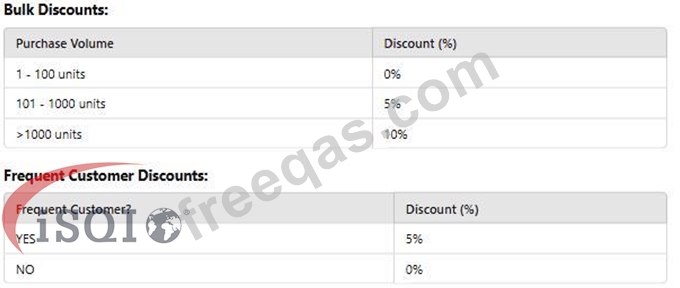
How manypossible decision rulescan be extracted from this table?

Correct Answer: B
Decision rules define possiblecombinations of conditions and outcomes.
For this scenario:
* Bulk discount has 3 categories(0%, 5%, 10%)
* Frequent customer discount has 2 categories(Yes = +5%, No = 0%)
The total number of decision rules is:
3 bulk discount options × 2 frequent customer options = 6 rules.
Thus, the correct answer is6 decision rules (B).
Reference:ISTQB CTFL v4.0 Syllabus, Section 4.2.3 - Decision Table Testing
insert code
  • «
  • 1
  • 2
  • 3
  • 4
  • 5
  • 6
  • 7
  • 8
  • 9
  • 10
  • …
  • »
  • »»
[×]

Download PDF File

Enter your email address to download ISQI.CTFL_Syll_4.0.v2025-10-06.q124 Dumps

Email:

FreeQAs

Our website provides the Largest and the most Latest vendors Certification Exam materials around the world.

Using dumps we provide to Pass the Exam, we has the Valid Dumps with passing guranteed just which you need.

  • DMCA
  • About
  • Contact Us
  • Privacy Policy
  • Terms & Conditions
©2026 FreeQAs

www.freeqas.com materials do not contain actual questions and answers from Cisco's certification exams.
