FreeQAs
 Request Exam  Contact
  • Home
  • View All Exams
  • New QA's
  • Upload
PRACTICE EXAMS:
  • Oracle
  • Fortinet
  • Juniper
  • Microsoft
  • Cisco
  • Citrix
  • CompTIA
  • VMware
  • SAP
  • EMC
  • PMI
  • HP
  • Salesforce
  • Other
  • Oracle
    Oracle
  • Fortinet
    Fortinet
  • Juniper
    Juniper
  • Microsoft
    Microsoft
  • Cisco
    Cisco
  • Citrix
    Citrix
  • CompTIA
    CompTIA
  • VMware
    VMware
  • SAP
    SAP
  • EMC
    EMC
  • PMI
    PMI
  • HP
    HP
  • Salesforce
    Salesforce
  1. Home
  2. ISQI Certification
  3. CTFL_Syll_4.0 Exam
  4. ISQI.CTFL_Syll_4.0.v2025-10-06.q124 Dumps
  • ««
  • «
  • …
  • 4
  • 5
  • 6
  • 7
  • 8
  • 9
  • 10
  • 11
  • 12
  • 13
  • …
  • »
  • »»
Download Now

Question 36

Which of the following statements is true?

Correct Answer: C
Experience-based test techniques are test design techniques that rely on the experience, knowledge, intuition, and creativity of the testers to identify and execute test cases that are likely to find defects in the software system. Experience-based test techniques are often useful to detect hidden defects that have not been targeted by black-box test techniques, which are test design techniques that use the external behavior and specifications of the software system as the test basis, without considering its internal structure or implementation. Experience-based test techniques can complement black-box test techniques by covering aspects that are not explicitly specified, such as usability, security, reliability, performance, etc. The other statements are false, because:
Experience-based test techniques do not rely on the experience of testers to identify the root causes of defects found by black-box test techniques, but rather to identify the potential sources of defects based on their own insights, heuristics, or exploratory testing. The root causes of defects are usually identified by debugging or root cause analysis, which are activities that involve examining the code or the development process to find and fix the errors that led to the defects.
Some of the most common test basis used by white-box test techniques include the source code, the design documents, the architecture diagrams, and the control flow graphs of the software system. White-box test techniques are test design techniques that use the internal structure and implementation of the software system as the test basis, and aim to achieve a certain level of test coverage based on the code elements, such as statements, branches, paths, etc. User stories, use cases, and business processes are examples of test basis used by black-box test techniques, as they describe the functional and non-functional requirements of the software system from the perspective of the users or the stakeholders.
The primary goal of experience-based test techniques is not to design test cases that can be easily automated using a GUI-based test automation tool, but rather to design test cases that can reveal defects that are not easily detected by other test techniques, such as boundary value analysis, equivalence partitioning, state transition testing, etc. Test automation is the use of software tools to execute test cases and compare actual results with expected results, without human intervention. Test automation can be applied to different types of test techniques, depending on the test objectives, the test levels, the test tools, and the test resources. However, test automation is not always feasible or beneficial, especially for test cases that require human judgment, creativity, or exploration, such as those designed by experience-based test techniques. Reference: ISTQB Certified Tester Foundation Level (CTFL) v4.0 sources and documents:
ISTQB® Certified Tester Foundation Level Syllabus v4.0, Chapter 2.2.1, Black-box Test Design Techniques ISTQB® Certified Tester Foundation Level Syllabus v4.0, Chapter 2.2.2, White-box Test Design Techniques ISTQB® Certified Tester Foundation Level Syllabus v4.0, Chapter 2.2.3, Experience-based Test Design Techniques ISTQB® Glossary of Testing Terms v4.0, Experience-based Test Technique, Black-box Test Technique, White-box Test Technique, Test Basis, Test Coverage, Test Automation
insert code

Question 37

The whole-team approach:

Correct Answer: C
This answer is correct because the whole-team approach is a way of working in agile projects where all team members share the responsibility for the quality of the product, and collaborate on delivering value to the customer. The whole-team approach involves testers, developers, business analysts, product owners, and other stakeholders in planning, designing, developing, testing, and delivering the product. The whole-team approach fosters communication, feedback, learning, and continuous improvement within the team. Reference: ISTQB Glossary of Testing Terms v4.0, ISTQB Foundation Level Syllabus v4.0, Section 3.1.1.1
insert code

Question 38

Scenario 1 "Happy Tomatoes" (used for questions 20-22):
An intelligent application for agricultural use incorporates temperature sensors located at different points of an enclosure. The sensors measure and record the temperature at regular intervals and extract the statistical values for these measurements. These values include the average daily temperature.
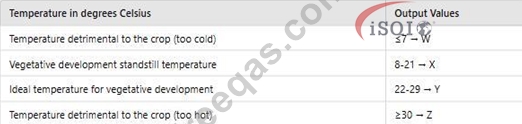
A new variety of tomatoes is currently being grown and the"World Organization for Happy Tomatoes"has established temperature ranges related to vegetative development.
When the system establishes that the average temperature is within a specific range, it emits a value that will be used to monitor and control the crop.

Using theequivalence partitioningtechnique, identify the set of input values that provides the HIGHEST coverage.

Correct Answer: C
Equivalence partitioning (EP)divides input values into classes where test casesrepresent all possible values of each partition. The partitions in this scenario are:
* #7 (too cold # W)
* 8-21 (standstill # X)
* 22-29 (ideal # Y)
* #30 (too hot # Z)
OptionC ({7,10,25,29})covers all partitionsby selecting representative values:
* 7 # Too cold (W)
* 10 # Standstill (X)
* 25 # Ideal (Y)
* 29 # Upper boundary of ideal (Y)
Other options do not cover all partitions adequately.
Reference:ISTQB CTFL v4.0 Syllabus, Section 4.2.1 - Equivalence Partitioning
insert code

Question 39

A state transition diagram describes a control system's behavior in different operational modes. The initial state is"NORMAL MODE".
Which ONE of the following test cases covers anINVALID sequence?

Correct Answer: D
State transition testing validatesvalid and invalid state transitionsbased on defined rules.
* D is invalidbecause it transitionsfrom DIAGNOSTIC MODE directly to EMERGENCY MODE, which isnot a valid state changein most systems.
* Other options follow valid sequences according tostate transition rules.
Reference:ISTQB CTFL v4.0 Syllabus, Section 4.2.4 - State Transition Testing
insert code

Question 40

Which ONE of the following roles is responsible for mediating, managing time, and generating a safe review environment in which everyone can speak freely?

Correct Answer: D
TheModerator(D) plays a key role informal reviewsby facilitating discussions, ensuring that reviews stay on track, and creating an open environment for feedback. TheManager (A)is responsible for overseeing the testing process but does not directly facilitate reviews. TheReviewer (B)is responsible for examining the work product, while theReview Leader (C)organizes reviews but does not necessarily mediate them.
insert code
  • ««
  • «
  • …
  • 4
  • 5
  • 6
  • 7
  • 8
  • 9
  • 10
  • 11
  • 12
  • 13
  • …
  • »
  • »»
[×]

Download PDF File

Enter your email address to download ISQI.CTFL_Syll_4.0.v2025-10-06.q124 Dumps

Email:

FreeQAs

Our website provides the Largest and the most Latest vendors Certification Exam materials around the world.

Using dumps we provide to Pass the Exam, we has the Valid Dumps with passing guranteed just which you need.

  • DMCA
  • About
  • Contact Us
  • Privacy Policy
  • Terms & Conditions
©2026 FreeQAs

www.freeqas.com materials do not contain actual questions and answers from Cisco's certification exams.
