Which two statements about BGP facilitate the prevention of routing loops between two autonomous systems? (Choose two.)
Correct Answer: A,C
Explanation BGP (Border Gateway Protocol) is a protocol designed to exchange routing and reachability information among autonomous systems (AS) on the internet1. Option A is correct. When an EBGP router advertises routes to its neighbors, it appends its AS number to the AS_PATH attribute1. This is a key mechanism in BGP to prevent routing loops1. Option C is correct. BGP has a built-in loop prevention mechanism whereby if a BGP router detects its own AS in the AS_PATH attribute, it will drop the prefix and will not continue to advertise it2. This helps to prevent routing loops2. Option B is incorrect. EBGP routers do not accept routes that contain their own AS number in the AS_PATH2. Instead, they drop such routes as part of the loop prevention mechanism2. Option D is incorrect. While it's true that EBGP routers append their AS number when advertising routes, they do not prepend their AS number1. The term "prepend" in BGP usually refers to a technique used to influence path selection by artificially lengthening the AS_PATH3.
Question 17
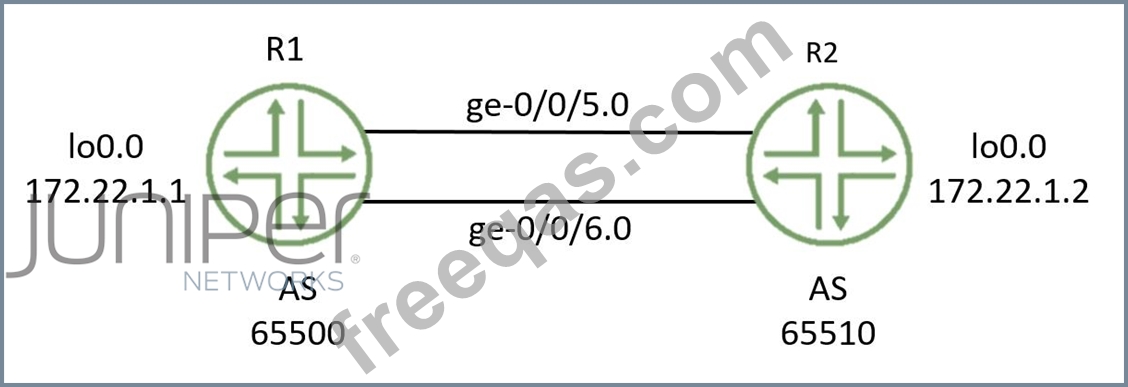
You want to enable redundancy for the EBGP peering between the two routers shown in the exhibit. Which three actions will you perform in this scenario? (Choose three.)
Correct Answer: A,B,C
A is correct because you need to configure BGP multihop to enable redundancy for the EBGP peering between the two routers. BGP multihop is a feature that allows BGP peers to establish a session over multiple hops, instead of requiring them to be directly connected. By default, EBGP peers use a time-to-live (TTL) value of 1 for their packets, which means that they can only reach adjacent neighbors. However, if you configure BGP multihop with a higher TTL value, you can allow EBGP peers to communicate over multiple routers in between. This can provide redundancy in case of a link failure or a router failure between the EBGP peers. B is correct because you need to configure loopback interface peering to enable redundancy for the EBGP peering between the two routers. Loopback interface peering is a technique that uses loopback interfaces as the source and destination addresses for BGP sessions, instead of physical interfaces. Loopback interfaces are virtual interfaces that are always up and reachable as long as the router is operational. By using loopback interface peering, you can avoid the dependency on a single physical interface or link for the BGP session, and use multiple paths to reach the loopback address of the peer. This can provide redundancy and load balancing for the EBGP peering. C is correct because you need to configure routes for the peer loopback interface IP addresses to enable redundancy for the EBGP peering between the two routers. Routes for the peer loopback interface IP addresses are necessary to ensure that the routers can reach each other's loopback addresses over multiple hops. You can use static routes or dynamic routing protocols to advertise and learn the routes for the peer loopback interface IP addresses. Without these routes, the routers will not be able to establish or maintain the BGP session using their loopback interfaces.
Question 18
Referring to the output shown in the exhibit, which two statements are true?
Correct Answer: B,C
Question 19
You want to redistribute the static routes into BGP, but they do not show as BGP routes. What causes this result to occur?
Correct Answer: C
Question 20
You are troubleshooting a BGP routing issue between your network and a customer router and are reviewing the BGP routing policies. Which two statements are correct in this scenario? (Choose two.)
Correct Answer: C,D
Explanation In BGP, routing policies are used to control the flow of routing information between BGP peers1. Option C suggests that import policies are applied after the RIB-In table. This is correct because import policies in BGP are applied to routes that are received from a BGP peer, before they are installed in the local BGP Routing Information Base (RIB-In)1. The RIB-In is a database that stores all the routes that are received from all peers1. Option D suggests that export policies are applied after the RIB-Local table. This is correct because export policies in BGP are applied to routes that are being advertised to a BGP peer, after they have been selected from the local BGP Routing Information Base (RIB-Local)1. The RIB-Local is a database that stores all the routes that the local router is using1. Therefore, options C and D are correct.