FreeQAs
 Request Exam  Contact
  • Home
  • View All Exams
  • New QA's
  • Upload
PRACTICE EXAMS:
  • Oracle
  • Fortinet
  • IBM
  • Juniper
  • Microsoft
  • Cisco
  • Citrix
  • CompTIA
  • VMware
  • ISC
  • SAP
  • EMC
  • PMI
  • HP
  • Salesforce
  • Other
  • Oracle
    Oracle
  • Fortinet
    Fortinet
  • IBM
    IBM
  • Juniper
    Juniper
  • Microsoft
    Microsoft
  • Cisco
    Cisco
  • Citrix
    Citrix
  • CompTIA
    CompTIA
  • VMware
    VMware
  • ISC
    ISC
  • SAP
    SAP
  • EMC
    EMC
  • PMI
    PMI
  • HP
    HP
  • Salesforce
    Salesforce
  1. Home
  2. Microsoft Certification
  3. AZ-204 Exam
  4. Microsoft.AZ-204.v2024-05-19.q385 Dumps
  • ««
  • «
  • …
  • 6
  • 7
  • 8
  • 9
  • 10
  • 11
  • 12
  • 13
  • 14
  • 15
  • …
  • »
  • »»
Download Now

Question 46

You need to correct the Azure Logic app error message.
Which configuration values should you use? To answer, select the appropriate options in the answer area.
NOTE: Each correct selection is worth one point.
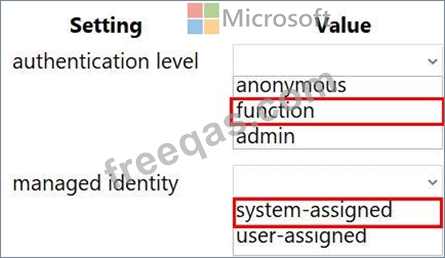
Correct Answer:

Reference:
https://docs.microsoft.com/en-us/azure/logic-apps/create-managed-service-identity
insert code

Question 47

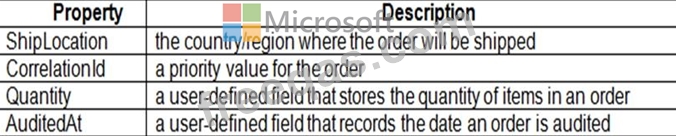
You are implementing an order processing system. A point of sale application publishes orders to topics in an Azure Service Bus queue. The label property for the topic includes the following data:
The system has the following requirements for subscriptions
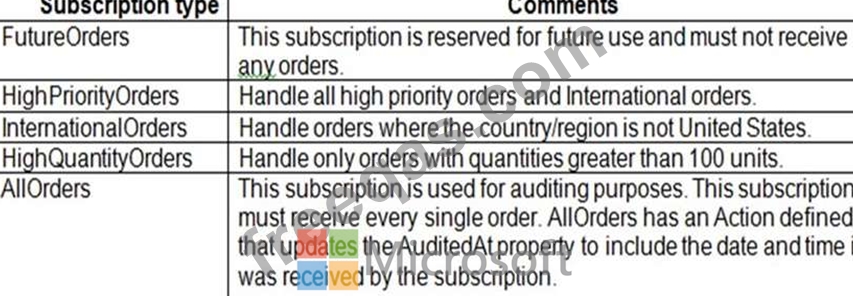
You need to implement filtering and maximize throughput while evaluating filters.
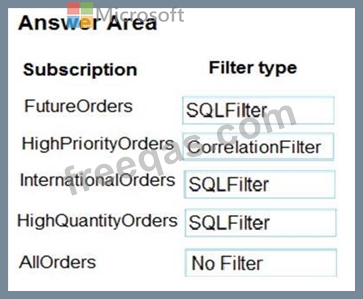
Which filter types should you implement? To answer, drag the appropriate filter types to the correct subscriptions. Each filter type may be used once, more than once, or not at all. You may need to drag the split bar between panes or scroll to view content.
NOTE: Each correct selection is worth one point.
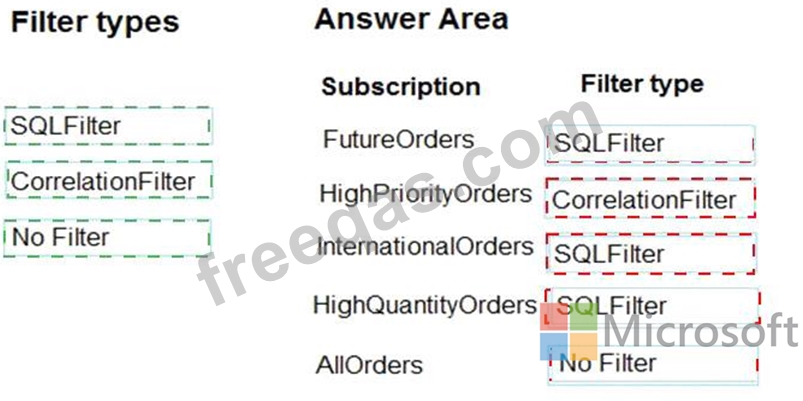
Correct Answer:

Explanation

FutureOrders: SQLFilter
HighPriortyOrders: CorrelationFilter
CorrelationID only
InternationalOrders: SQLFilter
Country NOT USA requires an SQL Filter
HighQuantityOrders: SQLFilter
Need to use relational operators so an SQL Filter is needed.
AllOrders: No Filter
SQL Filter: SQL Filters - A SqlFilter holds a SQL-like conditional expression that is evaluated in the broker against the arriving messages' user-defined properties and system properties. All system properties must be prefixed with sys. in the conditional expression. The SQL-language subset for filter conditions tests for the existence of properties (EXISTS), as well as for null-values (IS NULL), logical NOT/AND/OR, relational operators, simple numeric arithmetic, and simple text pattern matching with LIKE.
Correlation Filters - A CorrelationFilter holds a set of conditions that are matched against one or more of an arriving message's user and system properties. A common use is to match against the CorrelationId property, but the application can also choose to match against ContentType, Label, MessageId, ReplyTo, ReplyToSessionId, SessionId, To, and any user-defined properties. A match exists when an arriving message's value for a property is equal to the value specified in the correlation filter. For string expressions, the comparison is case-sensitive. When specifying multiple match properties, the filter combines them as a logical AND condition, meaning for the filter to match, all conditions must match.
Boolean filters - The TrueFilter and FalseFilter either cause all arriving messages (true) or none of the arriving messages (false) to be selected for the subscription.
References:
https://docs.microsoft.com/en-us/azure/service-bus-messaging/topic-filters
insert code

Question 48

You are developing an Azure-hosted e-commerce web application. The application will use Azure Cosmos DB to store sales orders. You are using the latest SDK to manage the sales orders in the database.
You create a new Azure Cosmos DB instance. You include a valid endpoint and valid authorization key to an appSettings.json file in the code project.
You are evaluating the following application code: (Line number are included for reference only.)
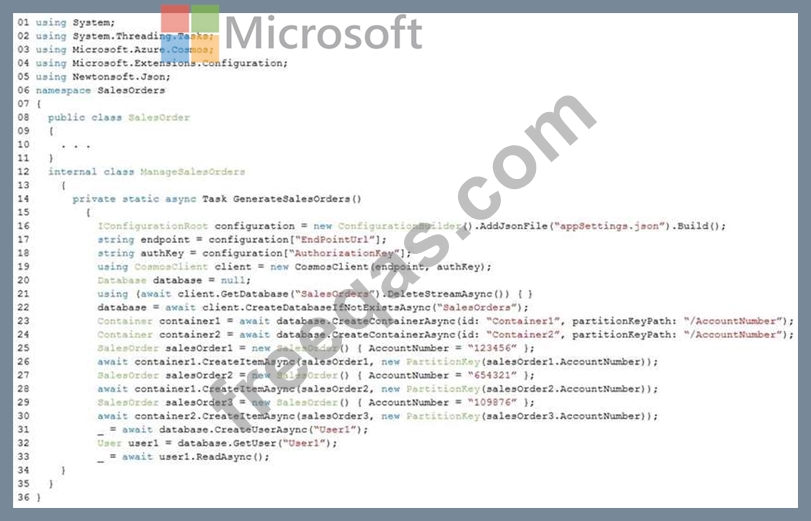
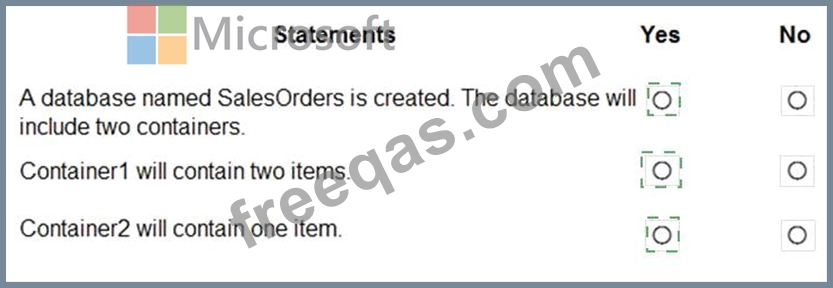
For each of the following statements, select Yes if the statement is true. Otherwise, select No.
NOTE: Each correct selection is worth one point.
Correct Answer:

Explanation
Graphical user interface, text, application Description automatically generated

Box 1: Yes
The createDatabaseIfNotExistsAsync method checks if a database exists, and if it doesn't, create it.
The Database.CreateContainerAsync method creates a container as an asynchronous operation in the Azure Cosmos service.
Box 2: Yes
The CosmosContainer.CreateItemAsync method creates an item as an asynchronous operation in the Azure Cosmos service.
Box 3: Yes
Reference:
https://docs.microsoft.com/en-us/dotnet/api/microsoft.azure.cosmos.cosmosclient.createdatabaseifnotexistsasync
https://docs.microsoft.com/en-us/dotnet/api/microsoft.azure.cosmos.database.createcontainerasync
https://docs.microsoft.com/en-us/dotnet/api/azure.cosmos.cosmoscontainer.createitemasync
insert code

Question 49

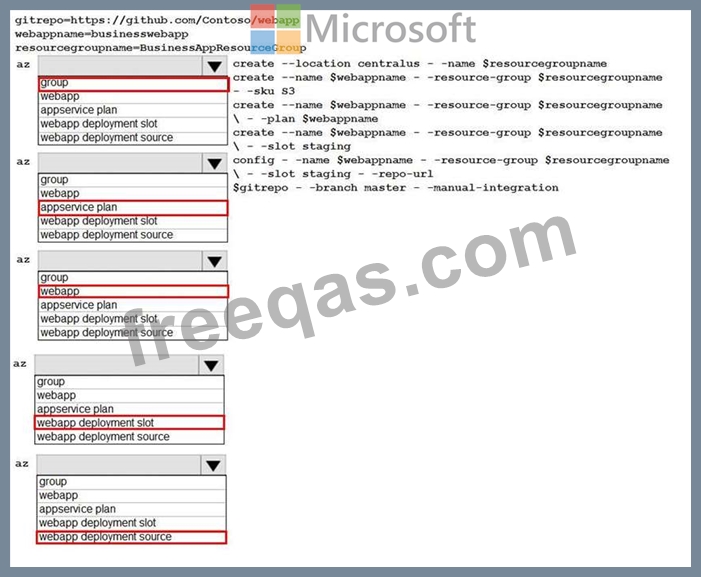
A company is developing a Java web app. The web app code is hosted in a GitHub repository located at https://github.com/Contoso/webapp.
The web app must be evaluated before it is moved to production. You must deploy the initial code release to a deployment slot named staging.
You need to create the web app and deploy the code.
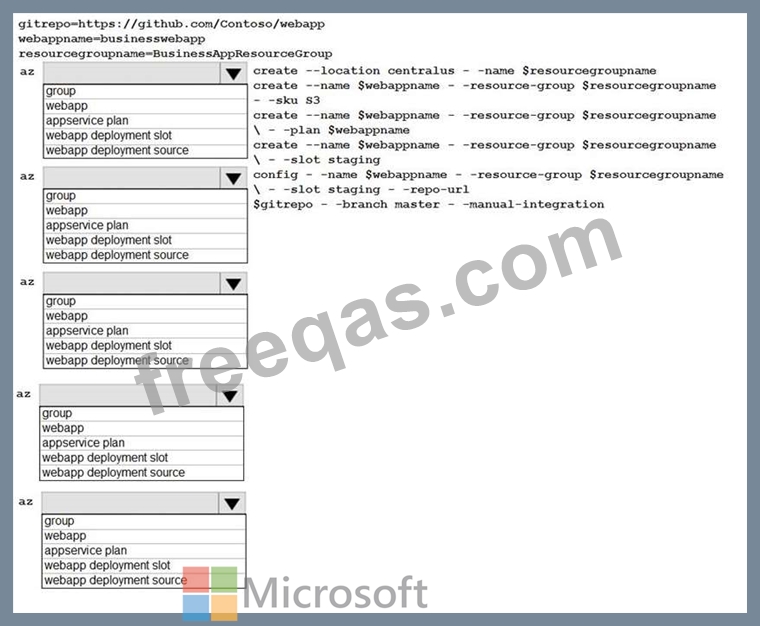
How should you complete the commands? To answer, select the appropriate options in the answer area.
NOTE: Each correct selection is worth one point.
Correct Answer:

Explanation:
Box 1: group
# Create a resource group.
az group create --location westeurope --name myResourceGroup
Box 2: appservice plan
# Create an App Service plan in STANDARD tier (minimum required by deployment slots).
az appservice plan create --name $webappname --resource-group myResourceGroup --sku S1 Box 3: webapp
# Create a web app.
az webapp create --name $webappname --resource-group myResourceGroup \
--plan $webappname
Box 4: webapp deployment slot
#Create a deployment slot with the name "staging".
az webapp deployment slot create --name $webappname --resource-group myResourceGroup \
--slot staging
Box 5: webapp deployment source
# Deploy sample code to "staging" slot from GitHub.
az webapp deployment source config --name $webappname --resource-group myResourceGroup \
--slot staging --repo-url $gitrepo --branch master --manual-integration References:
https://docs.microsoft.com/en-us/azure/app-service/scripts/cli-deploy-staging-environment
insert code

Question 50

Note: This question is part of a series of questions that present the same scenario. Each question in the series contains a unique solution that might meet the stated goals. Some question sets might have more than one correct solution, while others might not have a correct solution.
After you answer a question in this section, you will NOT be able to return to it. As a result, these questions will not appear in the review screen.
You develop Azure solutions.
You must grant a virtual machine (VM) access to specific resource groups in Azure Resource Manager.
You need to obtain an Azure Resource Manager access token.
Solution: Use an X.509 certificate to authenticate the VM with Azure Resource Manager.
Does the solution meet the goal?


Correct Answer: B
Instead run the Invoke-RestMethod cmdlet to make a request to the local managed identity for Azure resources endpoint.
Reference:
https://docs.microsoft.com/en-us/azure/active-directory/managed-identities-azure-resources/tutorial-windows-vm-access-arm
insert code
  • ««
  • «
  • …
  • 6
  • 7
  • 8
  • 9
  • 10
  • 11
  • 12
  • 13
  • 14
  • 15
  • …
  • »
  • »»
[×]

Download PDF File

Enter your email address to download Microsoft.AZ-204.v2024-05-19.q385 Dumps

Email:

FreeQAs

Our website provides the Largest and the most Latest vendors Certification Exam materials around the world.

Using dumps we provide to Pass the Exam, we has the Valid Dumps with passing guranteed just which you need.

  • DMCA
  • About
  • Contact Us
  • Privacy Policy
  • Terms & Conditions
©2026 FreeQAs

www.freeqas.com materials do not contain actual questions and answers from Cisco's certification exams.