FreeQAs
 Request Exam  Contact
  • Home
  • View All Exams
  • New QA's
  • Upload
PRACTICE EXAMS:
  • Oracle
  • Fortinet
  • IBM
  • Juniper
  • Microsoft
  • Cisco
  • Citrix
  • CompTIA
  • VMware
  • ISC
  • SAP
  • EMC
  • PMI
  • HP
  • Salesforce
  • Other
  • Oracle
    Oracle
  • Fortinet
    Fortinet
  • IBM
    IBM
  • Juniper
    Juniper
  • Microsoft
    Microsoft
  • Cisco
    Cisco
  • Citrix
    Citrix
  • CompTIA
    CompTIA
  • VMware
    VMware
  • ISC
    ISC
  • SAP
    SAP
  • EMC
    EMC
  • PMI
    PMI
  • HP
    HP
  • Salesforce
    Salesforce
  1. Home
  2. Microsoft Certification
  3. AZ-204 Exam
  4. Microsoft.AZ-204.v2024-05-19.q385 Dumps
  • ««
  • «
  • …
  • 60
  • 61
  • 62
  • 63
  • 64
  • 65
  • 66
  • 67
  • 68
  • 69
  • …
  • »
  • »»
Download Now

Question 316

You are developing an application to store business-critical data in Azure Blob storage. The application must meet the following requirements:
* Data must not be modified or deleted for a user-specified interval.
* Data must be protected from overwntes and deletes.
* Data must be written once and allowed to be read many times.
You need to protect the data fen the Azure Blob storage account.
Which two actions should you perform? Each correct answer presents part of the solution.
NOTE: Each correct selection is worth one point.

Correct Answer: A,D
insert code

Question 317

You develop a gateway solution for a public facing news API.
The news API back end is implemented as a RESTful service and hosted in an Azure App Service instance.
You need to configure back-end authentication for the API Management service instance.
Which target and gateway credential type should you use? To answer, drag the appropriate values to the correct parameters. Each value may be used once, more than once, or not at all. You may need to drag the split bar between panes or scroll to view content.
NOTE: Each correct selection is worth one point.

Correct Answer:

Reference:
https://docs.microsoft.com/en-us/rest/api/apimanagement/apimanagementrest/azure-api-management-rest-api-backend-entity
insert code

Question 318

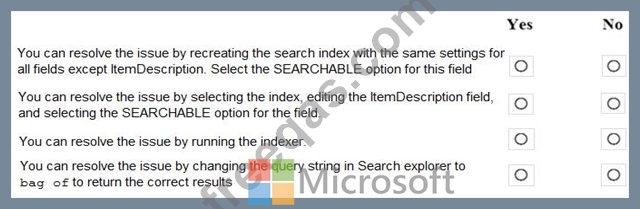
You are validating the configuration of an Azure Search indexer.
The service has been configured with an indexer that uses the Import Data option. The index is configured using options as shown in the Index Configuration exhibit. (Click the Index Configuration tab.)

You use an Azure table as the data source for the import operation. The table contains three records with item inventory data that matches the fields in the Storage data exhibit. These records were imported when the index was created. (Click the Storage Data tab.) When users search with no filter, all three records are displayed.


When users search for items by description, Search explorer returns no records. The Search Explorer exhibit shows the query and results for a test. In the test, a user is trying to search for all items in the table that have a description that contains the word bag. (Click the Search Explorer tab.) You need to resolve the issue.
For each of the following statements, select Yes if the statement is true. Otherwise, select No.
NOTE: Each correct selection is worth one point.
Correct Answer:
insert code

Question 319

You have a single page application (SPA) web application that manages information based on data returned by Microsoft Graph from another company's Azure Active Directory (Azure AD) instance.
Users must be able to authenticate and access Microsoft Graph by using their own company's Azure AD instance.
You need to configure the application manifest for the app registration.
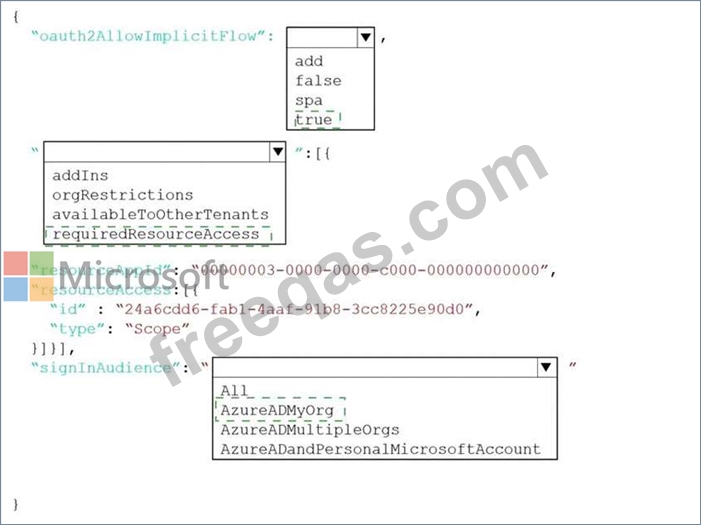
How should you complete the manifest? To answer, select the appropriate options in the answer area.
NOTE: Each correct selection is worth one point.
Correct Answer:

Explanation
Graphical user interface, text, application, email Description automatically generated

Box 1: true
The oauth2AllowImplicitFlow attribute Specifies whether this web app can request OAuth2.0 implicit flow access tokens. The default is false. This flag is used for browser-based apps, like JavaScript single-page apps.
In implicit flow, the app receives tokens directly from the Azure Active Directory (Azure AD) authorize endpoint, without any server-to-server exchange. All authentication logic and session handling is done entirely in the JavaScript client with either a page redirect or a pop-up box.
Box 2: requiredResourceAccess
With dynamic consent, requiredResourceAccess drives the admin consent experience and the user consent experience for users who are using static consent. However, this parameter doesn't drive the user consent experience for the general case.
resourceAppId is the unique identifier for the resource that the app requires access to. This value should be equal to the appId declared on the target resource app.
resourceAccess is an array that lists the OAuth2.0 permission scopes and app roles that the app requires from the specified resource. Contains the id and type values of the specified resources.
Example:
"requiredResourceAccess": [
{
"resourceAppId": "00000002-0000-0000-c000-000000000000",
"resourceAccess": [
{
"id": "311a71cc-e848-46a1-bdf8-97ff7156d8e6",
"type": "Scope"
}
]
}
],
Box 3: AzureADMyOrg
The signInAudience attribute specifies what Microsoft accounts are supported for the current application.
Supported values are:
AzureADMyOrg - Users with a Microsoft work or school account in my organization's Azure AD tenant (for example, single tenant) AzureADMultipleOrgs - Users with a Microsoft work or school account in any organization's Azure AD tenant (for example, multi-tenant) AzureADandPersonalMicrosoftAccount - Users with a personal Microsoft account, or a work or school account in any organization's Azure AD tenant Reference:
https://docs.microsoft.com/en-us/azure/active-directory/develop/reference-app-manifest
https://docs.microsoft.com/en-us/azure/active-directory/develop/v2-oauth2-implicit-grant-flow
insert code

Question 320

A company is developing a gaming platform. Users can join teams to play online and see leaderboards that include player statistics. The solution includes an entity named Team.
You plan to implement an Azure Redis Cache instance to improve the efficiency of data operations for entities that rarely change.
You need to invalidate the cache when team data is changed.
How should you complete the code? To answer, select the appropriate options in the answer area.
NOTE: Each correct selection is worth one point.

Correct Answer:
insert code
  • ««
  • «
  • …
  • 60
  • 61
  • 62
  • 63
  • 64
  • 65
  • 66
  • 67
  • 68
  • 69
  • …
  • »
  • »»
[×]

Download PDF File

Enter your email address to download Microsoft.AZ-204.v2024-05-19.q385 Dumps

Email:

FreeQAs

Our website provides the Largest and the most Latest vendors Certification Exam materials around the world.

Using dumps we provide to Pass the Exam, we has the Valid Dumps with passing guranteed just which you need.

  • DMCA
  • About
  • Contact Us
  • Privacy Policy
  • Terms & Conditions
©2026 FreeQAs

www.freeqas.com materials do not contain actual questions and answers from Cisco's certification exams.
