FreeQAs
 Request Exam  Contact
  • Home
  • View All Exams
  • New QA's
  • Upload
PRACTICE EXAMS:
  • Oracle
  • Fortinet
  • IBM
  • Juniper
  • Microsoft
  • Cisco
  • Citrix
  • CompTIA
  • VMware
  • ISC
  • SAP
  • EMC
  • PMI
  • HP
  • Salesforce
  • Other
  • Oracle
    Oracle
  • Fortinet
    Fortinet
  • IBM
    IBM
  • Juniper
    Juniper
  • Microsoft
    Microsoft
  • Cisco
    Cisco
  • Citrix
    Citrix
  • CompTIA
    CompTIA
  • VMware
    VMware
  • ISC
    ISC
  • SAP
    SAP
  • EMC
    EMC
  • PMI
    PMI
  • HP
    HP
  • Salesforce
    Salesforce
  1. Home
  2. Microsoft Certification
  3. AZ-400 Exam
  4. Microsoft.AZ-400.v2023-11-06.q439 Dumps
  • ««
  • «
  • …
  • 12
  • 13
  • 14
  • 15
  • 16
  • 17
  • 18
  • 19
  • 20
  • 21
  • …
  • »
  • »»
Download Now

Question 76

You use Azure DevOps to manage the build and deployment of an app named App1.
You have a release pipeline that deploys a virtual machine named VM1.
You plan to monitor the release pipeline by using Azure Monitor
You need to create an alert to monitor the performance of VM1. The alert must be triggered when the average CPU usage exceeds 70 percent for five minutes. The alert must calculate the average once every minute.
How should you configure the alert rule? To answer, select the appropriate options in the answer area.

Correct Answer:

Reference:
https://docs.microsoft.com/en-us/azure/azure-monitor/platform/alerts-metric-overview
insert code

Question 77

You are deploying a server application that will run on a Server Core installation of Windows Server 2019.
You create an Azure key vault and a secret.
You need to use the key vault to secure API secrets for third-party integrations.
Which three actions should you perform? Each correct answer presents part of the solution.
NOTE: Each correct selection is worth one point.
D18912E1457D5D1DDCBD40AB3BF70D5D

Correct Answer: B,C,E
BE: An app deployed to Azure can take advantage of Managed identities for Azure resources, which allows the app to authenticate with Azure Key Vault using Azure AD authentication without credentials (Application ID and Password/Client Secret) stored in the app.
* Select Add Access Policy.
* Open Secret permissions and provide the app with Get and List permissions.
* Select Select principal and select the registered app by name. Select the Select button.
* Select OK.
* Select Save.
* Deploy the app.
References:
https://docs.microsoft.com/en-us/aspnet/core/security/key-vault-configuration
insert code

Question 78

You plan to share packages that you wrote, tested, validated, and deployed by using Azure Artifacts.
You need to release multiple builds of each package by using a single feed. The solution must limit the release of packages that are in development.
What should you use?

Correct Answer: D
Upstream sources enable you to manage all of your product's dependencies in a single feed. We recommend publishing all of the packages for a given product to that product's feed, and managing that product's dependencies from remote feeds in the same feed, via upstream sources. This setup has a few benefits:
* Simplicity: your NuGet.config, .npmrc, or settings.xml contains exactly one feed (your feed).
* Determinism: your feed resolves package requests in order, so rebuilding the same codebase at the same commit or changeset uses the same set of packages
* Provenance: your feed knows the provenance of packages it saved via upstream sources, so you can verify that you're using the original package, not a custom or malicious copy published to your feed
* Peace of mind: packages used via upstream sources are guaranteed to be saved in the feed on first use; if the upstream source is disabled/removed, or the remote feed goes down or deletes a package you depend on, you can continue to develop and build References: https://docs.microsoft.com/en-us/azure/devops/artifacts/concepts/upstream-sources?view=vsts
insert code

Question 79

You have an application named App1 that has a custom domain of app.contoso.com.
You create a test in Azure Application Insights as shown in the following exhibit.

Use the drop-down menus to select the answer choice that completes each statement based on the information presented in the graphic.
NOTE: Each correct selection is worth one point.
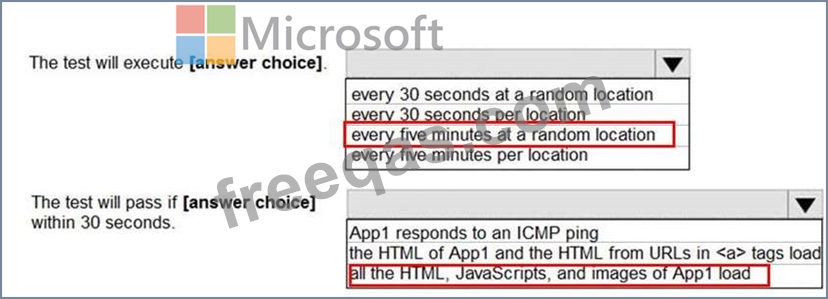
Correct Answer:

Reference:
https://docs.microsoft.com/en-us/azure/azure-monitor/app/monitor-web-app-availability
insert code

Question 80

You use Azure DevOps processes to build and deploy code.
You need to compare how much time is spent troubleshooting issues found during development and how much time is spent troubleshooting issues found in released code.
Which KPI should you use?


Correct Answer: D
The defect escape rate is a metric that assesses the collective quality of software releases by evaluating how often errors are discovered and rectified in the pre-production process versus during production.
The defect escape rate is a KPI (Key Performance Indicator) that measures how many defects are found in released code versus how many are found during development. This KPI can help you to compare how much time is spent troubleshooting issues found during development versus how much time is spent troubleshooting issues found in released code. The higher the defect escape rate, the more defects are found in released code, and thus more time is spent troubleshooting issues in released code.
insert code
  • ««
  • «
  • …
  • 12
  • 13
  • 14
  • 15
  • 16
  • 17
  • 18
  • 19
  • 20
  • 21
  • …
  • »
  • »»
[×]

Download PDF File

Enter your email address to download Microsoft.AZ-400.v2023-11-06.q439 Dumps

Email:

FreeQAs

Our website provides the Largest and the most Latest vendors Certification Exam materials around the world.

Using dumps we provide to Pass the Exam, we has the Valid Dumps with passing guranteed just which you need.

  • DMCA
  • About
  • Contact Us
  • Privacy Policy
  • Terms & Conditions
©2026 FreeQAs

www.freeqas.com materials do not contain actual questions and answers from Cisco's certification exams.