FreeQAs
 Request Exam  Contact
  • Home
  • View All Exams
  • New QA's
  • Upload
PRACTICE EXAMS:
  • Oracle
  • Fortinet
  • Juniper
  • Microsoft
  • Cisco
  • Citrix
  • CompTIA
  • VMware
  • ISC
  • SAP
  • EMC
  • PMI
  • HP
  • Salesforce
  • Other
  • Oracle
    Oracle
  • Fortinet
    Fortinet
  • Juniper
    Juniper
  • Microsoft
    Microsoft
  • Cisco
    Cisco
  • Citrix
    Citrix
  • CompTIA
    CompTIA
  • VMware
    VMware
  • ISC
    ISC
  • SAP
    SAP
  • EMC
    EMC
  • PMI
    PMI
  • HP
    HP
  • Salesforce
    Salesforce
  1. Home
  2. Microsoft Certification
  3. AZ-400 Exam
  4. Microsoft.AZ-400.v2023-11-06.q439 Dumps
  • ««
  • «
  • …
  • 37
  • 38
  • 39
  • 40
  • 41
  • 42
  • 43
  • 44
  • 45
  • 46
  • …
  • »
  • »»
Download Now

Question 201

You have a GitHub organization named org1 and an Azure tenant named Tenant1.
You need to enable single sign-on (SSO) in Azure Active Directory (Azure AD) for the users in org1.
Which URIs should you use for the SAML configuration in Azure AD? To answer, drag the appropriate URIs to the correct settings. Each URI may be used once, more than once, or not at all. You may need to drag the split bar between panes or scroll to view content.
NOTE: Each correct selection is worth one point.

Correct Answer:

Explanation
Graphical user interface, text, application Description automatically generated

Reference:
https://docs.microsoft.com/en-us/azure/active-directory/saas-apps/github-tutorial
insert code

Question 202

Your company hosts a web application in Azure. The company uses Azure Pipelines for the build and release management of the application.
Stakeholders report that the past few releases have negatively affected system performance.
You configure alerts in Azure Monitor.
You need to ensure that new releases are only deployed to production if the releases meet defined performance baseline criteria in the staging environment first.
What should you use to prevent the deployment of releases that fall to meet the performance baseline?

Correct Answer: C
Scenarios and use cases for gates include:
* Quality validation. Query metrics from tests on the build artifacts such as pass rate or code coverage and deploy only if they are within required thresholds.
Use Quality Gates to integrate monitoring into your pre-deployment or post-deployment. This ensures that you are meeting the key health/performance metrics (KPIs) as your applications move from dev to production and any differences in the infrastructure environment or scale is not negatively impacting your KPIs.
Note: Gates allow automatic collection of health signals from external services, and then promote the release when all the signals are successful at the same time or stop the deployment on timeout. Typically, gates are used in connection with incident management, problem management, change management, monitoring, and external approval systems.
References:
https://docs.microsoft.com/en-us/azure/azure-monitor/continuous-monitoring
https://docs.microsoft.com/en-us/azure/devops/pipelines/release/approvals/gates?view=azure-devops
insert code

Question 203

You plan to deploy a template named D:\Deploy.json to a resource group named Deploy-lod9940427.
You need to modify the template to meet the following requirements, and then to deploy the template:
* The address space must be reduced to support only 256 total IP addresses.
* The subnet address space must be reduced to support only 64 total IP addresses.
To complete this task, sign in to the Microsoft Azure portal.

Correct Answer:
See solution below.
Explanation
1. Sign in to the portal,
2. Choose template Deploy-lod9940427
3. Select Edit template, and then paste your JSON template code into the code window.
4. Change the ASddressPrefixes to 10.0.0.0/24 in order to support only 256 total IP addresses.
addressSpace":{"addressPrefixes": ["10.0.0.0/24"]},
5. Change the firstSubnet addressprefix to 10.0.0.0/26 to support only 64 total IP addresses.
"subnets":[
{
"name":"firstSubnet",
"properties":{
"addressPrefix":"10.0.0.0/24"
}
6. Select Save.

7. Select Edit parameters, provide values for the parameters that are shown, and then select OK.
8 Select Subscription. Choose the subscription you want to use, and then select OK.
9. Select Resource group. Choose an existing resource group or create a new one, and then select OK.

10. Select Create. A new tile on the dashboard tracks the progress of your template deployment.
References:
https://docs.microsoft.com/en-us/azure-stack/user/azure-stack-deploy-template-portal?view=azs-1908
https://docs.microsoft.com/en-us/azure/architecture/building-blocks/extending-templates/update-resource
insert code

Question 204

You need to ensure that an Azure web app named az400-9940427-main supports rolling upgrades. The solution must ensure that only 10 percent of users who connect to az400-9940427-main use update versions of the app.
The solution must minimize administrative effort.
To complete this task, sign in to the Microsoft Azure portal.

Correct Answer:
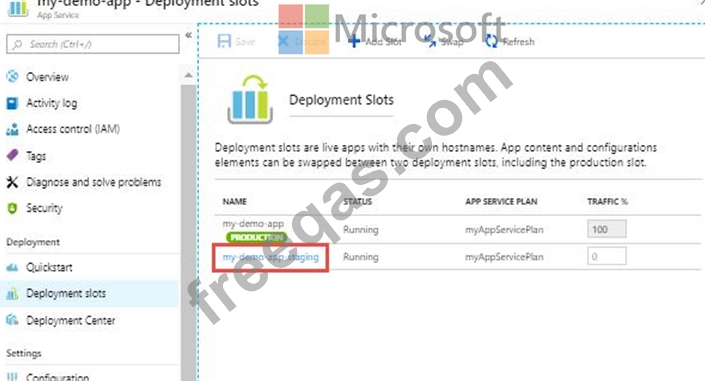
Set up staging environments in Azure App Service
1. Open Microsoft Azure Portal
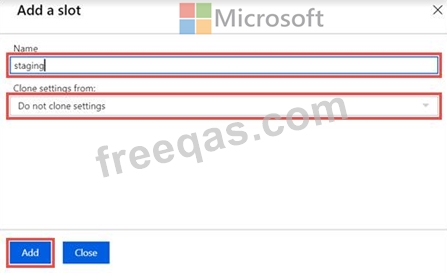
2. Log into your Azure account, select your app's resource page, in the left pane, select Deployment slots > Add Slot.

3. In the Add a slot dialog box, give the slot a name, and select whether to clone an app configuration from another deployment slot. Select Add to continue.

4. After the slot is added, select Close to close the dialog box. The new slot is now shown on the Deployment slots page. By default, Traffic % is set to 0 for the new slot, with all customer traffic routed to the production slot.
5. Select the new deployment slot to open that slot's resource page.

6. Change TRAFFIC % to 10
References:
https://docs.microsoft.com/en-us/azure/app-service/deploy-staging-slots
insert code

Question 205

Your company uses GitHub for source control. GitHub repositories store source code and store process documentation. The process documentation is saved as Microsoft Word documents that contain simple flow charts stored as .bmp files.
You need to optimize the integration and versioning of the process documentation and the flow charts. The solution must meet the following requirements:
* Store documents as plain text.
* Minimize the number of files that must be maintained.
* Simplify the modification, merging, and reuse of flow charts.
* Simplify the modification, merging, and reuse of documents.
What should you include in the solution? To answer, select the appropriate options in the answer area. NOTE:
Each correct selection is worth one point.

Correct Answer:

Explanation

Box 1: Markdown (.md)
Github understands several text formats, including .txt and .md. .md stands for a file written in Markdown.
Box 2: Mermaid diagrams
Mermaid lets you create diagrams and visualizations using text and code.
It is a Javascript based diagramming and charting tool that renders Markdown-inspired text definitions to create and modify diagrams dynamically.
Reference:
https://ourcodingclub.github.io/tutorials/git/
https://mermaid-js.github.io/mermaid/#/
insert code
  • ««
  • «
  • …
  • 37
  • 38
  • 39
  • 40
  • 41
  • 42
  • 43
  • 44
  • 45
  • 46
  • …
  • »
  • »»
[×]

Download PDF File

Enter your email address to download Microsoft.AZ-400.v2023-11-06.q439 Dumps

Email:

FreeQAs

Our website provides the Largest and the most Latest vendors Certification Exam materials around the world.

Using dumps we provide to Pass the Exam, we has the Valid Dumps with passing guranteed just which you need.

  • DMCA
  • About
  • Contact Us
  • Privacy Policy
  • Terms & Conditions
©2026 FreeQAs

www.freeqas.com materials do not contain actual questions and answers from Cisco's certification exams.