FreeQAs
 Request Exam  Contact
  • Home
  • View All Exams
  • New QA's
  • Upload
PRACTICE EXAMS:
  • Oracle
  • Fortinet
  • IBM
  • Juniper
  • Microsoft
  • Cisco
  • Citrix
  • CompTIA
  • VMware
  • ISC
  • SAP
  • EMC
  • PMI
  • HP
  • Salesforce
  • Other
  • Oracle
    Oracle
  • Fortinet
    Fortinet
  • IBM
    IBM
  • Juniper
    Juniper
  • Microsoft
    Microsoft
  • Cisco
    Cisco
  • Citrix
    Citrix
  • CompTIA
    CompTIA
  • VMware
    VMware
  • ISC
    ISC
  • SAP
    SAP
  • EMC
    EMC
  • PMI
    PMI
  • HP
    HP
  • Salesforce
    Salesforce
  1. Home
  2. Microsoft Certification
  3. AZ-400 Exam
  4. Microsoft.AZ-400.v2024-04-28.q185 Dumps
  • ««
  • «
  • …
  • 8
  • 9
  • 10
  • 11
  • 12
  • 13
  • 14
  • 15
  • 16
  • 17
  • …
  • »
  • »»
Download Now

Question 56

Note: This question is part of a series of questions that present the same scenario. Each question in the series contains a unique solution that might meet the stated goals. Some question sets might have more than one correct solution, while others might not have a correct solution.
After you answer a question in this section, you will NOT be able to return to it. As a result, these questions will not appear in the review screen.
You plan to create a release pipeline that will deploy Azure resources by using Azure Resource Manager templates. The release pipeline will create the following resources:
Two resource groups

Four Azure virtual machines in one resource group

Two Azure SQL databases in other resource group

You need to recommend a solution to deploy the resources.
Solution: Create a main template that has two linked templates, each of which will deploy the resource in its respective group.
Does this meet the goal?

Correct Answer: A
Explanation/Reference:
Explanation:
To deploy your solution, you can use either a single template or a main template with many related templates. The related template can be either a separate file that is linked to from the main template, or a template that is nested within the main template.
References: https://docs.microsoft.com/en-us/azure/azure-resource-manager/resource-group-linked- templates
insert code

Question 57

You have a project Azure DevOps.
You plan to create a build pipeline that will deploy resources by using Azure Resource Manager templates.
The templates will reference secretes stored in Azure Key Vault.
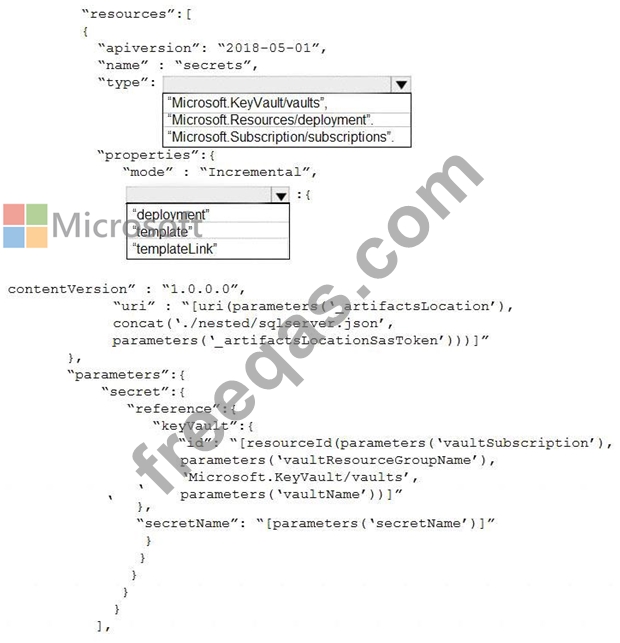
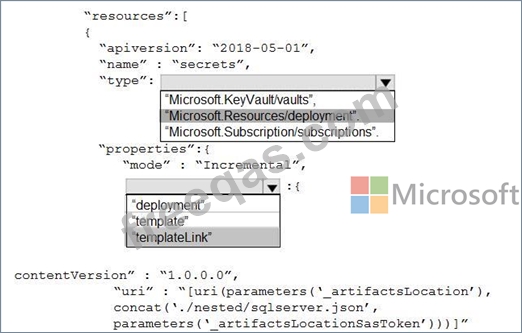
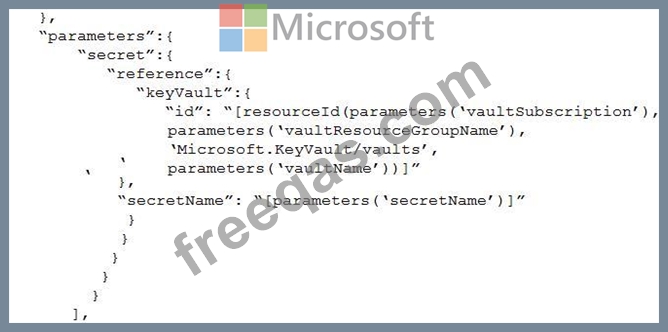
Yu need to ensure that you can dynamically generate the resource ID of the key vault during template deployment.
What should you include in the template? To answer, select eh appropriate options in the answer area.
NOTE: Each correct selection is worth one point.
Correct Answer:

Explanation

insert code

Question 58

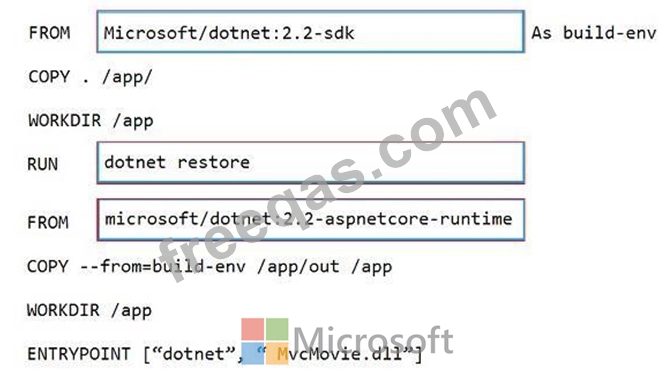
You are creating a container for an ASP.NET Core app.
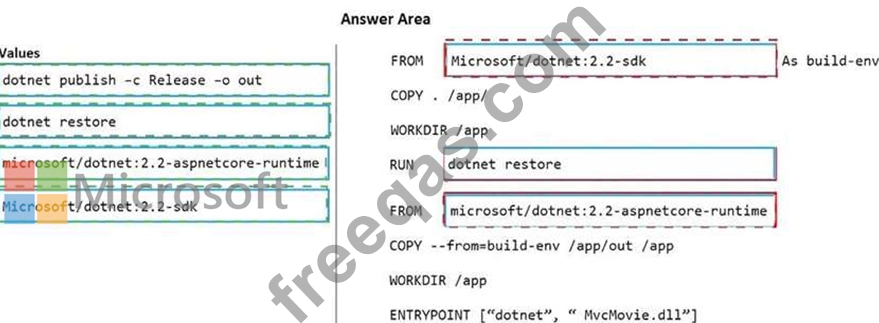
You need to create a Dockerfile file to build the image. The solution must ensure that the size of the image is minimized.
How should you configure the file? To answer, drag the appropriate values to the correct targets. Each value must be used once, more than once, or not at all. You may need to drag the split bar between panes or scroll to view content.
NOTE: Each correct selection is worth one point.
Correct Answer:

Explanation

Box 1: microsoft.com/dotnet/sdk:2.3
The first group of lines declares from which base image we will use to build our container on top of. If the local system does not have this image already, then docker will automatically try and fetch it. The mcr.microsoft.com/dotnet/core/sdk:2.1 comes packaged with the .NET core 2.1 SDK installed, so it's up to the task of building ASP .NET core projects targeting version 2.1 Box 2: dotnet restore The next instruction changes the working directory in our container to be /app, so all commands following this one execute under this context.
COPY *.csproj ./
RUN dotnet restore
Box 3: microsoft.com/dotnet/2.2-aspnetcore-runtime
When building container images, it's good practice to include only the production payload and its dependencies in the container image. We don't want the .NET core SDK included in our final image because we only need the .NET core runtime, so the dockerfile is written to use a temporary container that is packaged with the SDK called build-env to build the app.
Reference:
https://docs.microsoft.com/de-DE/virtualization/windowscontainers/quick-start/building-sample-app
insert code

Question 59

Your company uses the following resources:
* Windows Server 2019 container images hosted in an Azure Container Registry.
* Azure virtual machines that run the latest version of Ubuntu
* An Azure Log Analytics workspace
* Azure Active Directory (Azure AD)
* An Azure key vault
For which two resources can you receive vulnerability assessments in Azure Security Center? Each correct answer presents part of the solution.
NOTE: Each correct selection is worth one point.
Correct Answer: B,C
B: Azure Security Center includes Azure-native, advanced threat protection for Azure Key Vault, providing an additional layer of security intelligence.
C: When Security Center discovers a connected VM without a vulnerability assessment solution deployed, it provides the security recommendation "A vulnerability assessment solution should be enabled on your virtual machines".
Ubuntu supported versions: 12.04 LTS, 14.04 LTS, 15.x, 16.04 LTS, 18.04 LTS Reference:
https://docs.microsoft.com/en-us/azure/security-center/deploy-vulnerability-assessment-vm
insert code

Question 60

You plan to use Terraform to deploy an Azure resource group.
You need to install the required frameworks to support the planned deployment.
Which two frameworks should you install? Each correct answer presents part of the solution.
NOTE: Each correct selection is worth one point.

Correct Answer: B,D
Explanation
You can use the combination of Terraform and Yeoman. Terraform is a tool for creating infrastructure on Azure. Yeoman makes it easy to create Terraform modules.
Terratest provides a collection of helper functions and patterns for common infrastructure testing tasks, like making HTTP requests and using SSH to access a specific virtual machine. The following list describes some of the major advantages of using Terratest:
* Convenient helpers to check infrastructure - This feature is useful when you want to verify your real
* infrastructure in the real environment.
* Organized folder structure - Your test cases are organized clearly and follow the standard Terraform module folder structure.
* Test cases are written in Go - Many developers who use Terraform are Go developers. If you're a Go developer, you don't have to learn another programming language to use Terratest.
* Extensible infrastructure - You can extend additional functions on top of Terratest, including Azure-specific features.
Reference:
https://docs.microsoft.com/en-us/azure/developer/terraform/create-base-template-using-yeoman
https://docs.microsoft.com/en-us/azure/developer/terraform/test-modules-using-terratest
insert code
  • ««
  • «
  • …
  • 8
  • 9
  • 10
  • 11
  • 12
  • 13
  • 14
  • 15
  • 16
  • 17
  • …
  • »
  • »»
[×]

Download PDF File

Enter your email address to download Microsoft.AZ-400.v2024-04-28.q185 Dumps

Email:

FreeQAs

Our website provides the Largest and the most Latest vendors Certification Exam materials around the world.

Using dumps we provide to Pass the Exam, we has the Valid Dumps with passing guranteed just which you need.

  • DMCA
  • About
  • Contact Us
  • Privacy Policy
  • Terms & Conditions
©2026 FreeQAs

www.freeqas.com materials do not contain actual questions and answers from Cisco's certification exams.