FreeQAs
 Request Exam  Contact
  • Home
  • View All Exams
  • New QA's
  • Upload
PRACTICE EXAMS:
  • Oracle
  • Fortinet
  • Juniper
  • Microsoft
  • Cisco
  • Citrix
  • CompTIA
  • VMware
  • ISC
  • SAP
  • EMC
  • PMI
  • HP
  • Salesforce
  • Other
  • Oracle
    Oracle
  • Fortinet
    Fortinet
  • Juniper
    Juniper
  • Microsoft
    Microsoft
  • Cisco
    Cisco
  • Citrix
    Citrix
  • CompTIA
    CompTIA
  • VMware
    VMware
  • ISC
    ISC
  • SAP
    SAP
  • EMC
    EMC
  • PMI
    PMI
  • HP
    HP
  • Salesforce
    Salesforce
  1. Home
  2. Microsoft Certification
  3. AZ-400 Exam
  4. Microsoft.AZ-400.v2025-02-10.q279 Dumps
  • ««
  • «
  • …
  • 48
  • 49
  • 50
  • 51
  • 52
  • 53
  • 54
  • 55
  • 56
  • 57
  • »
Download Now

Question 266

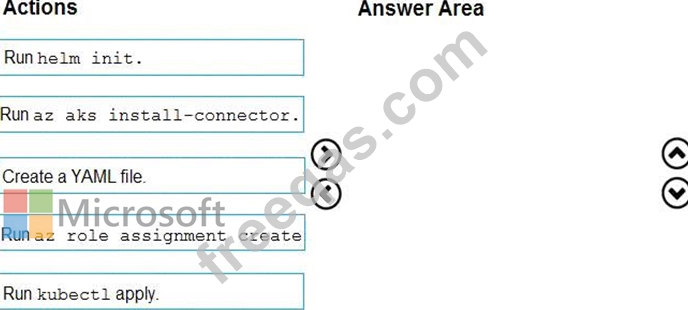
You have an Azure Kubermets Service (AKS) implementation that is RBAC-enabled You plan to use Azure Container Instances as a hosted development environment to run containers in the AKS implementation.
You need to conjure Azure Container Instances as a hosted environment for running me containers in AKS.
Which three actions should you perform m sequence?
To answer, move the appropriate actions from the list of actions to the answer area and arrange them in the correct order.
Correct Answer:

Explanation

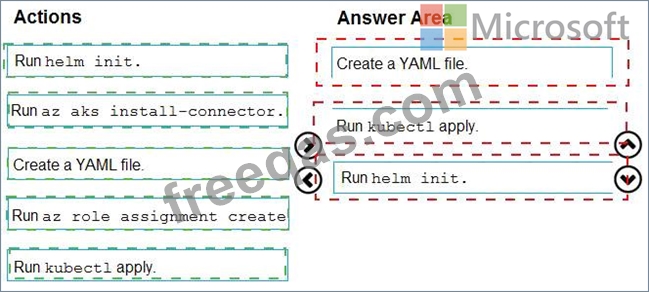
Step 1: Create a YAML file.
If your AKS cluster is RBAC-enabled, you must create a service account and role binding for use with Tiller.
To create a service account and role binding, create a file named rbac-virtual-kubelet.yaml Step 2: Run kubectl apply.
Apply the service account and binding with kubectl apply and specify your rbac-virtual-kubelet.yaml file.
Step 3: Run helm init.
Configure Helm to use the tiller service account:
helm init --service-account tiller
You can now continue to installing the Virtual Kubelet into your AKS cluster.
References: https://docs.microsoft.com/en-us/azure/aks/virtual-kubelet
insert code

Question 267

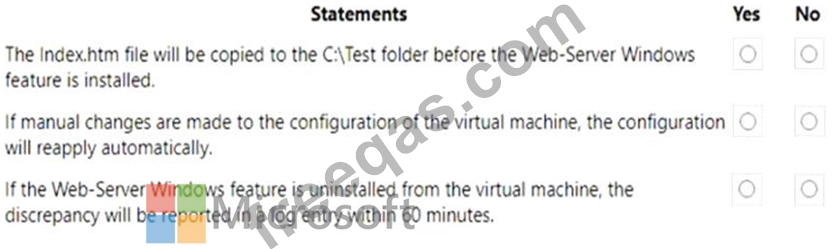
You have a virtual machine that runs Windows Server 2019 and is managed by using Desired State Configuration (DSC).
You have the following DSC configuration.

You have the following Local Configuration Manager (LCM) configuration.

For each of the following statements, select Yes if the statement is true. Otherwise, select No.
NOTE: Each correct selection is worth one point.
Correct Answer:

Explanation
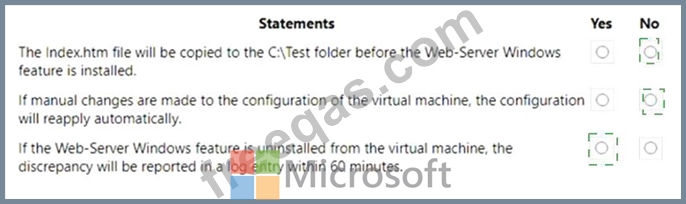
No " Dependson are defined"
No "Mode is Apply and Monitor"
Yes "ConfigurationModeFreqMin : 60 "
------
ConfigurationModeFreqMin :How often, in minutes, the current configuration is checked and applied. This property is ignored if the ConfigurationMode property is set to ApplyOnly.
https://docs.microsoft.com/en-us/powershell/dsc/managing-nodes/metaconfig?view=dsc-1.1
https://docs.microsoft.com/en-us/powershell/dsc/configurations/resource-depends-on?view=dsc-1.1
insert code

Question 268

You have an Azure solution that contains a build pipeline in Azure Pipelines. You experience intermittent delays before the build pipeline starts. You need to reduce the time it takes to start the build pipeline. What should you do?

Correct Answer: C
Explanation
https://docs.microsoft.com/en-us/azure/devops/pipelines/troubleshooting/troubleshooting
insert code

Question 269

You manage a website that uses an Azure SQL Database named db1 in a resource group named RG1lod11566895.
You need to modify the SQL database to protect against SQL injection.
To complete this task, sign in to the Microsoft Azure portal.
Correct Answer: A
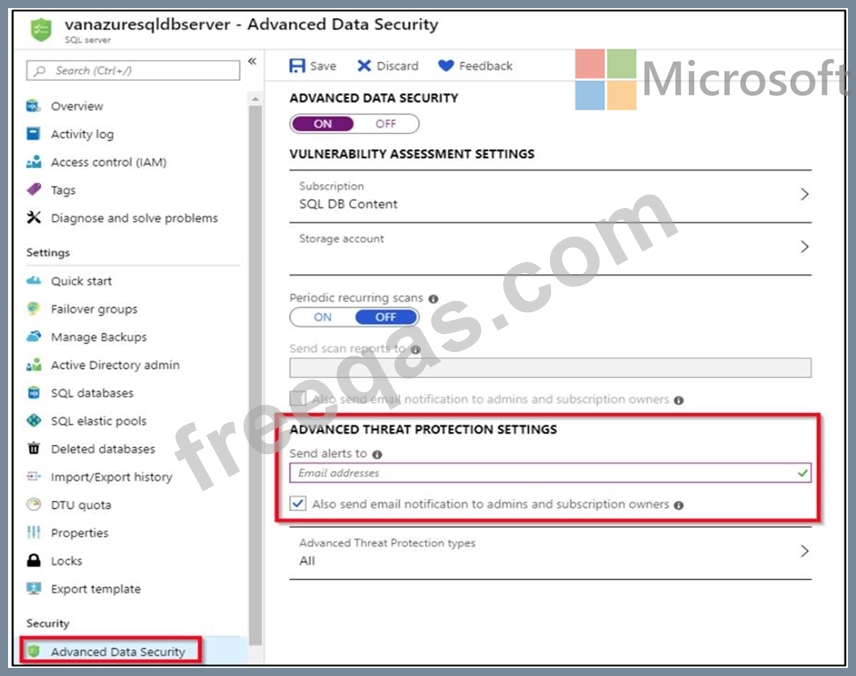
Set up Advanced Threat Protection in the Azure portal
1. Sign into the Azure portal.
2. Navigate to the configuration page of the server you want to protect. In the security settings, select Advanced Data Security.
3. On the Advanced Data Security configuration page:

4. Enable Advanced Data Security on the server.
Note: Advanced Threat Protection for Azure SQL Database detects anomalous activities indicating unusual and potentially harmful attempts to access or exploit databases. Advanced Threat Protection can identify Potential SQL injection, Access from unusual location or data center, Access from unfamiliar principal or potentially harmful application, and Brute force SQL credentials Reference:
https://docs.microsoft.com/en-us/azure/storage/common/storage-account-create
https://docs.microsoft.com/en-us/azure/azure-sql/database/threat-detection-configure
insert code

Question 270

You have an Azure DevOps project named Project1 and an Azure subscription named Sub1. Sub1 contains an Azure SQL database named DB1.
You need to create a release pipeline that uses the Azure SQL Database Deployment task to update DB1.
Which artifact should you deploy?


Correct Answer: B
Use Azure SQL Database Deployment task in a build or release pipeline to deploy to Azure SQL DB using a DACPAC or run scripts using SQLCMD.
Reference:
https://docs.microsoft.com/en-us/azure/devops/pipelines/tasks/deploy/sql-azure-dacpac-deployment
insert code
  • ««
  • «
  • …
  • 48
  • 49
  • 50
  • 51
  • 52
  • 53
  • 54
  • 55
  • 56
  • 57
  • »
[×]

Download PDF File

Enter your email address to download Microsoft.AZ-400.v2025-02-10.q279 Dumps

Email:

FreeQAs

Our website provides the Largest and the most Latest vendors Certification Exam materials around the world.

Using dumps we provide to Pass the Exam, we has the Valid Dumps with passing guranteed just which you need.

  • DMCA
  • About
  • Contact Us
  • Privacy Policy
  • Terms & Conditions
©2026 FreeQAs

www.freeqas.com materials do not contain actual questions and answers from Cisco's certification exams.