You have an Azure subscription that contains the following resources:
A virtual network named Vnet1
Two subnets named subnet1 and AzureFirewallSubnet
A public Azure Firewall named FW1
A route table named RT1 that is associated to Subnet1
A rule routing of 0.0.0.0/0 to FW1 in RT1
After deploying 10 servers that run Windows Server to Subnet1, you discover that none of the virtual machines were activated.
You need to ensure that the virtual machines can be activated.
What should you do?
You have an Azure Front Door instance named FD1 that is protected by using Azure Web Application Firewall (WAF).
FD1 uses a frontend host named app1.contoso.com to provide access to Azure web apps hosted in the East US Azure region and the West US Azure region.
You need to configure FD1 to block requests to app1.contoso.com from all countries other than the United States.
What should you include in the WAF policy?

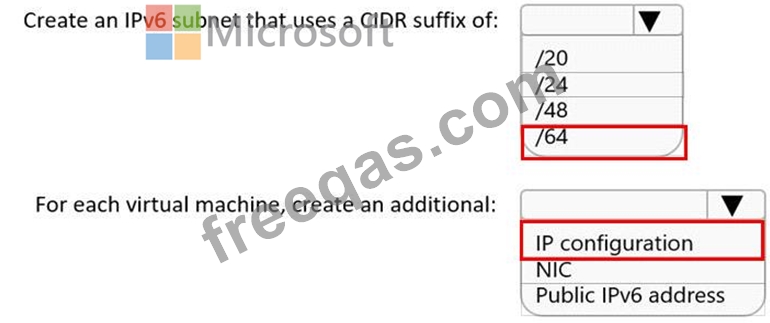
Your company has an Azure virtual network named Vnet1 that uses an IP address space of 192.168.0.0/20. Vnet1 contains a subnet named Subnet1 that uses an IP address space of 192.168.0.0/24.
You create an IPv6 address range to Vnet1 by using a CIDR suffix of /48.
You need to enable the virtual machines on Subnet1 to communicate with each other by using IPv6 addresses assigned by the company. The solution must minimize the number of additional IPv4 addresses.
What should you do? To answer, select the appropriate options in the answer area.
NOTE: Each correct selection is worth one point.
You have an Azure subscription that contains two virtual networks named Vnet1 and Vnet2.
You register a public DNS zone named fabrikam.com. The zone is configured as shown in the Public DNS Zone exhibit.
You have a private DNS zone named fabrikam.com. The zone is configured as shown in the Private DNS Zone exhibit.
You have a virtual network link configured as shown in the Virtual Network Link exhibit.
For each of the following statements, select Yes if the statement is true. Otherwise, select No.
NOTE: Each correct selection is worth one point.

You have 10 Azure App Service instances. Each instance hosts the same web app. Each instance is in a different Azure region.
You need to configure Azure Traffic Manager to direct users to the instance that has the lowest latency.
Which routing method should you use?

