Note: This question is part of a series of questions that present the same scenario. Each question in the series contains a unique solution that might meet the stated goals. Some question sets might have more than one correct solution, while others might not have a correct solution.
After you answer a question in this section, you will NOT be able to return to it. As a result, these questions will not appear in the review screen.
You are creating a new experiment in Azure Machine Learning Studio.
One class has a much smaller number of observations than the other classes in the training set.
You need to select an appropriate data sampling strategy to compensate for the class imbalance.
Solution: You use the Scale and Reduce sampling mode.
Does the solution meet the goal?
You are using the Azure Machine Learning Service to automate hyperparameter exploration of your neural network classification model.
You must define the hyperparameter space to automatically tune hyperparameters using random sampling according to following requirements:
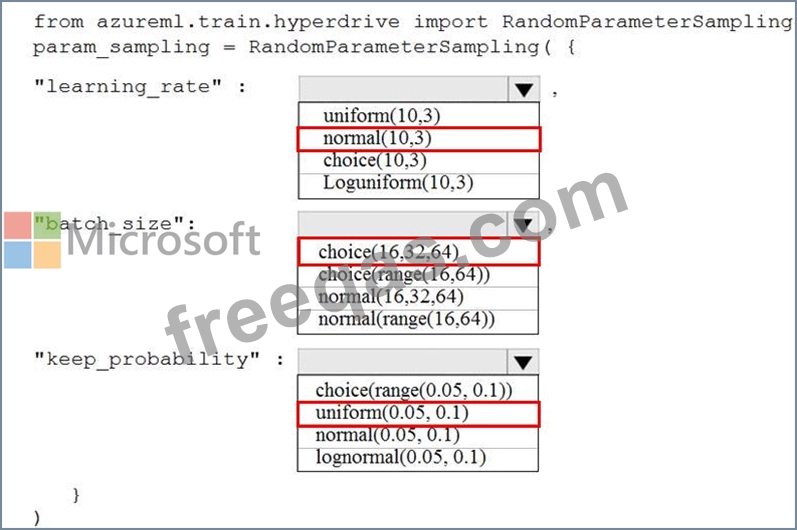
* The learning rate must be selected from a normal distribution with a mean value of 10 and a standard deviation of 3.
* Batch size must be 16, 32 and 64.
* Keep probability must be a value selected from a uniform distribution between the range of 0.05 and 0.1.
You need to use the param_sampling method of the Python API for the Azure Machine Learning Service.
How should you complete the code segment? To answer, select the appropriate options in the answer area.
NOTE: Each correct selection is worth one point.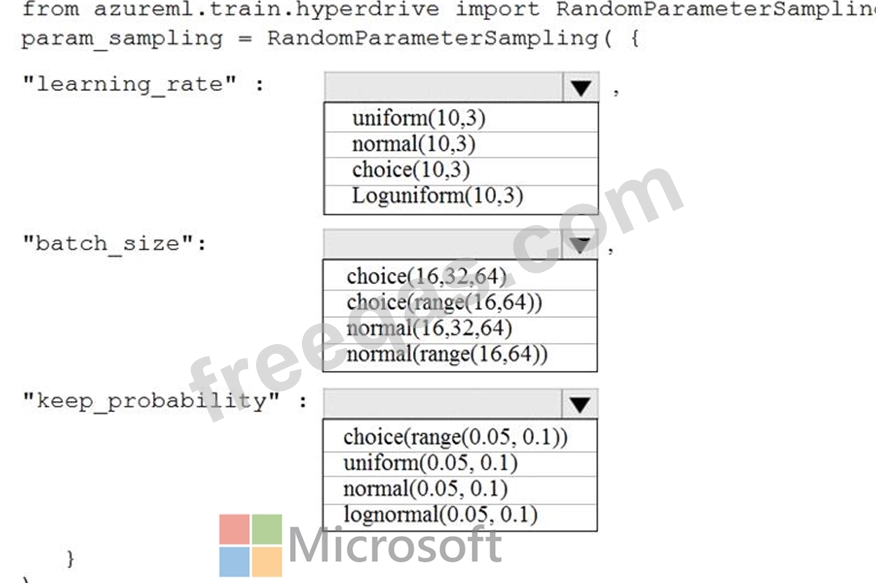
You use the Azure Machine Learning service to create a tabular dataset named training.data. You plan to use this dataset in a training script.
You create a variable that references the dataset using the following code:
training_ds = workspace.datasets.get("training_data")
You define an estimator to run the script.
You need to set the correct property of the estimator to ensure that your script can access the training.data dataset Which property should you set?
A)
B)
C)
D)
You are a data scientist working for a bank and have used Azure ML to train and register a machine learning model that predicts whether a customer is likely to repay a loan.
You want to understand how your model is making selections and must be sure that the model does not violate government regulations such as denying loans based on where an applicant lives.
You need to determine the extent to which each feature in the customer data is influencing predictions.
What should you do?
You need to configure the Edit Metadata module so that the structure of the datasets match.
Which configuration options should you select? To answer, select the appropriate options in the answer area.
NOTE: Each correct selection is worth one point.


