FreeQAs
 Request Exam  Contact
  • Home
  • View All Exams
  • New QA's
  • Upload
PRACTICE EXAMS:
  • Oracle
  • Fortinet
  • Juniper
  • Microsoft
  • Cisco
  • Citrix
  • CompTIA
  • VMware
  • ISC
  • SAP
  • EMC
  • PMI
  • HP
  • Salesforce
  • Other
  • Oracle
    Oracle
  • Fortinet
    Fortinet
  • Juniper
    Juniper
  • Microsoft
    Microsoft
  • Cisco
    Cisco
  • Citrix
    Citrix
  • CompTIA
    CompTIA
  • VMware
    VMware
  • ISC
    ISC
  • SAP
    SAP
  • EMC
    EMC
  • PMI
    PMI
  • HP
    HP
  • Salesforce
    Salesforce
  1. Home
  2. Microsoft Certification
  3. DP-203 Exam
  4. Microsoft.DP-203.v2022-04-01.q227 Dumps
  • ««
  • «
  • …
  • 11
  • 12
  • 13
  • 14
  • 15
  • 16
  • 17
  • 18
  • 19
  • 20
  • …
  • »
  • »»
Download Now

Question 71

You have an Azure Databricks workspace named workspace1 in the Standard pricing tier.
You need to configure workspace1 to support autoscaling all-purpose clusters. The solution must meet the following requirements:
Automatically scale down workers when the cluster is underutilized for three minutes.
Minimize the time it takes to scale to the maximum number of workers.
Minimize costs.
What should you do first?

Correct Answer: B
For clusters running Databricks Runtime 6.4 and above, optimized autoscaling is used by all-purpose clusters in the Premium plan Optimized autoscaling:
Scales up from min to max in 2 steps.
Can scale down even if the cluster is not idle by looking at shuffle file state.
Scales down based on a percentage of current nodes.
On job clusters, scales down if the cluster is underutilized over the last 40 seconds.
On all-purpose clusters, scales down if the cluster is underutilized over the last 150 seconds.
The spark.databricks.aggressiveWindowDownS Spark configuration property specifies in seconds how often a cluster makes down-scaling decisions. Increasing the value causes a cluster to scale down more slowly. The maximum value is 600.
Note: Standard autoscaling
Starts with adding 8 nodes. Thereafter, scales up exponentially, but can take many steps to reach the max. You can customize the first step by setting the spark.databricks.autoscaling.standardFirstStepUp Spark configuration property.
Scales down only when the cluster is completely idle and it has been underutilized for the last 10 minutes.
Scales down exponentially, starting with 1 node.
Reference:
https://docs.databricks.com/clusters/configure.html
insert code

Question 72

You have an Azure Data Lake Storage Gen2 account that contains a JSON file for customers. The file contains two attributes named FirstName and LastName.
You need to copy the data from the JSON file to an Azure Synapse Analytics table by using Azure Databricks.
A new column must be created that concatenates the FirstName and LastName values.
You create the following components:
* A destination table in Azure Synapse
* An Azure Blob storage container
* A service principal
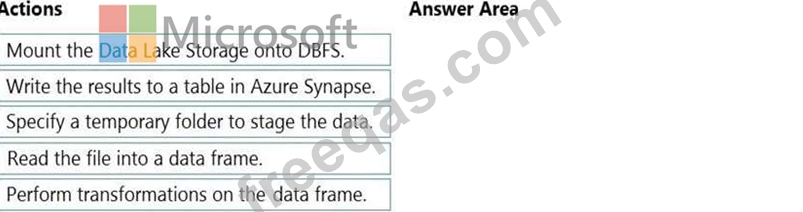
In which order should you perform the actions? To answer, move the appropriate actions from the list of actions to the answer area and arrange them in the correct order.
Correct Answer:

Explanation
Table Description automatically generated

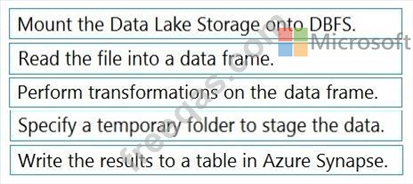
Step 1: Mount the Data Lake Storage onto DBFS
Begin with creating a file system in the Azure Data Lake Storage Gen2 account.
Step 2: Read the file into a data frame.
You can load the json files as a data frame in Azure Databricks.
Step 3: Perform transformations on the data frame.
Step 4: Specify a temporary folder to stage the data
Specify a temporary folder to use while moving data between Azure Databricks and Azure Synapse.
Step 5: Write the results to a table in Azure Synapse.
You upload the transformed data frame into Azure Synapse. You use the Azure Synapse connector for Azure Databricks to directly upload a dataframe as a table in a Azure Synapse.
Reference:
https://docs.microsoft.com/en-us/azure/azure-databricks/databricks-extract-load-sql-data-warehouse
insert code

Question 73

You are designing a partition strategy for a fact table in an Azure Synapse Analytics dedicated SQL pool. The table has the following specifications:
* Contain sales data for 20,000 products.
* Use hash distribution on a column named ProduclID,
* Contain 2.4 billion records for the years 20l9 and 2020.
Which number of partition ranges provides optimal compression and performance of the clustered columnstore index?

Correct Answer: B
insert code

Question 74

You are implementing Azure Stream Analytics windowing functions.
Which windowing function should you use for each requirement? To answer, select the appropriate options in the answer area.
NOTE: Each correct selection is worth one point.

Correct Answer:
insert code

Question 75

You are designing a real-time dashboard solution that will visualize streaming data from remote sensors that connect to the internet. The streaming data must be aggregated to show the average value of each 10-second interval. The data will be discarded after being displayed in the dashboard.
The solution will use Azure Stream Analytics and must meet the following requirements:
Minimize latency from an Azure Event hub to the dashboard.
Minimize the required storage.
Minimize development effort.
What should you include in the solution? To answer, select the appropriate options in the answer area.
NOTE: Each correct selection is worth one point

Correct Answer:

Reference:
https://docs.microsoft.com/en-us/azure/stream-analytics/stream-analytics-power-bi-dashboard
insert code
  • ««
  • «
  • …
  • 11
  • 12
  • 13
  • 14
  • 15
  • 16
  • 17
  • 18
  • 19
  • 20
  • …
  • »
  • »»
[×]

Download PDF File

Enter your email address to download Microsoft.DP-203.v2022-04-01.q227 Dumps

Email:

FreeQAs

Our website provides the Largest and the most Latest vendors Certification Exam materials around the world.

Using dumps we provide to Pass the Exam, we has the Valid Dumps with passing guranteed just which you need.

  • DMCA
  • About
  • Contact Us
  • Privacy Policy
  • Terms & Conditions
©2026 FreeQAs

www.freeqas.com materials do not contain actual questions and answers from Cisco's certification exams.
