FreeQAs
 Request Exam  Contact
  • Home
  • View All Exams
  • New QA's
  • Upload
PRACTICE EXAMS:
  • Oracle
  • Fortinet
  • Juniper
  • Microsoft
  • Cisco
  • Citrix
  • CompTIA
  • VMware
  • ISC
  • SAP
  • EMC
  • PMI
  • HP
  • Salesforce
  • Other
  • Oracle
    Oracle
  • Fortinet
    Fortinet
  • Juniper
    Juniper
  • Microsoft
    Microsoft
  • Cisco
    Cisco
  • Citrix
    Citrix
  • CompTIA
    CompTIA
  • VMware
    VMware
  • ISC
    ISC
  • SAP
    SAP
  • EMC
    EMC
  • PMI
    PMI
  • HP
    HP
  • Salesforce
    Salesforce
  1. Home
  2. Microsoft Certification
  3. DP-203 Exam
  4. Microsoft.DP-203.v2022-04-01.q227 Dumps
  • ««
  • «
  • …
  • 32
  • 33
  • 34
  • 35
  • 36
  • 37
  • 38
  • 39
  • 40
  • 41
  • …
  • »
  • »»
Download Now

Question 176

You have an Azure subscription that is linked to a hybrid Azure Active Directory (Azure AD) tenant. The subscription contains an Azure Synapse Analytics SQL pool named Pool1.
You need to recommend an authentication solution for Pool1. The solution must support multi-factor authentication (MFA) and database-level authentication.
Which authentication solution or solutions should you include in the recommendation? To answer, select the appropriate options in the answer area.
NOTE: Each correct selection is worth one point.

Correct Answer:

Explanation
Graphical user interface, text, application, chat or text message Description automatically generated

Box 1: Azure AD authentication
Azure Active Directory authentication supports Multi-Factor authentication through Active Directory Universal Authentication.
Box 2: Contained database users
Azure Active Directory Uses contained database users to authenticate identities at the database level.
Reference:
https://docs.microsoft.com/en-us/azure/synapse-analytics/sql-data-warehouse/sql-data-warehouse-authentication
insert code

Question 177

You create an Azure Databricks cluster and specify an additional library to install.
When you attempt to load the library to a notebook, the library in not found.
You need to identify the cause of the issue.
What should you review?

Correct Answer: C
Cluster-scoped Init Scripts: Init scripts are shell scripts that run during the startup of each cluster node before the Spark driver or worker JVM starts. Databricks customers use init scripts for various purposes such as installing custom libraries, launching background processes, or applying enterprise security policies.
Logs for Cluster-scoped init scripts are now more consistent with Cluster Log Delivery and can be found in the same root folder as driver and executor logs for the cluster.
Reference:
https://databricks.com/blog/2018/08/30/introducing-cluster-scoped-init-scripts.html
insert code

Question 178

You are creating an Azure Data Factory data flow that will ingest data from a CSV file, cast columns to specified types of data, and insert the data into a table in an Azure Synapse Analytic dedicated SQL pool. The CSV file contains three columns named username, comment, and date.
The data flow already contains the following:
A source transformation.
A Derived Column transformation to set the appropriate types of dat
a.
A sink transformation to land the data in the pool.
You need to ensure that the data flow meets the following requirements:
All valid rows must be written to the destination table.
Truncation errors in the comment column must be avoided proactively.
Any rows containing comment values that will cause truncation errors upon insert must be written to a file in blob storage.
Which two actions should you perform? Each correct answer presents part of the solution.
NOTE: Each correct selection is worth one point.

Correct Answer: A,B
B: Example:
1. This conditional split transformation defines the maximum length of "title" to be five. Any row that is less than or equal to five will go into the GoodRows stream. Any row that is larger than five will go into the BadRows stream.

2. This conditional split transformation defines the maximum length of "title" to be five. Any row that is less than or equal to five will go into the GoodRows stream. Any row that is larger than five will go into the BadRows stream.
A:
3. Now we need to log the rows that failed. Add a sink transformation to the BadRows stream for logging. Here, we'll "auto-map" all of the fields so that we have logging of the complete transaction record. This is a text-delimited CSV file output to a single file in Blob Storage. We'll call the log file "badrows.csv".

4. The completed data flow is shown below. We are now able to split off error rows to avoid the SQL truncation errors and put those entries into a log file. Meanwhile, successful rows can continue to write to our target database.

Reference:
https://docs.microsoft.com/en-us/azure/data-factory/how-to-data-flow-error-rows
insert code

Question 179

You are designing a slowly changing dimension (SCD) for supplier data in an Azure Synapse Analytics dedicated SQL pool.
You plan to keep a record of changes to the available fields.
The supplier data contains the following columns.

Which three additional columns should you add to the data to create a Type 2 SCD? Each correct answer presents part of the solution.
NOTE: Each correct selection is worth one point.

Correct Answer: A,B,D
insert code

Question 180

You have two Azure Storage accounts named Storage1 and Storage2. Each account holds one container and has the hierarchical namespace enabled. The system has files that contain data stored in the Apache Parquet format.
You need to copy folders and files from Storage1 to Storage2 by using a Data Factory copy activity. The solution must meet the following requirements:
* No transformations must be performed.
* The original folder structure must be retained.
* Minimize time required to perform the copy activity.
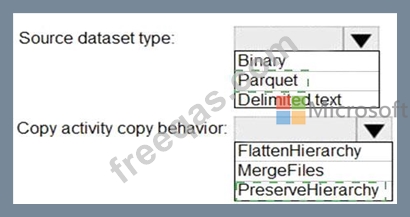
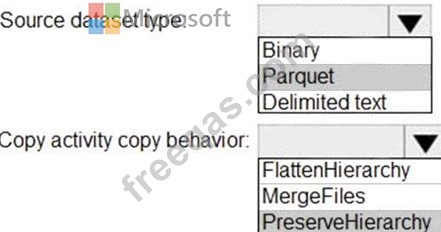
How should you configure the copy activity? To answer, select the appropriate options in the answer area.
NOTE: Each correct selection is worth one point.
Correct Answer:

Explanation
Graphical user interface, text, application, chat or text message Description automatically generated

Box 1: Parquet
For Parquet datasets, the type property of the copy activity source must be set to ParquetSource.
Box 2: PreserveHierarchy
PreserveHierarchy (default): Preserves the file hierarchy in the target folder. The relative path of the source file to the source folder is identical to the relative path of the target file to the target folder.
Reference:
https://docs.microsoft.com/en-us/azure/data-factory/format-parquet
https://docs.microsoft.com/en-us/azure/data-factory/connector-azure-data-lake-storage
insert code
  • ««
  • «
  • …
  • 32
  • 33
  • 34
  • 35
  • 36
  • 37
  • 38
  • 39
  • 40
  • 41
  • …
  • »
  • »»
[×]

Download PDF File

Enter your email address to download Microsoft.DP-203.v2022-04-01.q227 Dumps

Email:

FreeQAs

Our website provides the Largest and the most Latest vendors Certification Exam materials around the world.

Using dumps we provide to Pass the Exam, we has the Valid Dumps with passing guranteed just which you need.

  • DMCA
  • About
  • Contact Us
  • Privacy Policy
  • Terms & Conditions
©2026 FreeQAs

www.freeqas.com materials do not contain actual questions and answers from Cisco's certification exams.
