FreeQAs
 Request Exam  Contact
  • Home
  • View All Exams
  • New QA's
  • Upload
PRACTICE EXAMS:
  • Oracle
  • Fortinet
  • IBM
  • Juniper
  • Microsoft
  • Cisco
  • Citrix
  • CompTIA
  • VMware
  • ISC
  • SAP
  • EMC
  • PMI
  • HP
  • Salesforce
  • Other
  • Oracle
    Oracle
  • Fortinet
    Fortinet
  • IBM
    IBM
  • Juniper
    Juniper
  • Microsoft
    Microsoft
  • Cisco
    Cisco
  • Citrix
    Citrix
  • CompTIA
    CompTIA
  • VMware
    VMware
  • ISC
    ISC
  • SAP
    SAP
  • EMC
    EMC
  • PMI
    PMI
  • HP
    HP
  • Salesforce
    Salesforce
  1. Home
  2. Microsoft Certification
  3. DP-203 Exam
  4. Microsoft.DP-203.v2023-12-07.q182 Dumps
  • «
  • 1
  • 2
  • 3
  • 4
  • 5
  • 6
  • 7
  • 8
  • 9
  • 10
  • …
  • »
  • »»
Download Now

Question 21

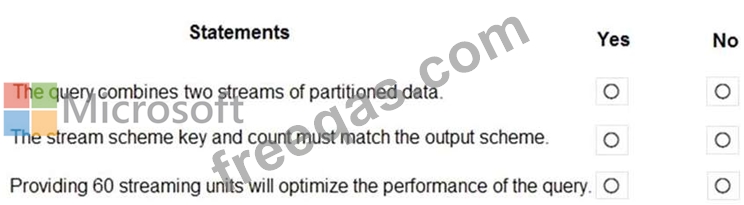
You have the following Azure Stream Analytics query.

For each of the following statements, select Yes if the statement is true. Otherwise, select No.
NOTE: Each correct selection is worth one point.
Correct Answer:

Explanation
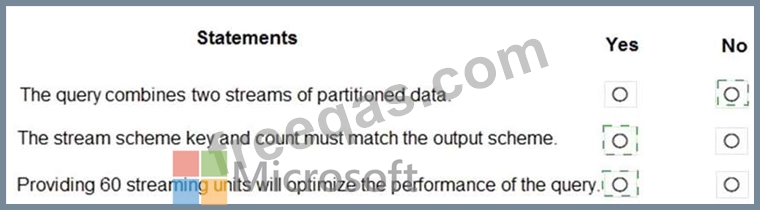
Box 1: No
Note: You can now use a new extension of Azure Stream Analytics SQL to specify the number of partitions of a stream when reshuffling the data.
The outcome is a stream that has the same partition scheme. Please see below for an example:
WITH step1 AS (SELECT * FROM [input1] PARTITION BY DeviceID INTO 10),
step2 AS (SELECT * FROM [input2] PARTITION BY DeviceID INTO 10)
SELECT * INTO [output] FROM step1 PARTITION BY DeviceID UNION step2 PARTITION BY DeviceID Note: The new extension of Azure Stream Analytics SQL includes a keyword INTO that allows you to specify the number of partitions for a stream when performing reshuffling using a PARTITION BY statement.
Box 2: Yes
When joining two streams of data explicitly repartitioned, these streams must have the same partition key and partition count.
Box 3: Yes
Streaming Units (SUs) represents the computing resources that are allocated to execute a Stream Analytics job. The higher the number of SUs, the more CPU and memory resources are allocated for your job.
In general, the best practice is to start with 6 SUs for queries that don't use PARTITION BY.
Here there are 10 partitions, so 6x10 = 60 SUs is good.
Note: Remember, Streaming Unit (SU) count, which is the unit of scale for Azure Stream Analytics, must be adjusted so the number of physical resources available to the job can fit the partitioned flow. In general, six SUs is a good number to assign to each partition. In case there are insufficient resources assigned to the job, the system will only apply the repartition if it benefits the job.
Reference:
https://azure.microsoft.com/en-in/blog/maximize-throughput-with-repartitioning-in-azure-stream-analytics/
https://docs.microsoft.com/en-us/azure/stream-analytics/stream-analytics-streaming-unit-consumption
insert code

Question 22

Note: This question is part of a series of questions that present the same scenario. Each question in the series contains a unique solution that might meet the stated goals. Some question sets might have more than one correct solution, while others might not have a correct solution.
After you answer a question in this section, you will NOT be able to return to it. As a result, these questions will not appear in the review screen.
You have an Azure Synapse Analytics dedicated SQL pool that contains a table named Table1.
You have files that are ingested and loaded into an Azure Data Lake Storage Gen2 container named container1.
You plan to insert data from the files in container1 into Table1 and transform the data. Each row of data in the files will produce one row in the serving layer of Table1.
You need to ensure that when the source data files are loaded to container1, the DateTime is stored as an additional column in Table1.
Solution: You use an Azure Synapse Analytics serverless SQL pool to create an external table that has an additional DateTime column.
Does this meet the goal?

Correct Answer: B
Explanation
Instead use the derived column transformation to generate new columns in your data flow or to modify existing fields.
Reference:
https://docs.microsoft.com/en-us/azure/data-factory/data-flow-derived-column
insert code

Question 23

You are designing an enterprise data warehouse in Azure Synapse Analytics that will store website traffic analytics in a star schema.
You plan to have a fact table for website visits. The table will be approximately 5 GB.
You need to recommend which distribution type and index type to use for the table. The solution must provide the fastest query performance.
What should you recommend? To answer, select the appropriate options in the answer area.
NOTE: Each correct selection is worth one point.

Correct Answer:

Reference:
https://docs.microsoft.com/en-us/azure/synapse-analytics/sql-data-warehouse/sql-data-warehouse-tables-distribute
https://docs.microsoft.com/en-us/azure/synapse-analytics/sql-data-warehouse/sql-data-warehouse-tables-index
insert code

Question 24

You have an Azure Data Lake Storage Gen2 account that contains a JSON file for customers. The file contains two attributes named FirstName and LastName.
You need to copy the data from the JSON file to an Azure Synapse Analytics table by using Azure Databricks.
A new column must be created that concatenates the FirstName and LastName values.
You create the following components:
* A destination table in Azure Synapse
* An Azure Blob storage container
* A service principal
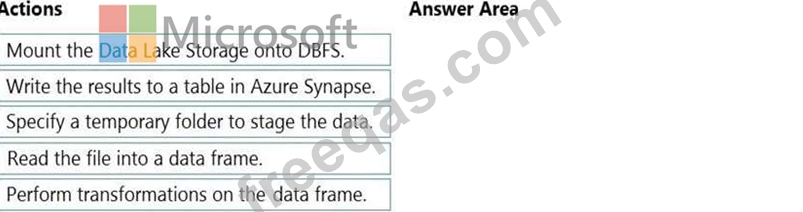
In which order should you perform the actions? To answer, move the appropriate actions from the list of actions to the answer area and arrange them in the correct order.
Correct Answer:

Explanation
Table Description automatically generated

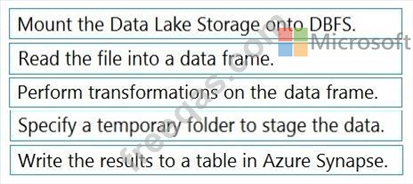
Step 1: Mount the Data Lake Storage onto DBFS
Begin with creating a file system in the Azure Data Lake Storage Gen2 account.
Step 2: Read the file into a data frame.
You can load the json files as a data frame in Azure Databricks.
Step 3: Perform transformations on the data frame.
Step 4: Specify a temporary folder to stage the data
Specify a temporary folder to use while moving data between Azure Databricks and Azure Synapse.
Step 5: Write the results to a table in Azure Synapse.
You upload the transformed data frame into Azure Synapse. You use the Azure Synapse connector for Azure Databricks to directly upload a dataframe as a table in a Azure Synapse.
Reference:
https://docs.microsoft.com/en-us/azure/azure-databricks/databricks-extract-load-sql-data-warehouse
insert code

Question 25

You are designing an enterprise data warehouse in Azure Synapse Analytics that will contain a table named Customers. Customers will contain credit card information.
You need to recommend a solution to provide salespeople with the ability to view all the entries in Customers.
The solution must prevent all the salespeople from viewing or inferring the credit card information.
What should you include in the recommendation?


Correct Answer: A
SQL Database dynamic data masking limits sensitive data exposure by masking it to non-privileged users.
The Credit card masking method exposes the last four digits of the designated fields and adds a constant string as a prefix in the form of a credit card.
Example: XXXX-XXXX-XXXX-1234
Reference:
https://docs.microsoft.com/en-us/azure/sql-database/sql-database-dynamic-data-masking-get-started Monitor and optimize data storage and data processing Testlet 1 Case study This is a case study. Case studies are not timed separately. You can use as much exam time as you would like to complete each case. However, there may be additional case studies and sections on this exam. You must manage your time to ensure that you are able to complete all questions included on this exam in the time provided.
To answer the questions included in a case study, you will need to reference information that is provided in the case study. Case studies might contain exhibits and other resources that provide more information about the scenario that is described in the case study. Each question is independent of the other questions in this case study.
At the end of this case study, a review screen will appear. This screen allows you to review your answers and to make changes before you move to the next section of the exam. After you begin a new section, you cannot return to this section.
To start the case study
To display the first question in this case study, click the Next button. Use the buttons in the left pane to explore the content of the case study before you answer the questions. Clicking these buttons displays information such as business requirements, existing environment, and problem statements. If the case study has an All Information tab, note that the information displayed is identical to the information displayed on the subsequent tabs. When you are ready to answer a question, click the Question button to return to the question.
Overview
Litware, Inc. owns and operates 300 convenience stores across the US. The company sells a variety of packaged foods and drinks, as well as a variety of prepared foods, such as sandwiches and pizzas.
Litware has a loyalty club whereby members can get daily discounts on specific items by providing their membership number at checkout.
Litware employs business analysts who prefer to analyze data by using Microsoft Power BI, and data scientists who prefer analyzing data in Azure Databricks notebooks.
Requirements
Business Goals
Litware wants to create a new analytics environment in Azure to meet the following requirements:
* See inventory levels across the stores. Data must be updated as close to real time as possible.
* Execute ad hoc analytical queries on historical data to identify whether the loyalty club discounts increase sales of the discounted products.
* Every four hours, notify store employees about how many prepared food items to produce based on historical demand from the sales data.
Technical Requirements
Litware identifies the following technical requirements:
* Minimize the number of different Azure services needed to achieve the business goals.
* Use platform as a service (PaaS) offerings whenever possible and avoid having to provision virtual machines that must be managed by Litware.
* Ensure that the analytical data store is accessible only to the company's on-premises network and Azure services.
* Use Azure Active Directory (Azure AD) authentication whenever possible.
* Use the principle of least privilege when designing security.
* Stage Inventory data in Azure Data Lake Storage Gen2 before loading the data into the analytical data store. Litware wants to remove transient data from Data Lake Storage once the data is no longer in use.
Files that have a modified date that is older than 14 days must be removed.
* Limit the business analysts' access to customer contact information, such as phone numbers, because this type of data is not analytically relevant.
* Ensure that you can quickly restore a copy of the analytical data store within one hour in the event of corruption or accidental deletion.
Planned Environment
Litware plans to implement the following environment:
* The application development team will create an Azure event hub to receive real-time sales data, including store number, date, time, product ID, customer loyalty number, price, and discount amount, from the point of sale (POS) system and output the data to data storage in Azure.
* Customer data, including name, contact information, and loyalty number, comes from Salesforce, a SaaS application, and can be imported into Azure once every eight hours. Row modified dates are not trusted in the source table.
* Product data, including product ID, name, and category, comes from Salesforce and can be imported into Azure once every eight hours. Row modified dates are not trusted in the source table.
* Daily inventory data comes from a Microsoft SQL server located on a private network.
* Litware currently has 5 TB of historical sales data and 100 GB of customer data. The company expects approximately 100 GB of new data per month for the next year.
* Litware will build a custom application named FoodPrep to provide store employees with the calculation results of how many prepared food items to produce every four hours.
* Litware does not plan to implement Azure ExpressRoute or a VPN between the on-premises network and Azure.
insert code
  • «
  • 1
  • 2
  • 3
  • 4
  • 5
  • 6
  • 7
  • 8
  • 9
  • 10
  • …
  • »
  • »»
[×]

Download PDF File

Enter your email address to download Microsoft.DP-203.v2023-12-07.q182 Dumps

Email:

FreeQAs

Our website provides the Largest and the most Latest vendors Certification Exam materials around the world.

Using dumps we provide to Pass the Exam, we has the Valid Dumps with passing guranteed just which you need.

  • DMCA
  • About
  • Contact Us
  • Privacy Policy
  • Terms & Conditions
©2026 FreeQAs

www.freeqas.com materials do not contain actual questions and answers from Cisco's certification exams.