FreeQAs
 Request Exam  Contact
  • Home
  • View All Exams
  • New QA's
  • Upload
PRACTICE EXAMS:
  • Oracle
  • Fortinet
  • Juniper
  • Microsoft
  • Cisco
  • Citrix
  • CompTIA
  • VMware
  • ISC
  • SAP
  • EMC
  • PMI
  • HP
  • Salesforce
  • Other
  • Oracle
    Oracle
  • Fortinet
    Fortinet
  • Juniper
    Juniper
  • Microsoft
    Microsoft
  • Cisco
    Cisco
  • Citrix
    Citrix
  • CompTIA
    CompTIA
  • VMware
    VMware
  • ISC
    ISC
  • SAP
    SAP
  • EMC
    EMC
  • PMI
    PMI
  • HP
    HP
  • Salesforce
    Salesforce
  1. Home
  2. Microsoft Certification
  3. DP-203 Exam
  4. Microsoft.DP-203.v2024-01-19.q230 Dumps
  • ««
  • «
  • …
  • 11
  • 12
  • 13
  • 14
  • 15
  • 16
  • 17
  • 18
  • 19
  • 20
  • …
  • »
  • »»
Download Now

Question 71

You need to output files from Azure Data Factory.
Which file format should you use for each type of output? To answer, select the appropriate options in the answer area.
NOTE: Each correct selection is worth one point.
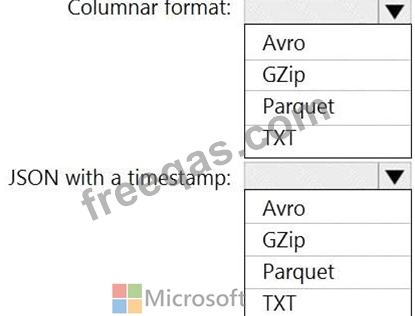
Correct Answer:

Explanation

Box 1: Parquet
Parquet stores data in columns, while Avro stores data in a row-based format. By their very nature, column-oriented data stores are optimized for read-heavy analytical workloads, while row-based databases are best for write-heavy transactional workloads.
Box 2: Avro
An Avro schema is created using JSON format.
AVRO supports timestamps.
Note: Azure Data Factory supports the following file formats (not GZip or TXT).
* Avro format
* Binary format
* Delimited text format
* Excel format
* JSON format
* ORC format
* Parquet format
* XML format
Reference:
https://www.datanami.com/2018/05/16/big-data-file-formats-demystified
insert code

Question 72

You are designing a streaming data solution that will ingest variable volumes of data.
You need to ensure that you can change the partition count after creation.
Which service should you use to ingest the data?

Correct Answer: D
insert code

Question 73

You are designing an Azure Stream Analytics job to process incoming events from sensors in retail environments.
You need to process the events to produce a running average of shopper counts during the previous 15 minutes, calculated at five-minute intervals.
Which type of window should you use?

Correct Answer: B
Tumbling windows are a series of fixed-sized, non-overlapping and contiguous time intervals. The following diagram illustrates a stream with a series of events and how they are mapped into 10-second tumbling windows.

Reference:
https://docs.microsoft.com/en-us/stream-analytics-query/tumbling-window-azure-stream-analytics
insert code

Question 74

You need to design an analytical storage solution for the transactional data. The solution must meet the sales transaction dataset requirements.
What should you include in the solution? To answer, select the appropriate options in the answer area.
NOTE: Each correct selection is worth one point.

Correct Answer:

Explanation
Graphical user interface, text, application, table Description automatically generated

Box 1: Round-robin
Round-robin tables are useful for improving loading speed.
Scenario: Partition data that contains sales transaction records. Partitions must be designed to provide efficient loads by month.
Box 2: Hash
Hash-distributed tables improve query performance on large fact tables.
Reference:
https://docs.microsoft.com/en-us/azure/synapse-analytics/sql-data-warehouse/sql-data-warehouse-tables-distribu
insert code

Question 75

You need to implement a Type 3 slowly changing dimension (SCD) for product category data in an Azure Synapse Analytics dedicated SQL pool.
You have a table that was created by using the following Transact-SQL statement.

Which two columns should you add to the table? Each correct answer presents part of the solution.
NOTE: Each correct selection is worth one point.

Correct Answer: B,E
A Type 3 SCD supports storing two versions of a dimension member as separate columns. The table includes a column for the current value of a member plus either the original or previous value of the member. So Type 3 uses additional columns to track one key instance of history, rather than storing additional rows to track each change like in a Type 2 SCD.
This type of tracking may be used for one or two columns in a dimension table. It is not common to use it for many members of the same table. It is often used in combination with Type 1 or Type 2 members.

Reference:
https://k21academy.com/microsoft-azure/azure-data-engineer-dp203-q-a-day-2-live-session-review/
insert code
  • ««
  • «
  • …
  • 11
  • 12
  • 13
  • 14
  • 15
  • 16
  • 17
  • 18
  • 19
  • 20
  • …
  • »
  • »»
[×]

Download PDF File

Enter your email address to download Microsoft.DP-203.v2024-01-19.q230 Dumps

Email:

FreeQAs

Our website provides the Largest and the most Latest vendors Certification Exam materials around the world.

Using dumps we provide to Pass the Exam, we has the Valid Dumps with passing guranteed just which you need.

  • DMCA
  • About
  • Contact Us
  • Privacy Policy
  • Terms & Conditions
©2026 FreeQAs

www.freeqas.com materials do not contain actual questions and answers from Cisco's certification exams.
