FreeQAs
 Request Exam  Contact
  • Home
  • View All Exams
  • New QA's
  • Upload
PRACTICE EXAMS:
  • Oracle
  • Fortinet
  • Juniper
  • Microsoft
  • Cisco
  • Citrix
  • CompTIA
  • VMware
  • ISC
  • SAP
  • EMC
  • PMI
  • HP
  • Salesforce
  • Other
  • Oracle
    Oracle
  • Fortinet
    Fortinet
  • Juniper
    Juniper
  • Microsoft
    Microsoft
  • Cisco
    Cisco
  • Citrix
    Citrix
  • CompTIA
    CompTIA
  • VMware
    VMware
  • ISC
    ISC
  • SAP
    SAP
  • EMC
    EMC
  • PMI
    PMI
  • HP
    HP
  • Salesforce
    Salesforce
  1. Home
  2. Microsoft Certification
  3. DP-203 Exam
  4. Microsoft.DP-203.v2024-01-19.q230 Dumps
  • ««
  • «
  • …
  • 13
  • 14
  • 15
  • 16
  • 17
  • 18
  • 19
  • 20
  • 21
  • 22
  • …
  • »
  • »»
Download Now

Question 81

You have an Azure Data Lake Storage Gen2 container.
Data is ingested into the container, and then transformed by a data integration application. The data is NOT modified after that. Users can read files in the container but cannot modify the files.
You need to design a data archiving solution that meets the following requirements:
New data is accessed frequently and must be available as quickly as possible.
Data that is older than five years is accessed infrequently but must be available within one second when requested.
Data that is older than seven years is NOT accessed. After seven years, the data must be persisted at the lowest cost possible.
Costs must be minimized while maintaining the required availability.
How should you manage the data? To answer, select the appropriate options in the answer area.
NOTE: Each correct selection is worth one point
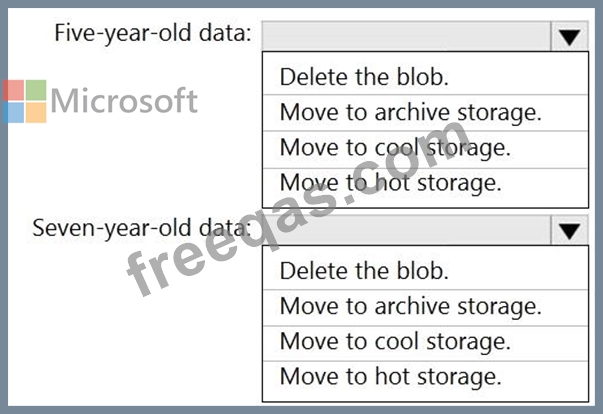
Correct Answer:

Reference:
https://docs.microsoft.com/en-us/azure/storage/blobs/storage-blob-storage-tiers
https://azure.microsoft.com/en-us/updates/reduce-data-movement-and-make-your-queries-more-efficient-with-the-general-availability-of-replicated-tables/
https://azure.microsoft.com/en-us/blog/replicated-tables-now-generally-available-in-azure-sql-data-warehouse/
insert code

Question 82

You are designing an Azure Synapse Analytics dedicated SQL pool.
You need to ensure that you can audit access to Personally Identifiable information (PII).
What should you include in the solution?

Correct Answer: C
Data Discovery & Classification is built into Azure SQL Database, Azure SQL Managed Instance, and Azure Synapse Analytics. It provides basic capabilities for discovering, classifying, labeling, and reporting the sensitive data in your databases.
Your most sensitive data might include business, financial, healthcare, or personal information. Discovering and classifying this data can play a pivotal role in your organization's information-protection approach. It can serve as infrastructure for:
Helping to meet standards for data privacy and requirements for regulatory compliance.
Various security scenarios, such as monitoring (auditing) access to sensitive data.
Controlling access to and hardening the security of databases that contain highly sensitive data.
Reference:
https://docs.microsoft.com/en-us/azure/azure-sql/database/data-discovery-and-classification-overview
insert code

Question 83

You need to ensure that the Twitter feed data can be analyzed in the dedicated SQL pool. The solution must meet the customer sentiment analytics requirements.
Which three Transaction-SQL DDL commands should you run in sequence? To answer, move the appropriate commands from the list of commands to the answer area and arrange them in the correct order.
NOTE: More than one order of answer choices is correct. You will receive credit for any of the correct orders you select.

Correct Answer:

Explanation

Scenario: Allow Contoso users to use PolyBase in an Azure Synapse Analytics dedicated SQL pool to query the content of the data records that host the Twitter feeds. Data must be protected by using row-level security (RLS). The users must be authenticated by using their own Azure AD credentials.
Box 1: CREATE EXTERNAL DATA SOURCE
External data sources are used to connect to storage accounts.
Box 2: CREATE EXTERNAL FILE FORMAT
CREATE EXTERNAL FILE FORMAT creates an external file format object that defines external data stored in Azure Blob Storage or Azure Data Lake Storage. Creating an external file format is a prerequisite for creating an external table.
Box 3: CREATE EXTERNAL TABLE AS SELECT
When used in conjunction with the CREATE TABLE AS SELECT statement, selecting from an external table imports data into a table within the SQL pool. In addition to the COPY statement, external tables are useful for loading data.
Reference:
https://docs.microsoft.com/en-us/azure/synapse-analytics/sql/develop-tables-external-tables
insert code

Question 84

You have an Azure Data Lake Storage Gen2 account named account1 that stores logs as shown in the following table.

You do not expect that the logs will be accessed during the retention periods.
You need to recommend a solution for account1 that meets the following requirements:
* Automatically deletes the logs at the end of each retention period
* Minimizes storage costs
What should you include in the recommendation? To answer, select the appropriate options in the answer area.
NOTE: Each correct selection is worth one point.

Correct Answer:

Explanation
Table Description automatically generated

Box 1: Store the infrastructure logs in the Cool access tier and the application logs in the Archive access tier For infrastructure logs: Cool tier - An online tier optimized for storing data that is infrequently accessed or modified. Data in the cool tier should be stored for a minimum of 30 days. The cool tier has lower storage costs and higher access costs compared to the hot tier.
For application logs: Archive tier - An offline tier optimized for storing data that is rarely accessed, and that has flexible latency requirements, on the order of hours. Data in the archive tier should be stored for a minimum of 180 days.
Box 2: Azure Blob storage lifecycle management rules
Blob storage lifecycle management offers a rule-based policy that you can use to transition your data to the desired access tier when your specified conditions are met. You can also use lifecycle management to expire data at the end of its life.
Reference:
https://docs.microsoft.com/en-us/azure/storage/blobs/access-tiers-overview
insert code

Question 85

You are designing a solution that will copy Parquet files stored in an Azure Blob storage account to an Azure Data Lake Storage Gen2 account.
The data will be loaded daily to the data lake and will use a folder structure of {Year}/{Month}/{Day}/.
You need to design a daily Azure Data Factory data load to minimize the data transfer between the two accounts.
Which two configurations should you include in the design? Each correct answer presents part of the solution.
NOTE: Each correct selection is worth one point.


Correct Answer: A,D
Explanation
Copy data from one place to another. The requirements are : 1- need to minimize transfert and 2- need to adapte data to the destination folder structure. Filter on LastModifiedDate will copy everything that have changed since the latest load while minimizing the data transfert. Specifying the file naming pattern allows to copy data at the right place to the destination Data Lake.
insert code
  • ««
  • «
  • …
  • 13
  • 14
  • 15
  • 16
  • 17
  • 18
  • 19
  • 20
  • 21
  • 22
  • …
  • »
  • »»
[×]

Download PDF File

Enter your email address to download Microsoft.DP-203.v2024-01-19.q230 Dumps

Email:

FreeQAs

Our website provides the Largest and the most Latest vendors Certification Exam materials around the world.

Using dumps we provide to Pass the Exam, we has the Valid Dumps with passing guranteed just which you need.

  • DMCA
  • About
  • Contact Us
  • Privacy Policy
  • Terms & Conditions
©2026 FreeQAs

www.freeqas.com materials do not contain actual questions and answers from Cisco's certification exams.