You need to design an Azure Synapse Analytics dedicated SQL pool that meets the following requirements:
Can return an employee record from a given point in time.
Maintains the latest employee information.
Minimizes query complexity.
How should you model the employee data?
You have an Azure Data Lake Storage Gen2 account named account1 that stores logs as shown in the following table.
You do not expect that the logs will be accessed during the retention periods.
You need to recommend a solution for account1 that meets the following requirements:
Automatically deletes the logs at the end of each retention period
Minimizes storage costs
What should you include in the recommendation? To answer, select the appropriate options in the answer are a.
NOTE: Each correct selection is worth one point.

You have an Azure Data Factory instance named ADF1 and two Azure Synapse Analytics workspaces named WS1 and WS2.
ADF1 contains the following pipelines:
P1: Uses a copy activity to copy data from a nonpartitioned table in a dedicated SQL pool of WS1 to an Azure Data Lake Storage Gen2 account P2: Uses a copy activity to copy data from text-delimited files in an Azure Data Lake Storage Gen2 account to a nonpartitioned table in a dedicated SQL pool of WS2 You need to configure P1 and P2 to maximize parallelism and performance.
Which dataset settings should you configure for the copy activity if each pipeline? To answer, select the appropriate options in the answer are a.
NOTE: Each correct selection is worth one point.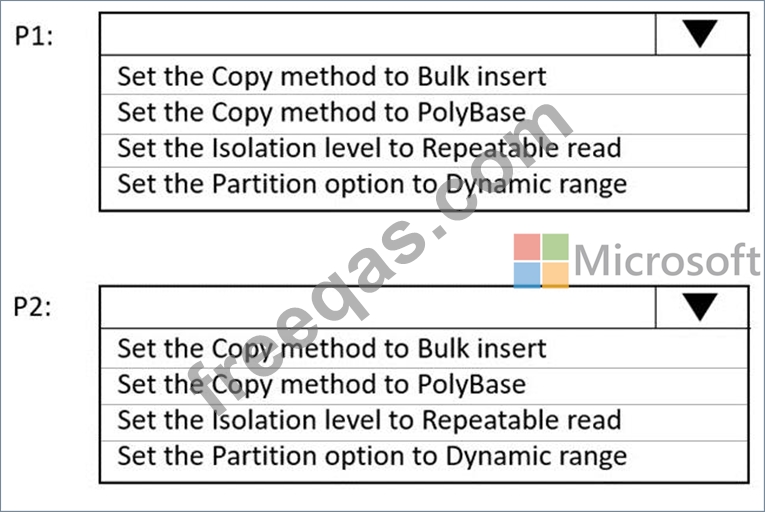

You are designing a folder structure for the files m an Azure Data Lake Storage Gen2 account. The account has one container that contains three years of data.
You need to recommend a folder structure that meets the following requirements:
* Supports partition elimination for queries by Azure Synapse Analytics serverless SQL pooh
* Supports fast data retrieval for data from the current month
* Simplifies data security management by department
Which folder structure should you recommend?
You are developing a solution using a Lambda architecture on Microsoft Azure.
The data at test layer must meet the following requirements:
Data storage:
* Serve as a repository (or high volumes of large files in various formats.
* Implement optimized storage for big data analytics workloads.
* Ensure that data can be organized using a hierarchical structure.
Batch processing:
* Use a managed solution for in-memory computation processing.
* Natively support Scala, Python, and R programming languages.
* Provide the ability to resize and terminate the cluster automatically.
Analytical data store:
* Support parallel processing.
* Use columnar storage.
* Support SQL-based languages.
You need to identify the correct technologies to build the Lambda architecture.
Which technologies should you use? To answer, select the appropriate options in the answer area NOTE: Each correct selection is worth one point.


