FreeQAs
 Request Exam  Contact
  • Home
  • View All Exams
  • New QA's
  • Upload
PRACTICE EXAMS:
  • Oracle
  • Fortinet
  • IBM
  • Juniper
  • Microsoft
  • Cisco
  • Citrix
  • CompTIA
  • VMware
  • ISC
  • SAP
  • EMC
  • PMI
  • HP
  • Salesforce
  • Other
  • Oracle
    Oracle
  • Fortinet
    Fortinet
  • IBM
    IBM
  • Juniper
    Juniper
  • Microsoft
    Microsoft
  • Cisco
    Cisco
  • Citrix
    Citrix
  • CompTIA
    CompTIA
  • VMware
    VMware
  • ISC
    ISC
  • SAP
    SAP
  • EMC
    EMC
  • PMI
    PMI
  • HP
    HP
  • Salesforce
    Salesforce
  1. Home
  2. Microsoft Certification
  3. DP-300 Exam
  4. Microsoft.DP-300.v2024-01-23.q244 Dumps
  • ««
  • «
  • …
  • 41
  • 42
  • 43
  • 44
  • 45
  • 46
  • 47
  • 48
  • 49
  • 50
  • »
Download Now

Question 236

You have the following Transact-SQL query.
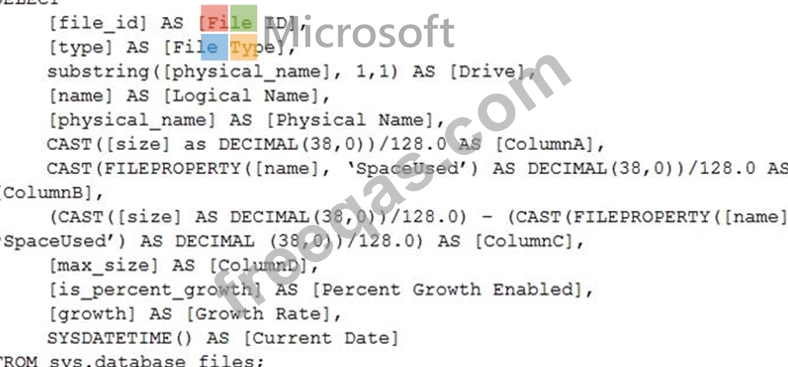
Which column returned by the query represents the free space in each file?

Correct Answer: C
Example:
Free space for the file in the below query result set will be returned by the FreeSpaceMB column.
SELECT DB_NAME() AS DbName,
name AS FileName,
type_desc,
size/128.0 AS CurrentSizeMB,
size/128.0 - CAST(FILEPROPERTY(name, 'SpaceUsed') AS INT)/128.0 AS FreeSpaceMB FROM sys.database_files WHERE type IN (0,1); Reference:
https://www.sqlshack.com/how-to-determine-free-space-and-file-size-for-sql-server-databases/
insert code

Question 237

You configure version control for an Azure Data Factory instance as shown in the following exhibit.
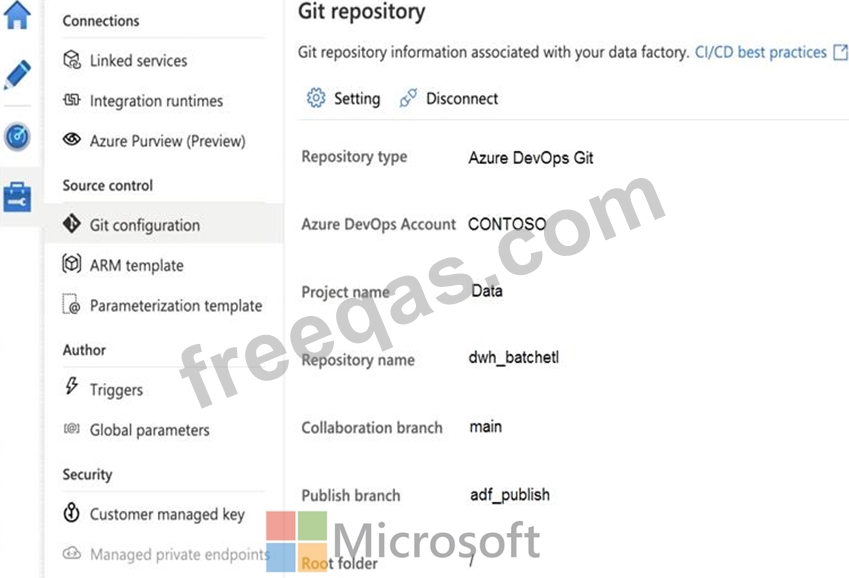
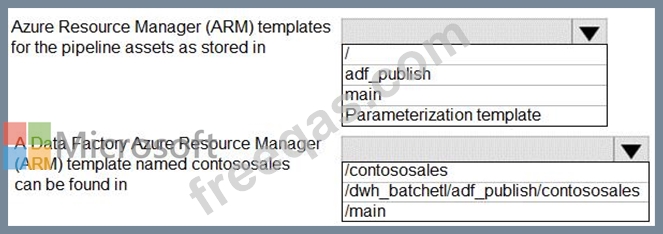
Use the drop-down menus to select the answer choice that completes each statement based on the information presented in the graphic.
NOTE: Each correct selection is worth one point.
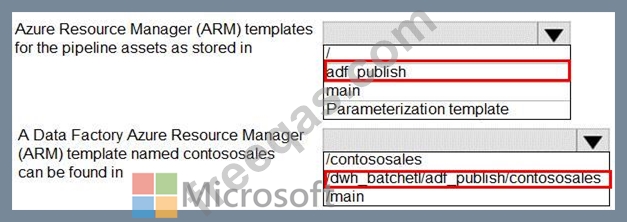
Correct Answer:

Reference:
https://docs.microsoft.com/en-us/azure/data-factory/source-control
insert code

Question 238

You have a Microsoft SQL Server 2019 database named DB1 that uses the following database-level and instance-level features.
Clustered columnstore indexes
Automatic tuning
Change tracking
PolyBase
You plan to migrate DB1 to an Azure SQL database.
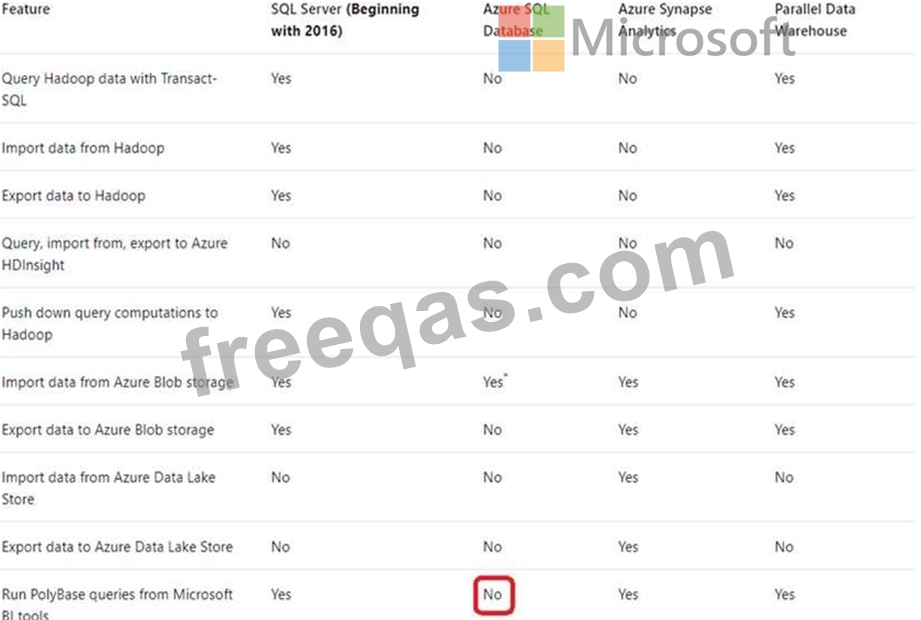
What feature should be removed or replaced before DB1 can be migrated?
Correct Answer: B
This table lists the key features for PolyBase and the products in which they're available.

Reference:
https://docs.microsoft.com/en-us/sql/relational-databases/polybase/polybase-versioned-feature-summary
insert code

Question 239

Which audit log destination should you use to meet the monitoring requirements?

Correct Answer: C
Explanation
Scenario: Use a single dashboard to review security and audit data for all the PaaS databases.
With dashboards can bring together operational data that is most important to IT across all your Azure resources, including telemetry from Azure Log Analytics.
Note: Auditing for Azure SQL Database and Azure Synapse Analytics tracks database events and writes them to an audit log in your Azure storage account, Log Analytics workspace, or Event Hubs.
Reference:
https://docs.microsoft.com/en-us/azure/azure-monitor/visualize/tutorial-logs-dashboards
Topic 2, Litware
Existing Environment
Network Environment
The manufacturing and research datacenters connect to the primary datacenter by using a VPN.
The primary datacenter has an ExpressRoute connection that uses both Microsoft peering and private peering.
The private peering connects to an Azure virtual network named HubVNet.
Identity Environment
Litware has a hybrid Azure Active Directory (Azure AD) deployment that uses a domain named litwareinc.com. All Azure subscriptions are associated to the litwareinc.com Azure AD tenant.
Database Environment
The sales department has the following database workload:
An on-premises named SERVER1 hosts an instance of Microsoft SQL Server 2012 and two 1-TB databases.
A logical server named SalesSrv01A contains a geo-replicated Azure SQL database named SalesSQLDb1. SalesSQLDb1 is in an elastic pool named SalesSQLDb1Pool. SalesSQLDb1 uses database firewall rules and contained database users.
An application named SalesSQLDb1App1 uses SalesSQLDb1.
The manufacturing office contains two on-premises SQL Server 2016 servers named SERVER2 and SERVER3. The servers are nodes in the same Always On availability group. The availability group contains a database named ManufacturingSQLDb1 Database administrators have two Azure virtual machines in HubVnet named VM1 and VM2 that run Windows Server 2019 and are used to manage all the Azure databases.
Licensing Agreement
Litware is a Microsoft Volume Licensing customer that has License Mobility through Software Assurance.
Current Problems
SalesSQLDb1 experiences performance issues that are likely due to out-of-date statistics and frequent blocking queries.
Requirements
Planned Changes
Litware plans to implement the following changes:
Implement 30 new databases in Azure, which will be used by time-sensitive manufacturing apps that have varying usage patterns. Each database will be approximately 20 GB.
Create a new Azure SQL database named ResearchDB1 on a logical server named ResearchSrv01.
ResearchDB1 will contain Personally Identifiable Information (PII) data.
Develop an app named ResearchApp1 that will be used by the research department to populate and access ResearchDB1.
Migrate ManufacturingSQLDb1 to the Azure virtual machine platform.
Migrate the SERVER1 databases to the Azure SQL Database platform.
Technical Requirements
Litware identifies the following technical requirements:
Maintenance tasks must be automated.
The 30 new databases must scale automatically.
The use of an on-premises infrastructure must be minimized.
Azure Hybrid Use Benefits must be leveraged for Azure SQL Database deployments.
All SQL Server and Azure SQL Database metrics related to CPU and storage usage and limits must be analyzed by using Azure built-in functionality.
Security and Compliance Requirements
Litware identifies the following security and compliance requirements:
Store encryption keys in Azure Key Vault.
Retain backups of the PII data for two months.
Encrypt the PII data at rest, in transit, and in use.
Use the principle of least privilege whenever possible.
Authenticate database users by using Active Directory credentials.
Protect Azure SQL Database instances by using database-level firewall rules.
Ensure that all databases hosted in Azure are accessible from VM1 and VM2 without relying on public endpoints.
Business Requirements
Litware identifies the following business requirements:
Meet an SLA of 99.99% availability for all Azure deployments.
Minimize downtime during the migration of the SERVER1 databases.
Use the Azure Hybrid Use Benefits when migrating workloads to Azure.
Once all requirements are met, minimize costs whenever possible.
insert code

Question 240

You have a SQL Server on Azure Virtual Machines instance that hosts a database named Db1.
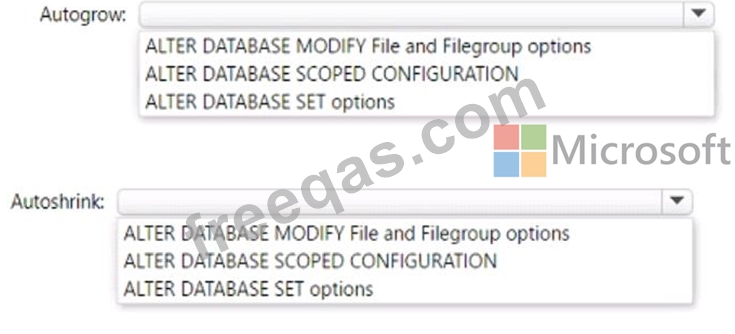
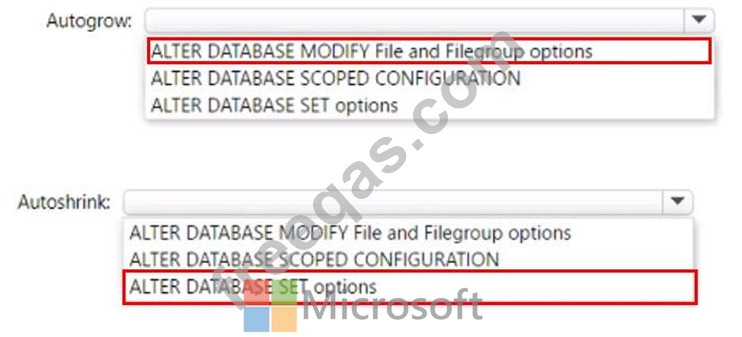
You need to configure the autogrow and autoshrink settings for DB1.
Which statements should you use? To answer, select the appropriate options in the answer are a.
NOTE: Each correct selection is worth one point.
Correct Answer:
insert code
  • ««
  • «
  • …
  • 41
  • 42
  • 43
  • 44
  • 45
  • 46
  • 47
  • 48
  • 49
  • 50
  • »
[×]

Download PDF File

Enter your email address to download Microsoft.DP-300.v2024-01-23.q244 Dumps

Email:

FreeQAs

Our website provides the Largest and the most Latest vendors Certification Exam materials around the world.

Using dumps we provide to Pass the Exam, we has the Valid Dumps with passing guranteed just which you need.

  • DMCA
  • About
  • Contact Us
  • Privacy Policy
  • Terms & Conditions
©2026 FreeQAs

www.freeqas.com materials do not contain actual questions and answers from Cisco's certification exams.
