FreeQAs
 Request Exam  Contact
  • Home
  • View All Exams
  • New QA's
  • Upload
PRACTICE EXAMS:
  • Oracle
  • Fortinet
  • Juniper
  • Microsoft
  • Cisco
  • Citrix
  • CompTIA
  • VMware
  • ISC
  • SAP
  • EMC
  • PMI
  • HP
  • Salesforce
  • Other
  • Oracle
    Oracle
  • Fortinet
    Fortinet
  • Juniper
    Juniper
  • Microsoft
    Microsoft
  • Cisco
    Cisco
  • Citrix
    Citrix
  • CompTIA
    CompTIA
  • VMware
    VMware
  • ISC
    ISC
  • SAP
    SAP
  • EMC
    EMC
  • PMI
    PMI
  • HP
    HP
  • Salesforce
    Salesforce
  1. Home
  2. Microsoft Certification
  3. DP-420 Exam
  4. Microsoft.DP-420.v2024-08-19.q100 Dumps
  • ««
  • «
  • …
  • 7
  • 8
  • 9
  • 10
  • 11
  • 12
  • 13
  • 14
  • 15
  • 16
  • …
  • »
  • »»
Download Now

Question 51

You have a container named container1 in an Azure Cosmos DB for NoSQL account named account1.
You configure container1 to use Always Encrypted by using an encryption policy as shown in the C# and the Java exhibits. (Click the C# tab to view the encryption policy in C#. Click the Java tab to see the encryption policy in Java.)


For each of the following statements, select Yes if the statement is true. Otherwise, select No.
NOTE: Each correct selection is worth one point.

Correct Answer:

Explanation
According to the Azure Cosmos DB documentation , Always Encrypted is a feature designed to protect sensitive data, such as credit card numbers or national identification numbers, stored in Azure Cosmos DB.
Always Encrypted allows clients to encrypt sensitive data inside client applications and never reveal the encryption keys to the database.
To use Always Encrypted, you need to define an encryption policy for each container that specifies which properties should be encrypted and which data encryption keys (DEK) should be used. The DEKs are stored in Azure Cosmos DB and are wrapped by customer-managed keys (CMK) that are stored in Azure Key Vault.
Based on the encryption policy shown in the exhibits, the creditcard property is encrypted with a DEK named dek1, and the SSN property is encrypted with a DEK named dek2. Both DEKs are wrapped by a CMK named cmk1.
To answer your statements:
* You can perform a query that filters on the creditcard property = No. This is because the creditcard property is encrypted and cannot be used for filtering or sorting operations1.
* You can perform a query that filters on the SSN property = No. This is also because the SSN property is encrypted and cannot be used for filtering or sorting operations1.
* An application can be allowed to read the creditcard property while being restricted from reading the SSN property = Yes. This is possible by using different CMKs to wrap different DEKs and applying access policies on the CMKs in Azure Key Vault. For example, if you use cmk2 to wrap dek2 instead of cmk1, you can grant an application access to cmk1 but not cmk2, which means it can read the creditcard property but not the SSN property2.
insert code

Question 52

You have a container in an Azure Cosmos DB Core (SQL) API account. The container stores telemetry data from IoT devices. The container uses telemetryId as the partition key and has a throughput of 1,000 request units per second (RU/s). Approximately 5,000 IoT devices submit data every five minutes by using the same telemetryId value.
You have an application that performs analytics on the data and frequently reads telemetry data for a single IoT device to perform trend analysis.
The following is a sample of a document in the container.

You need to reduce the amount of request units (RUs) consumed by the analytics application.
What should you do?

Correct Answer: C
Explanation
The partition key is what will determine how data is routed in the various partitions by Cosmos DB and needs to make sense in the context of your specific scenario. The IoT Device ID is generally the "natural" partition key for IoT applications.
Reference: https://docs.microsoft.com/en-us/azure/architecture/solution-ideas/articles/iot-using-cosmos-db
insert code

Question 53

Note: This question is part of a series of questions that present the same scenario. Each question in the series contains a unique solution that might meet the stated goals. Some question sets might have more than one correct solution, while others might not have a correct solution.
After you answer a question in this section, you will NOT be able to return to it. As a result, these questions will not appear in the review screen.
You have an Azure Cosmos DB Core (SQL) API account named account 1 that uses autoscale throughput.
You need to run an Azure function when the normalized request units per second for a container in account1 exceeds a specific value.
Solution: You configure the function to have an Azure CosmosDB trigger.
Does this meet the goal?

Correct Answer: B
Instead configure an Azure Monitor alert to trigger the function.
You can set up alerts from the Azure Cosmos DB pane or the Azure Monitor service in the Azure portal.
insert code

Question 54

You have an Azure Cosmos DB Core (SQL) API account named account1.
In account1, you run the following query in a container that contains 100GB of data.
SELECT *
FROM c
WHERE LOWER(c.categoryid) = "hockey"
You view the following metrics while performing the query.
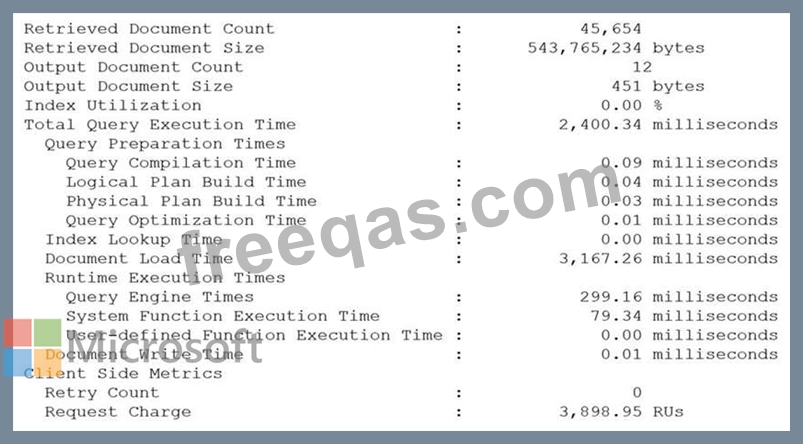
For each of the following statements, select Yes if the statement is true. Otherwise, select No.
NOTE: Each correct selection is worth one point.

Correct Answer:

Explanation

Box 1: No
Each physical partition should have its own index, but since no index is used, the query is not cross-partition.
Box 2: No
Index utilization is 0% and Index Look up time is also zero.
Box 3: Yes
A partition key index will be created, and the query will perform across the partitions.
Reference: https://docs.microsoft.com/en-us/azure/cosmos-db/sql/how-to-query-container
insert code

Question 55

You have an Azure Cosmos DB Core (SQL) API account that is used by 10 web apps.
You need to analyze the data stored in the account by using Apache Spark to create machine learning models.
The solution must NOT affect the performance of the web apps.
Which two actions should you perform? Each correct answer presents part of the solution.
NOTE: Each correct selection is worth one point.


Correct Answer: A,D
Reference:
https://github.com/microsoft/MCW-Cosmos-DB-Real-Time-Advanced-Analytics/blob/main/Hands-on%20lab/H
insert code
  • ««
  • «
  • …
  • 7
  • 8
  • 9
  • 10
  • 11
  • 12
  • 13
  • 14
  • 15
  • 16
  • …
  • »
  • »»
[×]

Download PDF File

Enter your email address to download Microsoft.DP-420.v2024-08-19.q100 Dumps

Email:

FreeQAs

Our website provides the Largest and the most Latest vendors Certification Exam materials around the world.

Using dumps we provide to Pass the Exam, we has the Valid Dumps with passing guranteed just which you need.

  • DMCA
  • About
  • Contact Us
  • Privacy Policy
  • Terms & Conditions
©2026 FreeQAs

www.freeqas.com materials do not contain actual questions and answers from Cisco's certification exams.