FreeQAs
 Request Exam  Contact
  • Home
  • View All Exams
  • New QA's
  • Upload
PRACTICE EXAMS:
  • Oracle
  • Fortinet
  • IBM
  • Juniper
  • Microsoft
  • Cisco
  • Citrix
  • CompTIA
  • VMware
  • ISC
  • SAP
  • EMC
  • PMI
  • HP
  • Salesforce
  • Other
  • Oracle
    Oracle
  • Fortinet
    Fortinet
  • IBM
    IBM
  • Juniper
    Juniper
  • Microsoft
    Microsoft
  • Cisco
    Cisco
  • Citrix
    Citrix
  • CompTIA
    CompTIA
  • VMware
    VMware
  • ISC
    ISC
  • SAP
    SAP
  • EMC
    EMC
  • PMI
    PMI
  • HP
    HP
  • Salesforce
    Salesforce
  1. Home
  2. Microsoft Certification
  3. DP-420 Exam
  4. Microsoft.DP-420.v2024-08-19.q100 Dumps
  • ««
  • «
  • …
  • 10
  • 11
  • 12
  • 13
  • 14
  • 15
  • 16
  • 17
  • 18
  • 19
  • …
  • »
  • »»
Download Now

Question 66

You have a container m an Azure Cosmos DB for NoSQL account. The container stores data about families. Data about parents, children, and pets are stored as separate documents.
Each document contains the address of each family. Members of the same family share the same partition key named family Id You need to update the address for each member of the same family that share the same address. The solution must meet the following requirements:
* Be atomic consistent isolated, and durable (ACID).
* Provide the lowest latency.
What should you do?

Correct Answer: A
insert code

Question 67

You have an Azure Cosmos DB for NoSQL account.
You plan 10 create a container named container1. The container1 container will store items that include two properties named nm and age The most commonly executed queries will query container1 for a specific name. The following is a sample of the query.

You need to define an opt-in Indexing policy for container1. The solution must meet the following requirements:
* Minimize the number of request units consumed by the queries.
* Ensure that the _etag property is excluded from indexing.
How should you define the indexing poky? To answer, select the appropriate options in the answer area.
NOTE: Each correct selection Is worth one point.

Correct Answer:

Explanation
insert code

Question 68

You have a database named db1 in an Azure Cosmos DB f You have a third-party application that is exposed thro You need to migrate data from the application to a What should you use?

Correct Answer: B
Explanation
you can migrate data from various data sources to Azure Cosmos DB using different tools and methods. The choice of the migration tool depends on factors such as the data source, the Azure Cosmos DB API, the size of data, and the expected migration duration1. Some of the common migration tools are:
Azure Cosmos DB Data Migration tool: This is an open source tool that can import data to Azure Cosmos DB from sources such as JSON files, MongoDB, SQL Server, CSV files, and Azure Cosmos DB collections. This tool supports the SQL API and the Table API of Azure Cosmos DB2.
Azure Data Factory: This is a cloud-based data integration service that can copy data from various sources to Azure Cosmos DB using connectors. This tool supports the SQL API, MongoDB API, Cassandra API, Gremlin API, and Table API of Azure Cosmos DB3.
Azure Cosmos DB live data migrator: This is a command-line tool that can migrate data from one Azure Cosmos DB container to another container within the same or different account. This tool supports live migration with minimal downtime and works with any Azure Cosmos DB API4.
For your scenario, if you want to migrate data from a third-party application that is exposed through an OData endpoint to a container in Azure Cosmos DB for NoSQL, you should use Azure Data Factory. Azure Data Factory has an OData connector that can read data from an OData source and write it to an Azure Cosmos DB sink using the SQL API5. You can create a copy activity in Azure Data Factory that specifies the OData source and the Azure Cosmos DB sink, and run it on demand or on a schedule.
insert code

Question 69

You have an Azure Cosmos DB Core (SQL) API account named account1.
You have the Azure virtual networks and subnets shown in the following table.

The vnet1 and vnet2 networks are connected by using a virtual network peer.
The Firewall and virtual network settings for account1 are configured as shown in the exhibit.

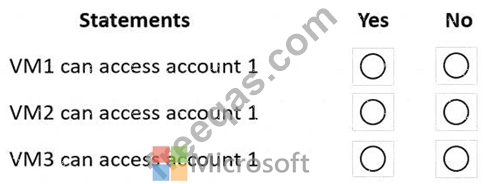
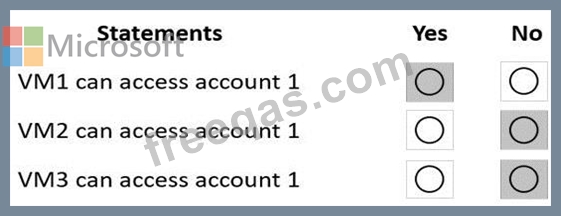
For each of the following statements, select Yes if the statement is true. Otherwise, select No.
NOTE: Each correct selection is worth one point.
Correct Answer:

Explanation

Box 1: Yes
VM1 is on vnet1.subnet1 which has the Endpoint Status enabled.
Box 2: No
Only virtual network and their subnets added to Azure Cosmos account have access. Their peered VNets cannot access the account until the subnets within peered virtual networks are added to the account.
Box 3: No
Only virtual network and their subnets added to Azure Cosmos account have access.
Reference: https://docs.microsoft.com/en-us/azure/cosmos-db/how-to-configure-vnet-service-endpoint
insert code

Question 70

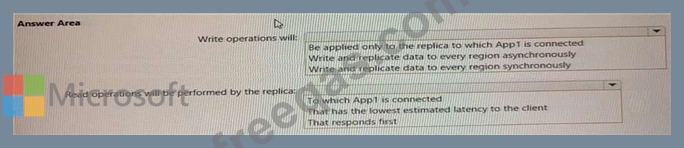
You have a multi-region Azure Cosmos DB account named account1 that has a default consistency level of strong.
You have an app named App1 that is configured to request a consistency level of session.
How will the read and write operations of App1 be handled? To answer, select the appropriate options in the answer area.
NOTE: Each correct selection is worth one point.
Correct Answer:
insert code
  • ««
  • «
  • …
  • 10
  • 11
  • 12
  • 13
  • 14
  • 15
  • 16
  • 17
  • 18
  • 19
  • …
  • »
  • »»
[×]

Download PDF File

Enter your email address to download Microsoft.DP-420.v2024-08-19.q100 Dumps

Email:

FreeQAs

Our website provides the Largest and the most Latest vendors Certification Exam materials around the world.

Using dumps we provide to Pass the Exam, we has the Valid Dumps with passing guranteed just which you need.

  • DMCA
  • About
  • Contact Us
  • Privacy Policy
  • Terms & Conditions
©2026 FreeQAs

www.freeqas.com materials do not contain actual questions and answers from Cisco's certification exams.
