FreeQAs
 Request Exam  Contact
  • Home
  • View All Exams
  • New QA's
  • Upload
PRACTICE EXAMS:
  • Oracle
  • Fortinet
  • Juniper
  • Microsoft
  • Cisco
  • Citrix
  • CompTIA
  • VMware
  • ISC
  • SAP
  • EMC
  • PMI
  • HP
  • Salesforce
  • Other
  • Oracle
    Oracle
  • Fortinet
    Fortinet
  • Juniper
    Juniper
  • Microsoft
    Microsoft
  • Cisco
    Cisco
  • Citrix
    Citrix
  • CompTIA
    CompTIA
  • VMware
    VMware
  • ISC
    ISC
  • SAP
    SAP
  • EMC
    EMC
  • PMI
    PMI
  • HP
    HP
  • Salesforce
    Salesforce
  1. Home
  2. Microsoft Certification
  3. DP-420 Exam
  4. Microsoft.DP-420.v2026-11-21.q284 Dumps
  • ««
  • «
  • …
  • 5
  • 6
  • 7
  • 8
  • 9
  • 10
  • 11
  • 12
  • 13
  • 14
  • …
  • »
  • »»
Download Now

Question 41

You plan to create an Azure Cosmos DB container named account that will contain items in the following format.

You need to define a query that will return the ids of all accounts that have ever recorded a negative value for balance.
How should you complete the query? To answer, select the appropriate options in the answer area.
NOTE: Each correct selection is worth one point.

Correct Answer:

Explanation
insert code

Question 42

Note: This question is part of a series of questions that present the same scenario. Each question in the series contains a unique solution that might meet the stated goals. Some question sets might have more than one correct solution, while others might not have a correct solution.
After you answer a question in this section, you will NOT be able to return to it. As a result, these questions will not appear in the review screen.
You have an Azure Cosmos DB Core (SQL) API account named account 1 that uses autoscale throughput.
You need to run an Azure function when the normalized request units per second for a container in account1 exceeds a specific value.
Solution: You configure an Azure Monitor alert to trigger the function.
Does this meet the goal?

Correct Answer: A
You can set up alerts from the Azure Cosmos DB pane or the Azure Monitor service in the Azure portal.
Note: Alerts are used to set up recurring tests to monitor the availability and responsiveness of your Azure Cosmos DB resources. Alerts can send you a notification in the form of an email, or execute an Azure Function when one of your metrics reaches the threshold or if a specific event is logged in the activity log.
Reference: https://docs.microsoft.com/en-us/azure/cosmos-db/create-alerts
insert code

Question 43

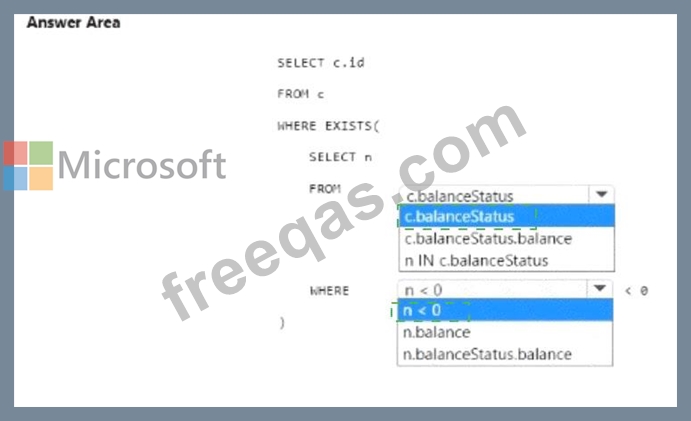
You plan to create an Azure Cosmos DB container named account that will contain items in the following format.

You need to define a query that will return the ids of all accounts that have ever recorded a negative value for balance.
How should you complete the query? To answer, select the appropriate options in the answer area.
NOTE: Each correct selection is worth one point.
Correct Answer:

Explanation:
insert code

Question 44

You have an Azure subscription that contains an Azure Cosmos DB for NoSQL database named DB1.
You develop a software as a service (SaaS) app named App1 that uses DB1. App1 will be used by multiple vendors to manage their customers.
You need to create a container in DB1 that will store customer and order details for each vendor.
The solution must meet the following requirements:
- Each vendor must have a unique tenant ID.
- The performance of the container must be optimized for reads.
- Customer IDs can be duplicated across the container but must be
unique for each vendor.
- The container must be optimized for concurrent queries from multiple
customers. Each query will return data for a single vendor.
How should you configure the container?

Correct Answer: B
For this multi-tenant SaaS scenario, you should use a hierarchical partition key and a unique key policy.
Partitioning Strategy: Hierarchical Partition Key
A hierarchical partition key (subpartitioning) is the optimal choice for your requirements.
Structure: Define the hierarchy as /TenantId followed by /CustomerId.
Why it meets your needs:
Single Vendor Scope: Since every query returns data for a single vendor, including TenantId as the first level of the hierarchy ensures all related data is logically grouped and queries are efficiently routed to the correct partitions.
Scale Beyond 20 GB: Standard partition keys limit a single logical partition (e.g., one vendor) to
20 GB. Hierarchical partitioning allows a single TenantId to scale across multiple physical partitions, supporting larger vendors without hitting storage limits.
Read Optimization: It optimizes concurrent queries from multiple customers by distributing the workload of a single large vendor across different subpartitions.
Reference:
https://devblogs.microsoft.com/cosmosdb/scaling-multi-tenant-go-applications-choosing-the-right-database-partitioning-approach/
insert code

Question 45

You have an Azure Cosmos DB for NoSQL account that has multiple write regions.
You need to receive an alert when requests that target the database exceed the available request units per second (RU/s).
Which Azure Monitor signal should you use?


Correct Answer: A
insert code
  • ««
  • «
  • …
  • 5
  • 6
  • 7
  • 8
  • 9
  • 10
  • 11
  • 12
  • 13
  • 14
  • …
  • »
  • »»
[×]

Download PDF File

Enter your email address to download Microsoft.DP-420.v2026-11-21.q284 Dumps

Email:

FreeQAs

Our website provides the Largest and the most Latest vendors Certification Exam materials around the world.

Using dumps we provide to Pass the Exam, we has the Valid Dumps with passing guranteed just which you need.

  • DMCA
  • About
  • Contact Us
  • Privacy Policy
  • Terms & Conditions
©2026 FreeQAs

www.freeqas.com materials do not contain actual questions and answers from Cisco's certification exams.